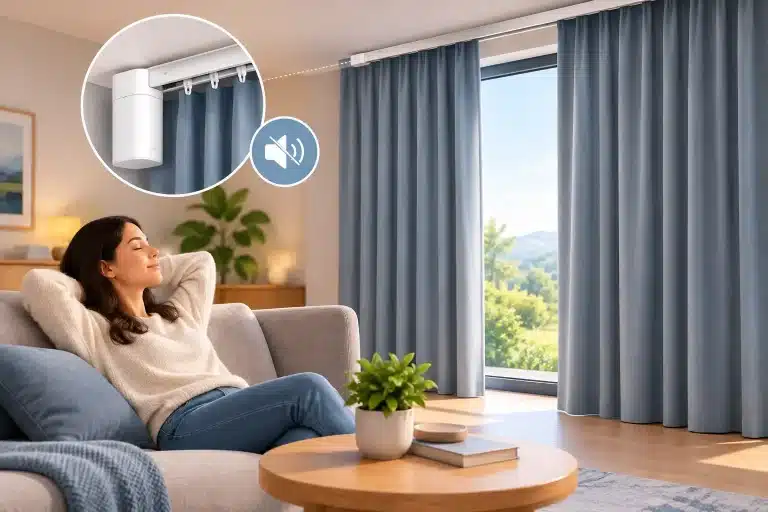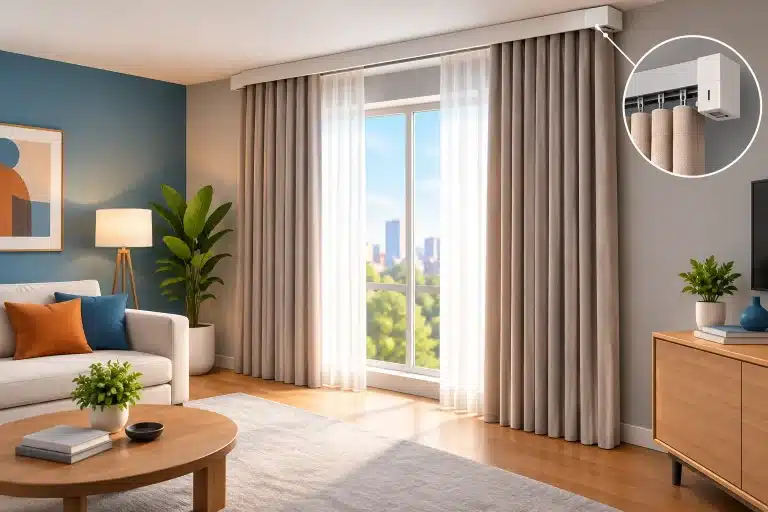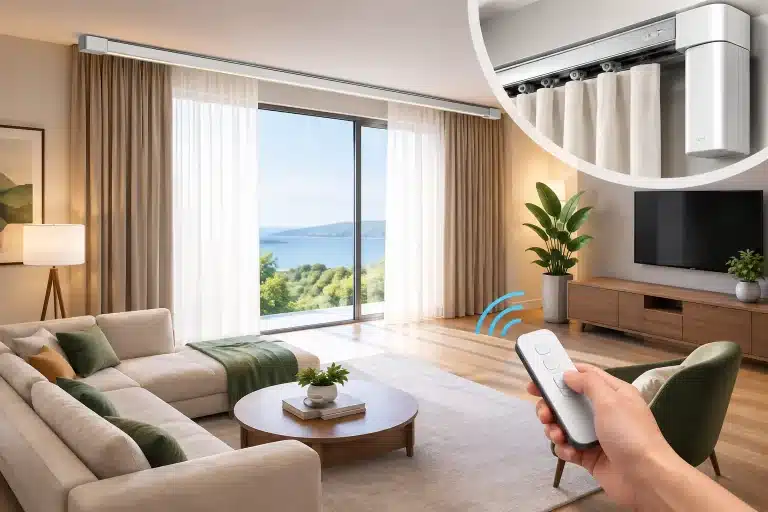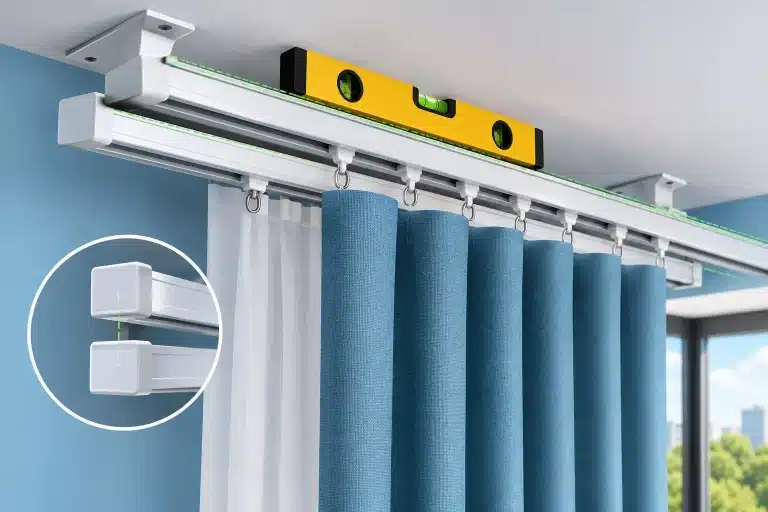
A bay window looks impressive when it is dressed well, but it is one of the trickiest parts of a room to get right. Manual curtains can snag at bends, stack awkwardly, or leave gaps where privacy matters most. A bay window electric curtain track solves those practical issues while giving the room a cleaner, more considered finish.
Thank you for reading this post, don't forget to subscribe!For many homeowners, the appeal starts with convenience. Open the curtains with a remote, wall switch, app or timer, and the room changes instantly. But with bay windows, convenience only works when the track has been specified properly. The shape of the bay, the curtain weight, the motor position and the way the curtains stack all affect the final result.
Why a bay window electric curtain track needs proper planning
Straight windows are relatively simple. Bays are not. Even a modest three-sided bay introduces angles, return walls and limited space for brackets, fixings and curtain stack-back. If the track layout is wrong by a small amount, it often shows up in daily use – curtains dragging, bunching unevenly, or failing to close neatly at the leading edge.
That is why a bay window electric curtain track should never be treated as an off-the-shelf purchase. It usually needs to be made to exact dimensions, with bends or segmented sections designed around the real shape of the window rather than an assumed standard form. In period homes especially, bays are often less symmetrical than they first appear.
There is also a visual reason to take planning seriously. Bay windows sit at the front of a room, and often at the front of the house. Any poor alignment, oversized stack, or visible compromise becomes part of the room every day. A well-designed motorised track keeps the look calm and intentional.
What makes bay windows more complex than standard windows
A bay can be square, angled, curved or semi-circular. Some have generous wall returns that allow the curtains to stack neatly back. Others have very little space at the sides, which means the curtain heading and track positions need more thought. Recess depth also matters. If there is a radiator beneath, a deep sill, shutters nearby or furniture close to the window, the projection of the track becomes part of the design decision.
Ceiling fixing versus wall fixing is another early choice. Ceiling fixing often gives the most elegant result and can help make the room feel taller. Wall fixing can be the better option where the ceiling is uneven, where there are covings to work around, or where access for installation is more practical. Neither is universally better – it depends on the bay shape and the room itself.
Motor location is not a minor detail either. On a bay, the motor needs to sit where it will work mechanically and still look discreet. In some layouts, placing the motor at one end is straightforward. In others, especially where stack-back space is limited, an offset arrangement may be the better route.
Curtain weight changes the specification
Not all curtains place the same demand on the system. Lightweight sheers are far easier to move than interlined curtains in a heavier decorative fabric. If the track is underspecified for the curtain weight, the system may still operate, but not as smoothly or reliably as it should.
This is one of the reasons bespoke advice matters. The track profile, gliders, motor strength and bracket spacing all need to suit the fabric choice. The right specification helps the curtains move quietly around bends and close with a neat leading edge rather than a strained or uneven finish.
Measuring for a bay window electric curtain track
The biggest mistake people make is assuming that one width measurement is enough. It rarely is. A bay needs a full understanding of each face, each angle and the intended mounting position. Measurements should reflect where the track will actually sit, not simply the glass line.
In practice, the most reliable process starts with identifying whether the track is recess fitted, face fitted or ceiling fixed in front of the bay. From there, each straight section is measured carefully, along with returns and any obstructions such as handles, coving, radiators or shelving. Photos are extremely useful because they reveal details a measurement alone can miss.
It is also worth deciding early how far the curtains should stack back when open. Homeowners often focus on the closed appearance, but the open position matters just as much. If the stack covers too much glass, the bay can lose light and feel heavier than intended. If the stack area has not been allowed for at all, the curtains may sit awkwardly into the room.
Why drawings matter
For bay installations, a fitting drawing can save a great deal of uncertainty. It helps confirm motor position, bracket points, bend locations and the final run of the track before anything is made. This is especially useful where builders, electricians or home automation installers are involved, because everyone can work from the same plan.
That level of coordination becomes even more valuable during renovations. A power point placed neatly near the intended motor position is far better than trying to disguise a compromise later.
Choosing the right control options
Most homeowners are drawn to electric curtains because they want everyday use to be easier. A remote control is still a popular choice because it is simple and immediate. A wall switch suits rooms where you want a fixed control point, such as a main bedroom or formal sitting room.
App control and timers add another layer of convenience. Curtains can open in the morning without anyone touching them and close at dusk to improve privacy. If you are away from home, scheduled movement can also make the property feel occupied. For some households, that reassurance is as valuable as the comfort.
Smart home integration is often the next step. A bay window electric curtain track can be part of a wider home setup, working alongside lighting, blinds or scenes for evening routines. The best option depends on how much automation you actually want. Some customers prefer one-touch simplicity. Others want the curtains fully integrated into the home.
Where electric bay curtains make the biggest difference
Bedrooms are an obvious fit, particularly where the bay is wide and the curtains are heavy. Opening them from bed on a dark winter morning is one of those upgrades that quickly feels normal. Living rooms are another strong candidate because bay windows tend to be a focal point, and the smooth movement of motorised curtains adds a polished finish.
They can also be particularly helpful for households where accessibility matters. If reaching across furniture, leaning over a radiator or pulling a large curtain run is uncomfortable, automation removes that daily strain. This is not only about luxury. For many people, it is a practical improvement that makes the room easier to use.
Common issues to avoid
The most common problems usually start long before installation. Inaccurate measurements, not enough stack-back space, poor allowance for handles or radiators, and choosing a system without considering curtain weight can all compromise the result. Another frequent issue is assuming all bay tracks bend in the same way. They do not. Some bays need formed bends, while others work better with joined straight sections at set angles.
Power supply planning is another area where shortcuts tend to show. A trailing cable in the wrong place can undermine an otherwise excellent installation. If the room is being renovated, it makes sense to think about power and control wiring early.
This is where a consultative approach makes the difference. A specialist can spot issues that are easy to miss on a product page, especially with unusual bays, tight recesses or offset layouts. Smart Curtains supports customers through that planning stage so the final track is made for the room, not forced into it.
Is a bay window electric curtain track worth it?
If the bay is a major feature of the room, usually yes. The value is not just in the motor. It comes from smoother operation, a tidier appearance, better control of privacy and light, and a result that feels properly finished. The larger and more awkward the bay, the more noticeable those benefits tend to be.
That said, the best outcome depends on the quality of the planning. A motorised bay track is not a decorative gadget. It is a made-to-measure solution that works best when the layout, fixings, controls and curtain fabric have been considered together.
If you are thinking about upgrading a bay window, treat the specification as carefully as the styling. Get the measurements right, decide how you want the room to work day to day, and allow the track to be designed around the bay rather than the other way round. That is usually the point where a complicated window starts to feel refreshingly simple.