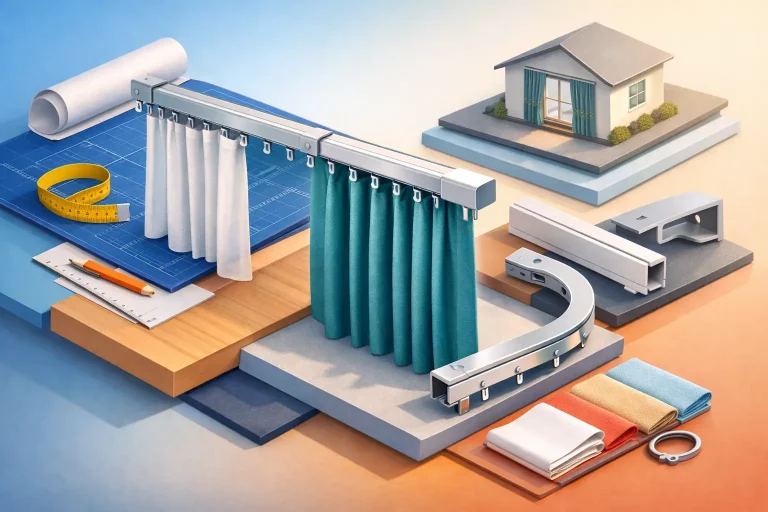
A curtain track that is even slightly wrong tends to announce itself every day. Curtains don’t stack neatly, the leading edge never quite meets the wall, or the fabric drags where it should glide. With made to measure curtain tracks, those small frustrations are designed out from the start, which is exactly why they suit modern homes so well – especially when automation is part of the plan.
Thank you for reading this post, don't forget to subscribe!For many homeowners, the appeal begins with appearance. A track cut and configured for the exact opening gives a cleaner, more deliberate finish than an off-the-shelf option that has been trimmed, adapted or forced to fit. But the real value goes further. Precise sizing affects how the curtains move, how well they close, how they stack, and how confidently the whole system performs over time.
What made to measure curtain tracks actually solve
Standard tracks are built for convenience in retail, not for the realities of individual homes. Real windows are rarely as simple as a single straight run with generous clearance on both sides. You may be dealing with a recess, a wall-to-wall span, a bay, a corner return, a bifold door opening or limited space above the window. In those cases, buying a generic track often shifts the problem to installation day.
Made to measure curtain tracks are different because the track is specified around the room rather than the room being forced to suit the product. That means the length, shape and fixing approach are considered before anything is supplied. If the curtains need to return to the wall for better light control, that can be planned. If there is a chimney breast, a pocket in the ceiling or an offset route around cabinetry, those details can be incorporated rather than improvised.
This matters even more with motorised systems. Automation depends on a track running smoothly and consistently. If the layout is awkward, the bends are too tight or the dimensions are guessed, performance can suffer. A well-planned bespoke system reduces that risk and gives you a much more polished result.
Why exact measurements matter more than people expect
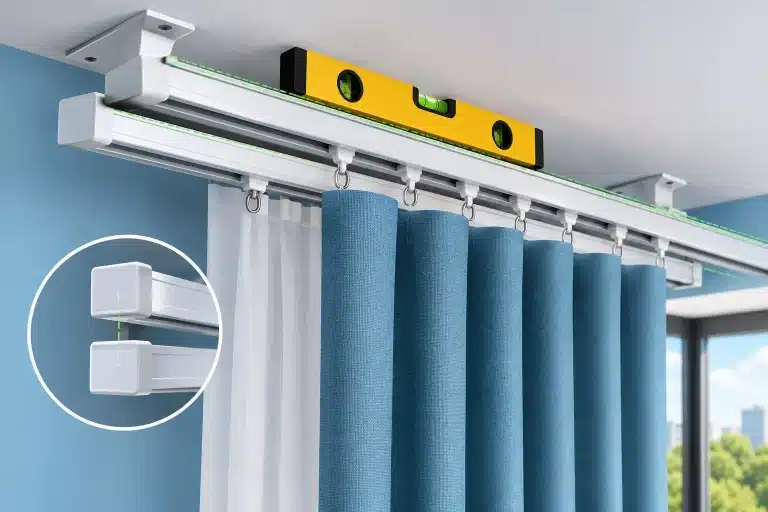
People often assume curtain track measurement is just about width. In practice, it is about how the curtains behave once they are hung. A track that is too short can leave light gaps at the edges and make the window look meaner than it should. A track that is too long may interfere with adjacent walls, cupboards or doors. Height, fixing position and stack-back space all influence the final effect.
There is also the question of curtain weight and fullness. Heavier lined curtains, interlined fabrics and extra-wide spans place more demand on the track than lightweight sheers. A made to measure approach helps ensure the right system is chosen for the fabric, not just the opening. That is one of the reasons bespoke advice is so valuable. It avoids the common mistake of treating all curtain tracks as interchangeable.
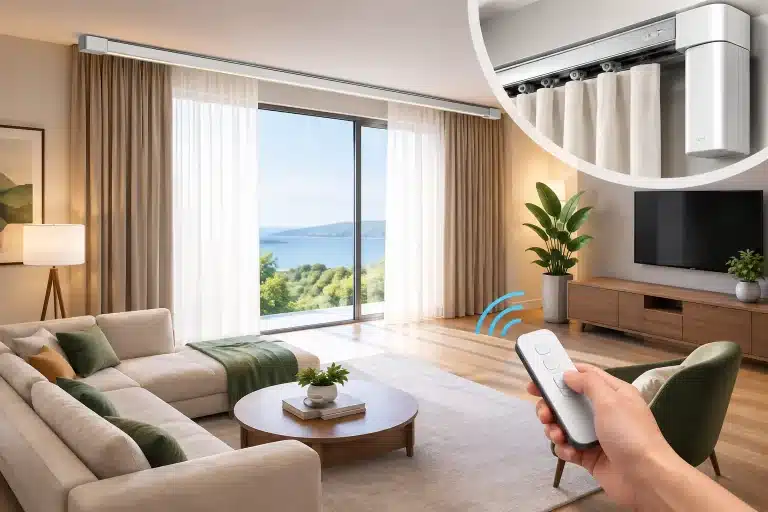
In homes where convenience is a priority, this precision becomes even more worthwhile. If you want curtains to open with a remote, a wall switch or a timer on your phone, you need more than a track that merely fits. You need one that has been planned properly.
Made to measure curtain tracks and automation
Automation changes the buying decision. Once you move from manual curtains to electric operation, the track becomes part of a wider system in the home. You may want the curtains to close automatically at dusk, open gradually in the morning, or work alongside lighting and other smart home settings. That is where made to measure curtain tracks stand out.
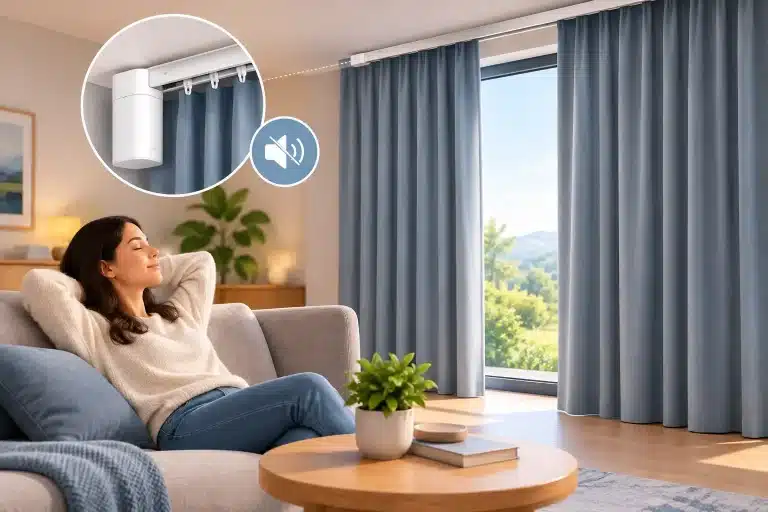
A bespoke electric track can be configured to suit the room layout and the way you want to use it. In a bedroom, quiet, reliable movement and good blackout coverage may matter most. In a large living space, the priority may be covering a long run of glazing with smooth operation and a neat stacked finish. In a bay window, the challenge is usually maintaining a continuous line without compromising movement.
The best result usually comes when dimensions, fixing points and power planning are considered together. That includes practical details such as where the motor will sit, whether there is a nearby spur, and how the track should be drawn for installers or electricians. This kind of support makes the process easier for the homeowner and often saves time on site as well.
Where bespoke tracks make the biggest difference
Straight windows can benefit from a made to measure system, but more complex layouts are where the difference becomes obvious. Bay windows are a good example. They look elegant when dressed properly, yet they are one of the most awkward areas to get right with standard components. Angles, returns and support positions all need careful thought, especially if the curtains are motorised.
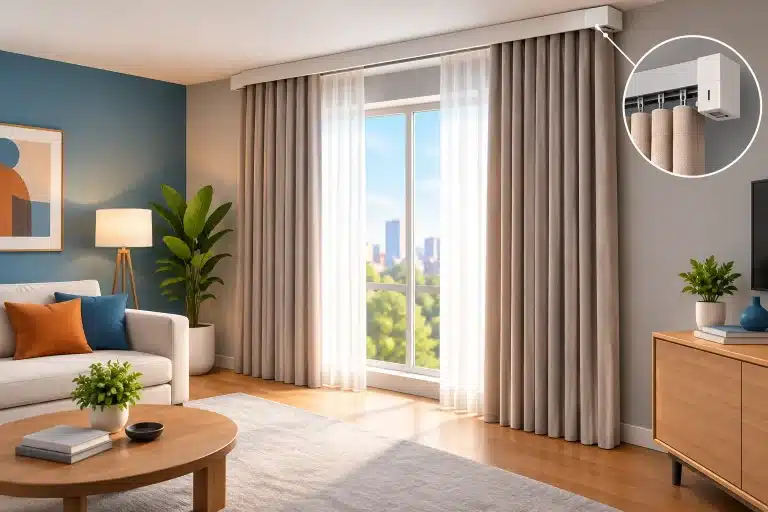
Corner windows raise similar issues. You may want a continuous run around the corner, or separate tracks depending on the room and the curtains. Recess installations need attention too, particularly where space is tight and every millimetre counts. Then there are wall-to-wall applications, where a bespoke track can create a calm, architectural finish that feels built in rather than added later.
These situations are entirely manageable, but they reward planning. That is why a consultative approach matters. It is not just about selling a product. It is about making sure the specification suits the room, the curtains and the people using them.
The trade-off between off-the-shelf and bespoke
There are times when a standard track is good enough. A simple spare room window with lightweight curtains and no special layout may not need anything more elaborate. If budget is the only deciding factor, off-the-shelf can seem attractive.
But for principal rooms, wider glazing, premium fabrics or electric operation, bespoke tends to be the better long-term choice. You are paying for fit, planning and confidence as much as for the track itself. That usually translates into a better finish and fewer compromises.
It also reduces the chance of hidden costs. A cheaper track that needs adapting on site, replacing after poor performance or reworking because the measurements were wrong can stop looking economical very quickly. Bespoke systems are rarely the cheapest route upfront, but they are often the most sensible when the room matters.
What to consider before ordering
If you are thinking about made to measure curtain tracks, it helps to look beyond the obvious dimensions. Start with how you want the room to work. Is privacy the main concern, or is this about convenience and smart control? Are you trying to improve accessibility for someone who finds manual curtains difficult to handle? Do you want a discreet ceiling-fixed look, or a wall-fixed installation with space for headings and stack-back?
From there, think about the window shape, the curtain type and any obstacles nearby. Radiators, furniture, alcoves and door swings can all influence the right specification. If the track will be motorised, power and control options should be considered early rather than treated as an afterthought.
This is where specialist guidance earns its place. A supplier that checks dimensions, advises on layouts and provides fitting drawings can remove a great deal of uncertainty. For homeowners, that usually means a smoother path from idea to installation. For builders and electricians, it means clearer information and fewer assumptions.
Smart Curtains works in exactly this way, helping customers move from rough plans to a properly specified system with practical support around measurements, layouts and control options.
A better fit is not just about looks
There is a visual benefit to made to measure curtain tracks, and it is significant. Curtains hang better, meet properly and sit more comfortably within the architecture of the room. But the deeper benefit is how they improve daily living. Opening and closing curtains becomes effortless. Timed automation can make the house feel occupied when you are away. For those with restricted mobility, powered operation can remove a task that is otherwise awkward or uncomfortable.
That combination of practicality and finish is why bespoke tracks appeal to such a wide range of homeowners. Some want the convenience of smart home integration. Others simply want their curtains to work properly and look as though they were always meant to be there. Both are valid, and both depend on good planning.
If your windows are an important part of the room, the track behind the curtains deserves more attention than it usually gets. Get that detail right, and the whole space feels calmer, neater and easier to live with.