You notice it most on a dark winter morning or when you are heading out in a rush – opening and closing heavy curtains can feel like one more task you do not need. That is usually the point when people ask, how do smart curtains work, and whether they are genuinely useful or just another gadget. In most homes, the answer is refreshingly practical: they replace the manual pull of a curtain with a motorised track and a control system that does the work for you.
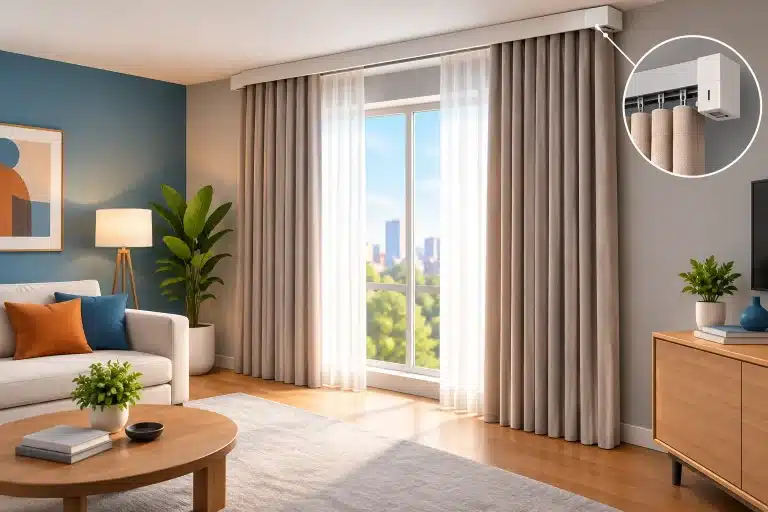
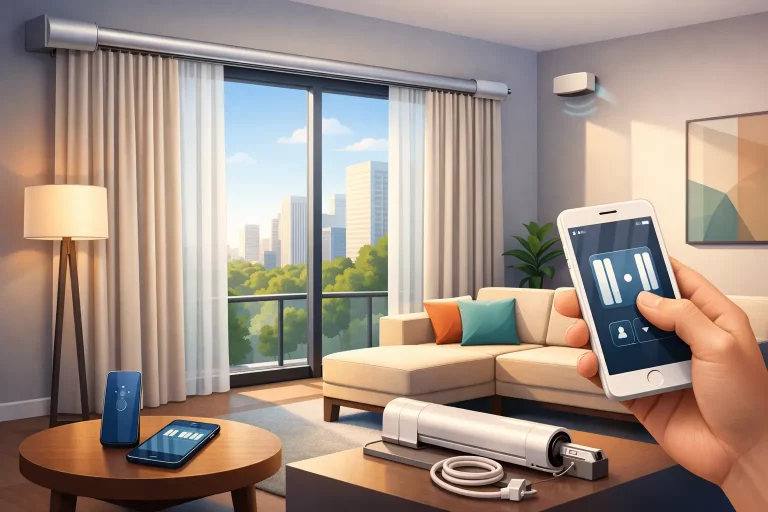
Thank you for reading this post, don't forget to subscribe!At their core, smart curtains are made up of three parts: a curtain track, a motor, and a control method. The track is fitted to your exact window, recess or wall width. The motor moves gliders or runners along that track, pulling the curtain fabric open or closed. The control method could be a wall switch, handheld remote, timer, smartphone app or smart home system. Once installed and set up properly, the curtains move smoothly at the touch of a button or automatically to a schedule.
How do smart curtains work day to day?
In everyday use, the system is simple. You press a switch, use a remote, tap an app, or trigger a voice command through your smart home platform. The motor receives that instruction and turns with controlled force, moving a belt or pulley inside the track. That movement pulls the curtain carriers along the track and opens or closes the curtains in a steady, measured way.
That is the basic mechanism, but the experience depends on the specification. A single straight window is straightforward. A bay window, a corner layout or a wall-to-wall installation needs more planning so the track shape, motor position and curtain stack-back all work properly in the space. This is where smart curtains are less like buying a gadget off a shelf and more like specifying a fitted part of the room.
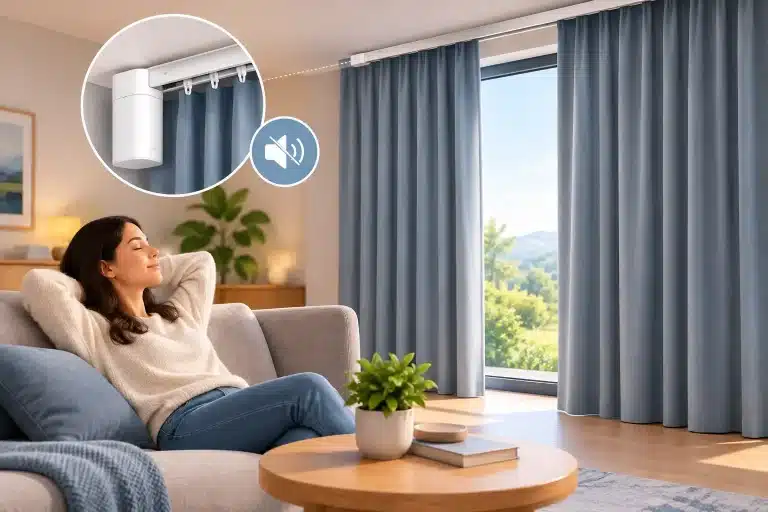
The motor itself is usually either mains powered or battery powered. Mains power suits many permanent installations, especially in renovations or new-build projects where an electrician can provide a neat power point in the right place. Battery motors can be a very good option where wiring is inconvenient, provided the curtain weight and usage pattern are suitable. Neither is automatically better in every case. It depends on the window, the room and how often you expect to use the system.
The main parts behind smart curtain automation
The track does more than simply hold the curtains. It is engineered to work with the motor and carry the curtain weight consistently. Made-to-measure tracks matter because even small differences in width, projection or curve can affect how the curtains hang and travel. If the track is not suited to the window shape or curtain weight, performance suffers.
The motor is the driving force. It is selected according to the track type, the size of the curtains and the intended controls. Heavier interlined curtains need more pulling power than lightweight sheers. A wide opening may need careful consideration of draw direction, especially if you want curtains to part from the centre or stack to one side.
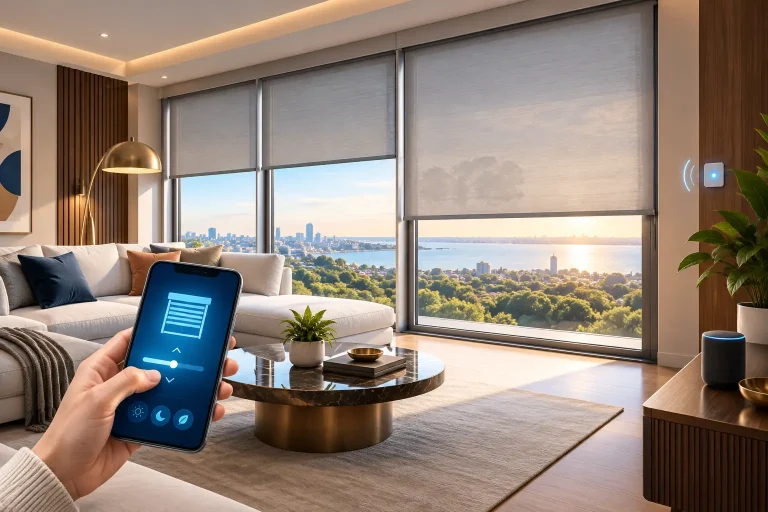
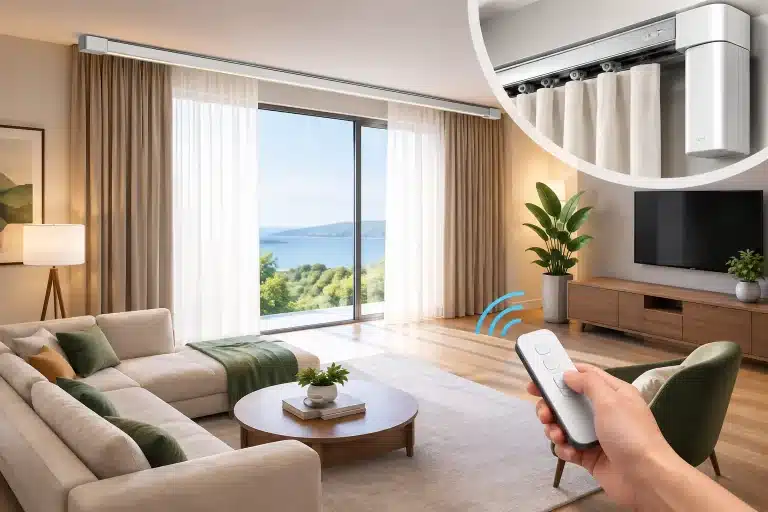
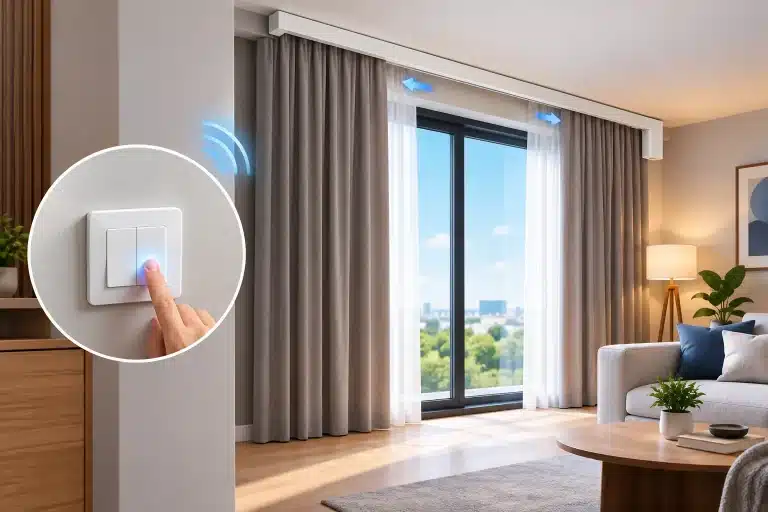
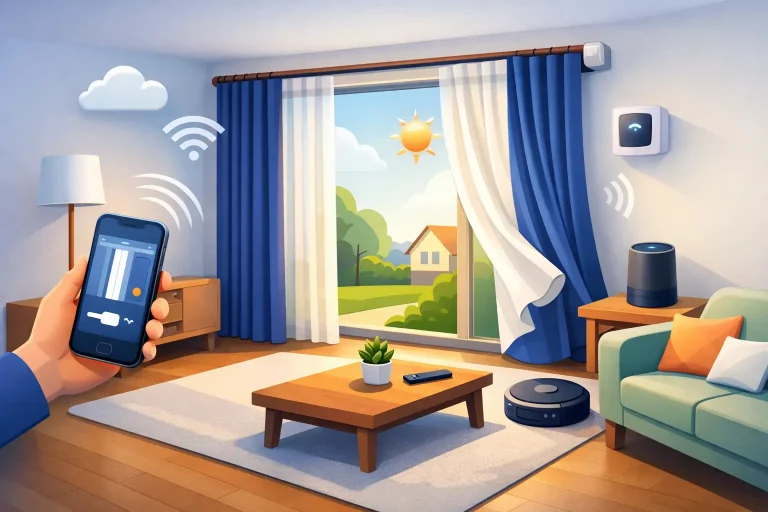
The controls are what make the system feel smart rather than merely electric. A simple wall switch gives reliable everyday use. A remote is convenient from bed or across the room. App control allows scheduling, while integration with broader smart home systems lets curtains react to scenes such as “good morning”, “movie night” or “away mode”. The right option depends on whether you want simplicity, automation, or a bit of both.
What makes curtains “smart” rather than just motorised?
This is where many homeowners understandably pause. Motorised curtains and smart curtains overlap, but they are not always exactly the same thing. A motorised curtain system opens and closes by powered control. A smart curtain system adds automation logic, scheduling or integration with other devices.
For example, if your curtains close every evening at sunset, that is smart functionality. If they open with the rest of your morning routine when your heating and lighting change, that is smart functionality too. If they only move when you press a button, they are motorised, but not necessarily fully smart.
That distinction matters when planning a system. Some customers simply want effortless opening and closing for a large set of curtains. Others want the curtains to become part of a connected home. Both are valid. The best result comes from deciding early how far you want to take the automation.
Why installation planning matters
When people ask how smart curtains work, they are often really asking whether they will work well in their home. That depends as much on planning as on the hardware itself.
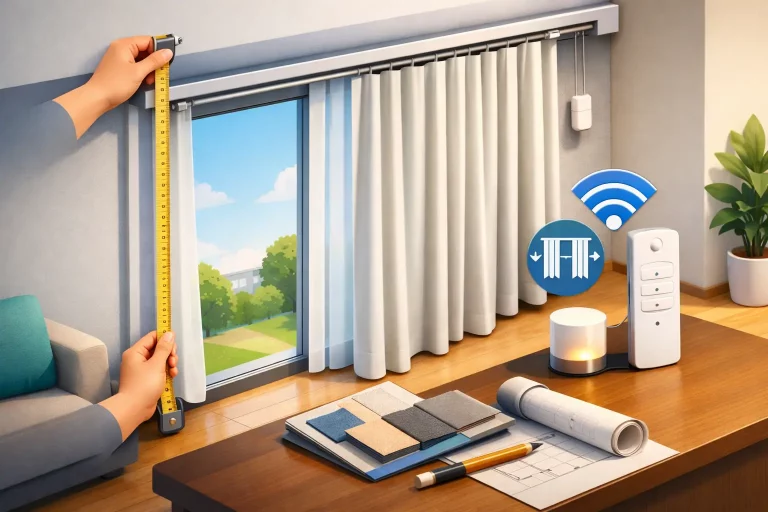
Curtain automation is very sensitive to measurements, fixing positions and track design. The width must be accurate, but so must the bracket spacing, recess depth, returns, overlap and the route the curtains need to travel. Bay windows and corners need particular attention. So do rooms where radiators, furniture or coving affect how the curtains hang.
You also need to think about power and control positions before installation. A wall switch should be easy to reach. A mains connection should be discreet but accessible. If the system is being integrated into a larger smart home setup, coordination with electricians or automation installers can save a great deal of frustration later.
That is why a consultative approach matters. A made-to-measure system is not difficult when it is specified properly, but it does reward careful planning.
Benefits that go beyond convenience
Convenience is the obvious one. Curtains open when you wake up, close when it gets dark, and you do not need to walk round the room pulling fabric by hand. But for most homeowners, the appeal goes further.
Privacy is a major benefit, especially in front-facing rooms or homes with large glazed areas. Scheduled closing means curtains are shut when you want them shut, not half an hour later when you remember. Security is another practical advantage. When you are away, automated curtains can make the house look lived in, which is far more convincing than a single lamp on a timer.
Accessibility is equally important. For anyone with restricted mobility, or simply for households with tall windows and heavy curtains, motorised operation removes daily effort. It also helps protect the curtains themselves. Repeated manual pulling can strain headings and cause uneven wear over time, whereas a properly set up motorised track moves them consistently.
There is also an aesthetic gain. Curtains that glide cleanly and stop at the right position make a room feel more polished. In high-spec interiors, that finished effect is often part of the decision.
Are smart curtains difficult to use?
Usually, no. The technology behind them is more involved than the user experience. Once the system is set, daily operation is simple. The challenge is not learning how to use them. It is making sure the system has been specified correctly for the room.
Some homeowners worry that smart controls will make ordinary tasks more complicated. In practice, a good setup should do the opposite. You might still have a wall switch for instant manual control, while timers or app settings handle the routine opening and closing in the background. Good automation should feel helpful, not demanding.
There are trade-offs, of course. Battery systems need charging or battery replacement at intervals. Mains-powered systems need power provision in the right place from the outset. Smart home integrations can add flexibility, but also call for compatibility checks. If you prefer absolute simplicity, a remote-controlled system may suit you better than a fully app-led setup.
Who smart curtains suit best
They are especially well suited to large or heavy curtains, hard-to-reach windows, media rooms, bedrooms, and homes where convenience and presentation both matter. They also make sense for renovations and new builds, where power and track positions can be planned neatly from the start.
That said, they are not only for high-tech homes. Many customers choose them because they want an easier routine, better privacy or more accessible control, not because they are building a complex smart home. The most effective systems are often the ones that solve a simple daily irritation very well.
For that reason, homeowners tend to get the best results when they look at the whole picture: the curtain fabric, the window shape, the control preference and the installation conditions. A bespoke approach avoids the common problem of trying to force a standard product into a non-standard room.
If you are considering a system for your own property, think less about gadgets and more about how you want the room to behave. Smart curtains work by combining a fitted motorised track with controls that suit your routine – and when that combination is planned properly, the result feels less like technology and more like a home that responds exactly as it should.