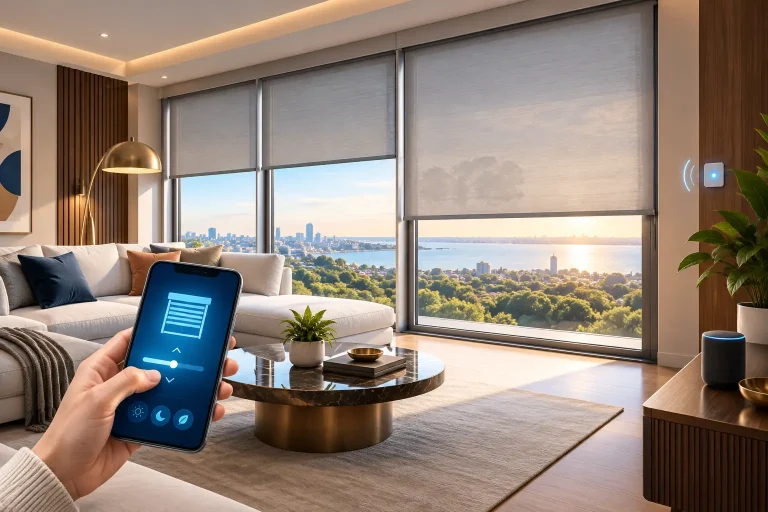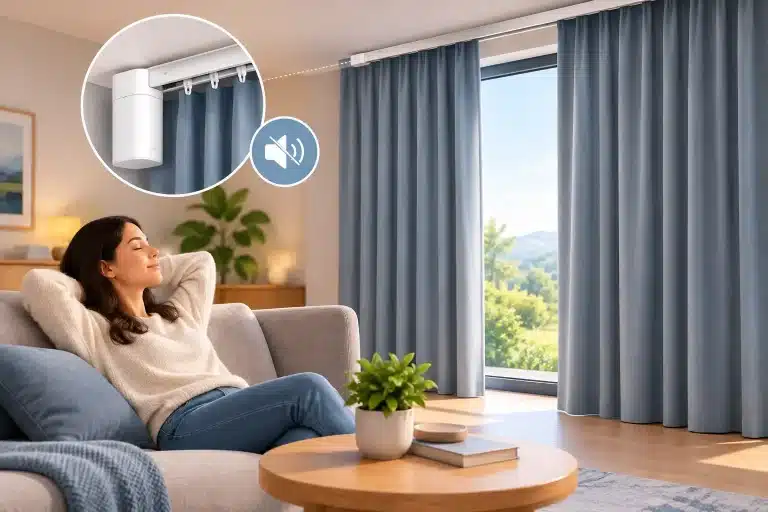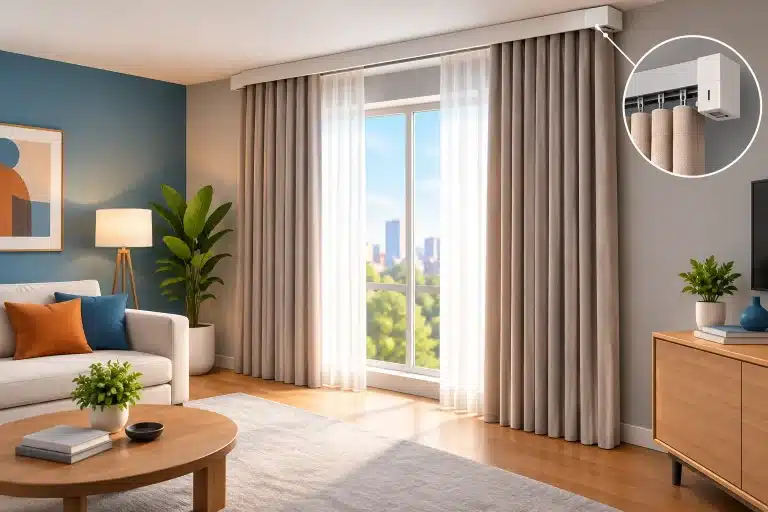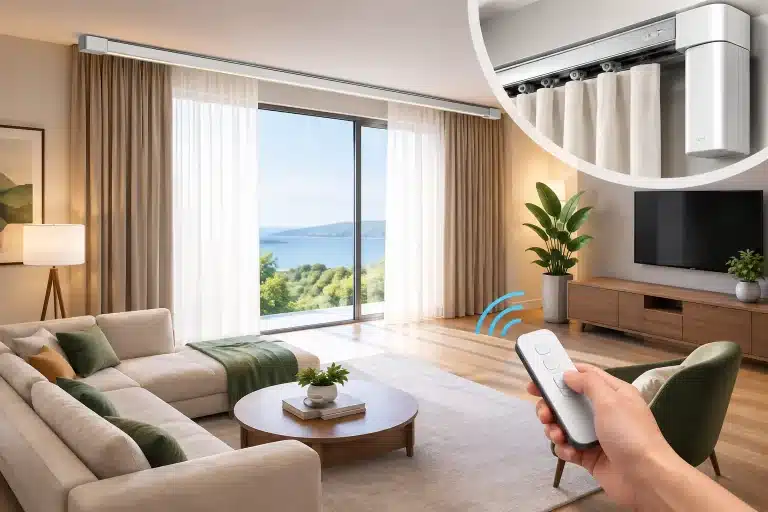
A good smart home setup should remove little frictions from daily life. Integrating curtains with home automation does exactly that. Instead of walking from room to room every morning and evening, you can have curtains open with your alarm, close at dusk, respond to a wall switch, or follow a schedule when you are away.
Thank you for reading this post, don't forget to subscribe!That sounds straightforward, but curtain automation works best when it is planned properly. The motor is only one part of the picture. Track shape, recess depth, power supply, control method, fabric weight and the way the curtain stacks all affect the final result. For homeowners, that means the smartest decision is rarely just choosing a motor. It is choosing a system that fits the room, the way you live, and the level of integration you actually want.
What integrating curtains with home automation really involves
When people think about smart curtains, they often picture voice control or an app on their phone. Those features matter, but they sit on top of the physical system. A motorised curtain track still has to suit the window opening, support the curtain weight and operate reliably every day.
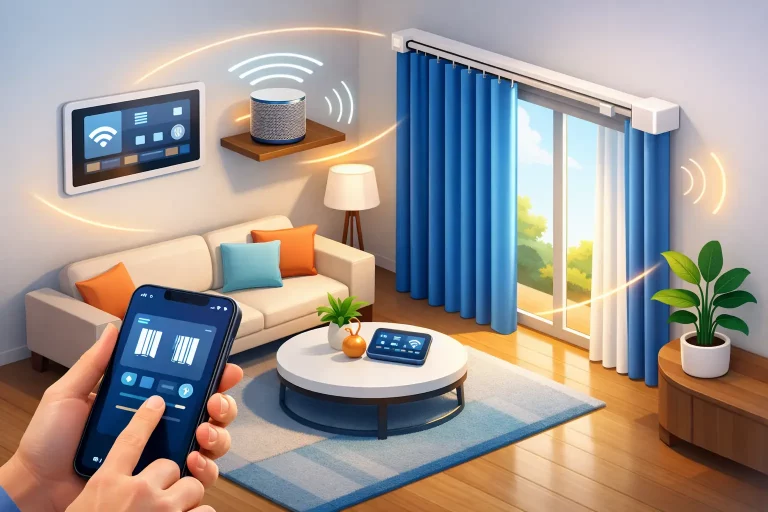
Integrating curtains with home automation usually means connecting a made-to-measure electric track to one or more control methods. That might be a handheld remote, a wall switch, a timer in an app, or a wider smart home platform that coordinates lighting, heating and blinds together. In a well-planned room, the technology feels calm and predictable rather than flashy.
For some households, simple timed opening and closing is enough. For others, the priority is accessibility, where pressing one button is easier than drawing heavy curtains by hand. In higher-specification homes, curtains may become part of broader scenes such as “Good morning”, “Movie night” or “Away mode”. The right setup depends on whether you want convenience, design refinement, security, assisted living support, or a bit of all four.
Start with the track, not the app
This is where many projects go wrong. Home automation discussions can quickly become focused on hubs, protocols and voice assistants, but curtains are a moving furnishing. If the track layout is wrong, the smartest controls in the world will not make the installation feel right.
Straight runs are usually the simplest. Bay windows, corners, reverse bends and offset layouts need more thought, especially if you want the curtains to park neatly and move without strain. Recess installations also need careful checking so the curtain can stack and travel freely without rubbing on a sill, radiator or projecting handle.
Fabric matters too. A lightweight sheer behaves very differently from a lined interlined curtain in a full-height living room. Motor specification should match the load rather than just the width of the opening. This is one reason bespoke advice is valuable. On paper, two windows can look similar. In practice, one may need a very different solution.
Choosing the right level of automation
Not every home needs the same type of control. The most successful systems usually match the household’s routines rather than trying to include every available feature.
A remote-controlled system is often the easiest entry point. It gives immediate convenience and avoids the need to manually operate large or awkward curtains. Adding a wall switch can make the setup feel more permanent and intuitive, especially in principal bedrooms and living spaces.
App control adds another layer. This is useful if you want timed schedules, holiday operation or the ability to close curtains from another part of the house. For many homeowners, this is the point where the system starts to feel part of a broader smart home rather than simply a powered curtain track.
Full integration with home automation platforms makes sense where you already use smart lighting, heating or security. Curtains can then respond to time of day, room scenes or occupancy patterns. That said, more integration is not always better. If a platform is overly complex or unreliable, everyday use becomes frustrating. A simple, dependable setup is usually the better choice than an advanced system that only one person in the house knows how to use.
Wiring, power and retrofit considerations
One of the first practical questions is whether the system is going into a new renovation or an existing finished room. The answer affects what is possible and how tidy the installation can be.
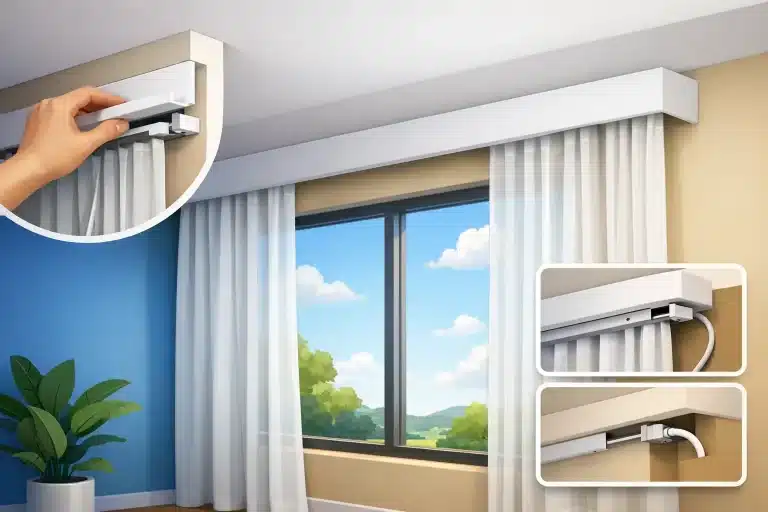
In a renovation or extension, it is easier to plan a concealed power feed and coordinate with electricians before plastering and decoration are complete. This can give a cleaner result, particularly where curtains sit in a ceiling recess or alongside other automated window treatments.
In an existing room, retrofit is often still very achievable, but cable routes and power positions need more thought. A visible cable may be acceptable in a utility room or home office, while a formal sitting room may call for a more discreet approach. The point is not that one method is right and the other wrong. It is that the room standard and customer expectation should shape the recommendation.
If you are building or remodelling, it also helps to think ahead. Even if full automation is not being installed immediately, allowing for the correct power provision and track space now can prevent compromise later.
Smart home compatibility without the guesswork
Integrating curtains with home automation platforms
Compatibility matters, but it should be approached calmly. Many homeowners do not want a lecture on technical standards. They want to know whether the curtains will work with the system they already use, and what level of control they can expect.
The first question is usually whether you want direct app control only, or whether the curtains need to talk to a wider platform. The second is whether you need simple open-close commands, scheduled routines, or scene-based control alongside lighting and shading. Those are not the same requirement.
This is where project support can save time. It is far easier to confirm compatibility before ordering than to discover later that the control method does not suit your electrician, integrator or preferred smart home setup. For bespoke curtain systems, the planning stage is part of getting the finish right.
It is also worth remembering that reliability should outrank novelty. Voice control sounds appealing, but many households still use wall switches and schedules most of the time. The best system is one that works naturally every day, regardless of whether guests know which app to open.
Everyday benefits beyond convenience
Convenience is usually the first reason people enquire, but it is rarely the only one. Automated curtains can improve privacy by closing at set times without anyone needing to remember. They can support home security by making an empty property appear occupied while you are away. For shift workers or families with young children, scheduled operation can also help rooms feel ready at the right time of day.
Accessibility is another major advantage. For anyone with reduced mobility, shoulder pain or difficulty reaching across furniture, pressing a switch is simply easier than pulling heavy curtains by hand. That benefit can be transformative, especially in bedrooms where daily use is non-negotiable.
Then there is the visual result. A properly specified motorised track gives controlled, even movement and a more polished finish than makeshift retrofit solutions. In a well-designed room, that refinement is noticeable.
Common planning mistakes to avoid
The most common mistake is underestimating the importance of measurements and layout. Width alone does not tell you enough. You need to think about where the curtain stacks, how far it projects, whether it clears the window handle, and where the power feed will sit.
Another frequent issue is choosing controls too early without understanding how the room will be used. A family room may benefit from a wall switch near the doorway, while a principal bedroom may be better served by bedside control and a wake-up schedule. The same technology does not suit every space in the same way.
Finally, some buyers assume any smart curtain product will adapt easily to unusual windows. Bay windows, corners and long wall-to-wall runs often need a bespoke approach. That is exactly why planning support matters. It reduces the chance of ordering a system that works in theory but feels compromised once installed.
A better result comes from better planning
For homeowners investing in made-to-measure automated curtains, the real value is not only in the motor. It is in getting the specification right before anything is manufactured. That means checking dimensions, understanding recesses, agreeing control preferences and making sure the curtain track layout fits the architecture of the room.
This is where a specialist approach makes a difference. Smart Curtains supports customers through those early decisions so the finished system looks right, operates properly and fits into the home with confidence rather than guesswork.
If you are considering automation, think less about adding a gadget and more about improving how the room works every day. When curtains are planned well, the technology quickly fades into the background, and that is usually the clearest sign you chose the right system.