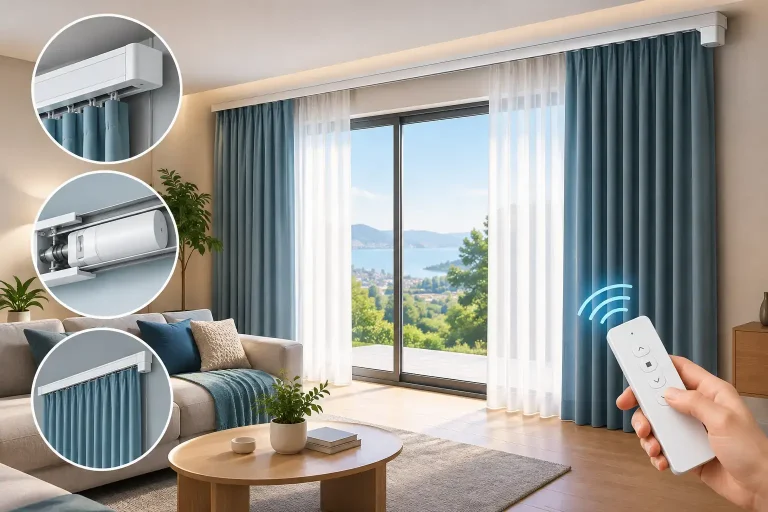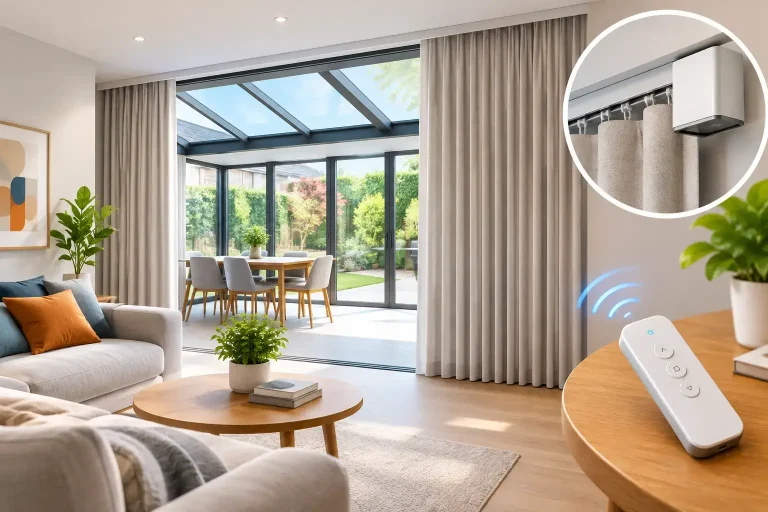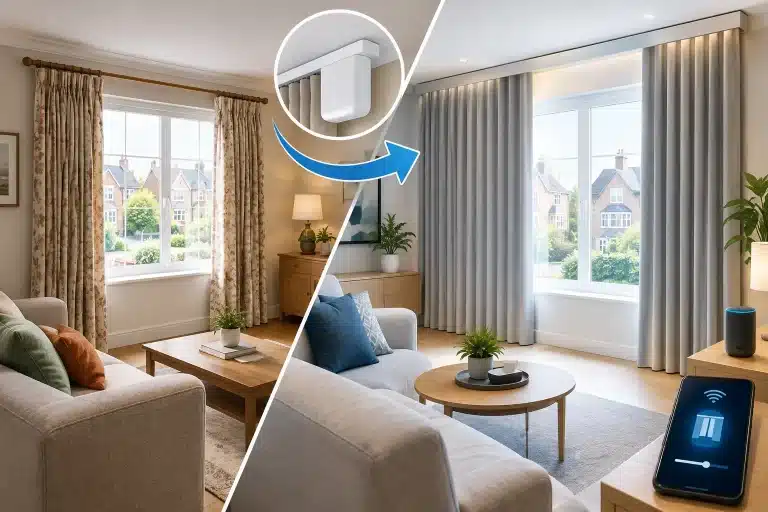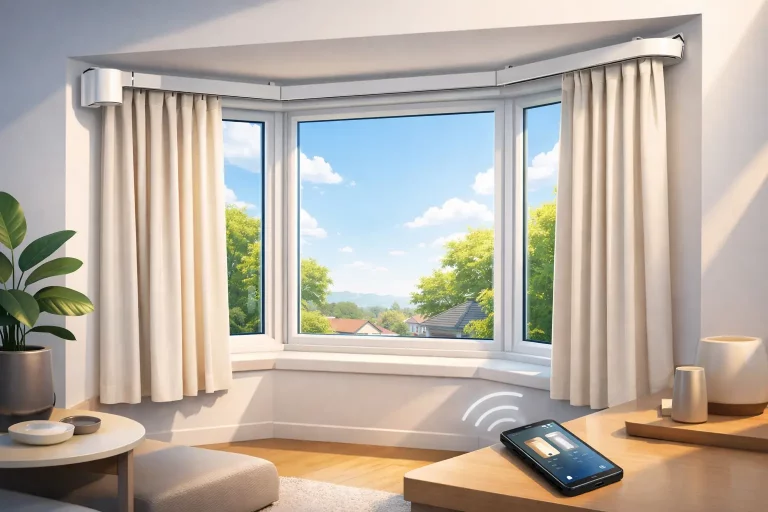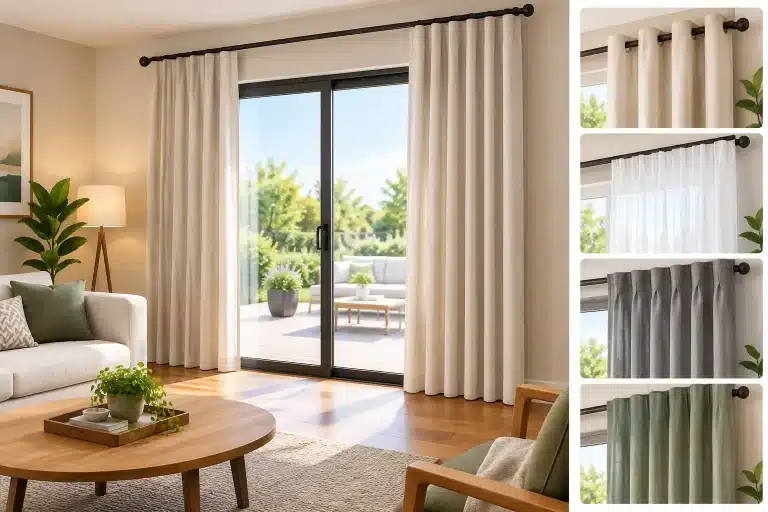
A patio door is often the brightest, most-used opening in the home, so the best curtains for patio doors need to do more than look attractive. They must cover a wide span properly, move easily when someone steps outside, soften the room without obstructing the door, and give you privacy when the lights come on. The right choice comes down to the door layout, how you use the room and the level of control you want every day.
Thank you for reading this post, don't forget to subscribe!For many UK homes, full-length curtains on a made-to-measure track offer the most polished and flexible answer. They can frame sliding, French and bi-fold doors beautifully, while a motorised system removes the usual struggle of drawing a large, heavy curtain by hand.
What makes the best curtains for patio doors?
Patio doors create a few practical challenges that ordinary window curtains do not. The opening is usually wider, traffic is frequent, and the curtains need enough stack-back space to reveal the glass fully. A beautiful fabric that leaves half the doorway covered when open will quickly become frustrating.
Start with the route through the room. If the doors lead to a garden, terrace or balcony used daily, the curtains should park neatly to one or both sides without narrowing the opening. Where furniture sits close to the doors, a ceiling-fixed track can be particularly useful: it keeps the treatment close to the glass and creates a clean, floor-to-ceiling line.
Light is the next consideration. South- and west-facing rooms may need a lining that reduces glare and protects furnishings from strong sunlight. In a bedroom or media room, blackout-lined curtains can make a substantial difference. For a living space where daylight matters, a dimout lining or a layered approach often gives a better balance between softness, privacy and natural light.
Finally, consider the view from outside after dark. Wide glazed doors can make a room feel exposed, particularly in homes overlooked by neighbours. Curtains that close fully across the complete opening provide a reassuring level of privacy, without introducing the hard, segmented appearance that some alternatives can create.
Choose the curtain heading for the door type
The fabric is only one part of the decision. The heading and track arrangement determine how the curtains open, stack and sit across the glass.
Wave curtains for a contemporary finish
Wave curtains form evenly spaced, soft folds and are a natural fit for modern extensions, open-plan kitchens and rooms with large expanses of glazing. They have a neat, relaxed appearance and work especially well on long, straight tracks. When open, they stack consistently, which makes planning the available space at each side of the door much easier.
A wave heading is not always the best option for a very formal interior or a tight recess. It also requires the correct track system and enough projection from the wall for the fabric to move freely past handles or other obstructions. With accurate planning, though, it gives patio doors a refined, hotel-style finish.
Pencil pleat curtains for flexibility
Pencil pleat curtains suit a broad range of interiors and fabrics. They can look traditional, understated or relaxed depending on the material and fullness selected. Their versatility can make them appealing where the home has existing curtains or a more classic style.
For very wide patio doors, however, pencil pleats can create a bulkier stack when open. This is not necessarily a problem, but it needs to be allowed for at the measuring and track-design stage. A made-to-measure track helps ensure the curtains still clear the opening comfortably.
Pinch pleat curtains for a tailored look
Pinch pleat curtains have defined, permanent folds that bring a more structured finish to formal sitting rooms, dining spaces and premium interiors. They work well with heavier fabrics and can give a substantial sense of quality around a large glazed opening.
The trade-off is stack-back. Because the folds are fixed, pinch pleat curtains generally occupy more room when drawn open than wave curtains. If maximising the clear door opening is the priority, the track position and return space deserve careful attention.
Fabric, lining and colour should suit the room
Long curtains across a patio door become a significant part of the room, so fabric choice should be guided by how the space feels as well as how it performs. Linen-look fabrics and textured weaves bring warmth to contemporary rooms and filter light pleasantly. Velvet and heavier woven fabrics offer more insulation and visual richness, particularly in rooms that feel cool in winter.
In kitchens or garden rooms, consider fabrics that are practical for the setting. Curtains close to a frequently used patio door may encounter muddy paws, small hands or moisture from damp coats. A durable material in a forgiving mid-tone is often easier to live with than a very pale, delicate fabric.
Lining matters just as much. Standard lining improves drape and gives the curtain body. Thermal lining can help reduce the cold feeling from large areas of glass, while blackout lining is useful where early morning light is unwelcome. Do not assume blackout always means complete darkness around patio doors: light can still enter at the sides, top and between curtain edges. A well-planned track, correctly sized curtains and suitable overlap all improve the result.
Why motorised curtains work so well on patio doors
A wide patio door can mean several metres of fabric, often in a heavier lined material. Even a well-made manual curtain may take a firm pull to move, particularly when it spans wall to wall. Motorised curtains make this simple: press a wall switch, use a remote, set a timer or include the curtains in a wider smart home routine.
That convenience quickly becomes part of everyday life. Open the curtains in the morning without crossing a cold room. Close them from the sofa when glare moves across the television. Set them to close as dusk falls for privacy, or programme them while you are away to make the home appear occupied.
Motorisation is also a valuable option for restricted mobility, tall or difficult-to-reach tracks, and doors where the curtains are used often. The aim is not technology for its own sake. It is a smoother, more accessible way to manage light, comfort and privacy.
For bi-fold doors, a motorised track can be particularly effective because it allows the curtains to move clear of the opening before the panels are folded back. With sliding doors, the curtain split can be planned around the active door panel, so access feels natural rather than awkward. French doors may suit centre-opening curtains, although one-way stacking can be preferable where one side has more clear wall space.
Measure the whole treatment, not just the glass
One of the most common mistakes is measuring the door opening alone. Curtain tracks usually need to extend beyond the glazed area, allowing the curtains to stack away from the view and door route. The exact extension depends on the heading, fabric fullness, wall space and whether the curtains draw to one side or meet in the middle.
Height is equally important. Ceiling-mounted tracks can make a room appear taller and often allow the most generous, elegant drop. Wall-mounted tracks may be the better choice where ceiling construction, coving or services need to be considered. In either case, check door handles, radiators, window sills and nearby furniture before settling on the track position.
This is where professional planning makes a material difference. Bespoke systems can account for recesses, returns, corners, offsets and unusually wide openings before anything is ordered. Smart Curtains provides planning support and fitting drawings so homeowners, builders and electricians can coordinate the details before installation, rather than trying to solve them on site.
Do patio doors need curtains as well as blinds?
Not always, but combining the two can be very effective. A blind can offer daytime glare control or privacy while still allowing some view through the glass, while curtains add softness, insulation and fuller privacy in the evening. This layered approach works especially well in large open-plan rooms that can otherwise feel echoing or sparse.
If the room already has shutters or blinds, curtains can still be chosen primarily for warmth and visual balance. Conversely, in a compact room where fabric would dominate, a well-specified blind may be the more practical main treatment. There is no universal answer, which is why the door configuration and daily routine should lead the decision.
The best result is a curtain arrangement that feels effortless: it clears the route to the garden, sits beautifully when closed and responds when you need it to. Before choosing fabric, confirm the track layout, stack-back space and control method. Those quiet details are what turn patio-door curtains from a decorative afterthought into a genuinely useful part of the home.