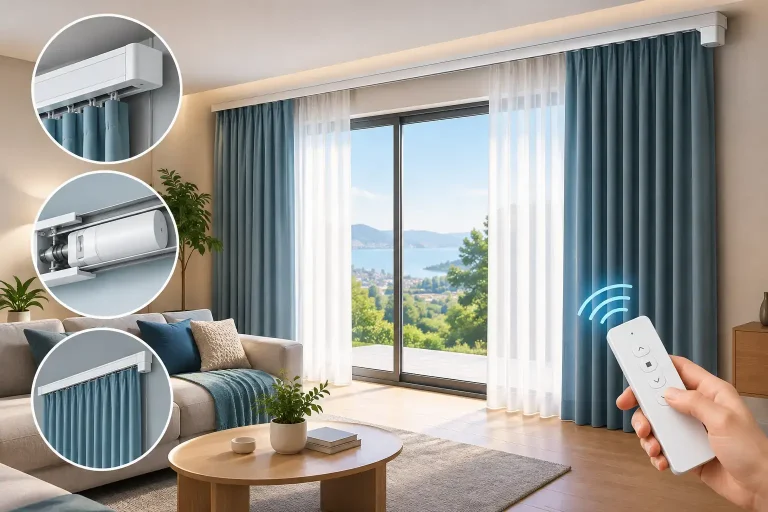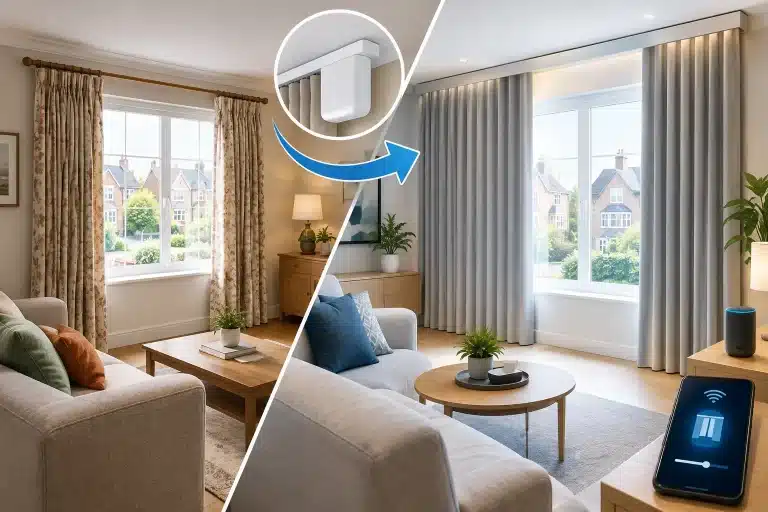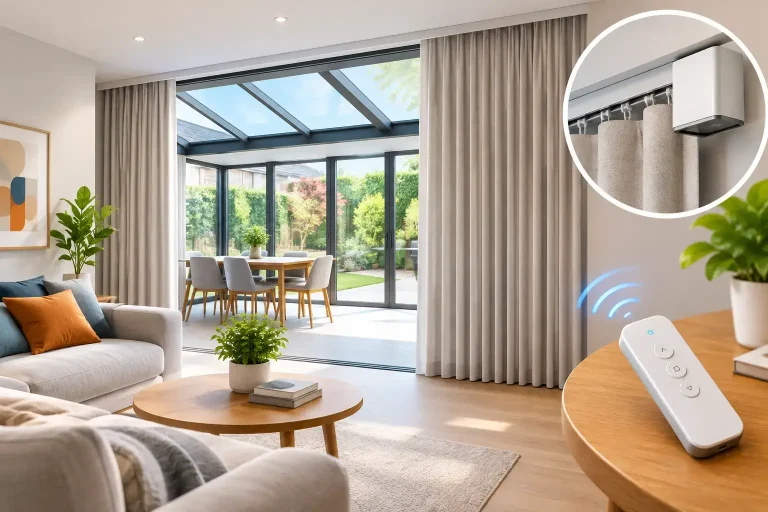
A rear extension can transform the way a home feels, but large areas of glazing bring a practical question with them: how will you control light, privacy and heat once the room is finished? The best electric curtain ideas for extensions start with the architecture, not the motor. A made-to-measure track planned around your doors, glazing and ceiling details gives the space a calm, considered finish while making daily life much easier.
Thank you for reading this post, don't forget to subscribe!Electric curtains are particularly well suited to extensions because the windows are often wider, taller and more frequently used than elsewhere in the house. Instead of reaching across furniture or wrestling with heavy curtain panels at a set of bifold doors, you can close the room with a wall switch, remote, timer or smart home command.
Start with how your extension is used
The right arrangement depends on whether your extension is a kitchen-diner, garden room, open-plan living area or a combination of all three. In a family kitchen, curtains may be used mainly after dark for privacy and warmth. In a lounge area facing west, reducing evening glare may be the priority. For a garden-facing room, you may want the curtains to close automatically at dusk when the house is unoccupied.
Think about the everyday routes through the room as well. Curtains across sliding or bifold doors should stack clear of the opening so they do not interrupt access to the garden. If one side of the glazing is used more often, the track can be specified to draw the curtains away from that side. This is a small detail, but one that makes a bespoke system feel genuinely useful rather than simply impressive.
Electric curtain ideas for extensions with wide glazing
Wall-to-wall glazing is common in modern extensions, and it is one of the strongest reasons to choose motorised curtains. A single, continuous track can run across the full elevation, giving a cleaner result than breaking the window treatment into separate sections. When open, the curtains stack neatly at one or both ends. When closed, they soften the hard lines of glass, frames and plasterboard with fabric and warmth.
For broad sliding doors, a centre-opening arrangement is often visually balanced, with curtains meeting in the middle and drawing back to either side. A one-way draw can be more practical where the door opens or where one end needs to stay clear. There is no universal answer: the best option comes from looking at door operation, furniture placement and where there is room for the curtain stack.
Floor-to-ceiling curtains can also make a modest extension look more generous. Hanging the track close to the ceiling draws the eye upwards and avoids a fussy break above the glazing. If the ceiling height changes between the original house and the extension, careful track positioning can help the transition look deliberate.
Use curtains to soften bifold doors
Bifold doors offer wonderful views when open, but at night they can leave a room feeling exposed. Electric curtains allow you to keep the openness during the day, then create a more intimate room at the press of a button. They are also useful in winter, when lined or interlined curtains add a welcome layer between the living space and large panes of glass.
The planning point is stack-back space. The curtain needs somewhere to sit when open, ideally without covering too much glazing or obstructing a door leaf. This should be considered before finalising the pelmet, lighting or adjacent cabinetry.
Treat corners, bays and offset doors as one scheme
Many extensions have an L-shaped corner, a projecting bay or doors offset from the main window. These layouts do not require a compromise with straight, standard-length tracks. A made-to-measure motorised track can be designed around bends, corners and returns so the curtains follow the room rather than fighting against it.
For a glazed corner, curtains can continue around the turn to provide complete privacy in the evening. In a bay, a shaped track keeps the fabric close to the glass and preserves the intended architecture. Where a structural post interrupts the glazing, separate tracks may be the tidier choice. The detail depends on the sightlines you want when the curtains are open and how the fabric will stack at each end.
Build the curtain track into the ceiling design
The most polished installations are planned before plastering. A recessed curtain pocket allows the track to disappear into the ceiling, leaving the curtains to appear as though they are falling directly from it. This works especially well in contemporary extensions with flat roofs, roof lanterns and clean-lined finishes.
A recess does not have to be elaborate, but it needs to be wide and deep enough for the track, motor and curtain heading. The space also needs to allow the curtains to move freely without catching on downlights, sprinkler heads, vents or doors. A narrow slot may look attractive on a drawing but become restrictive once full fabric panels are installed.
If the extension is already complete, surface-fixing a track remains an excellent option. A discreet ceiling-mounted system can look purposeful, particularly when paired with a simple fascia or pelmet. The priority is accurate measurement and a secure fixing point, not whether the motor is hidden completely.
Plan power before the electrician leaves
An electric curtain track needs a suitable power supply near the motor position. In a new extension, arranging this during first fix is usually straightforward and avoids visible cables later. The motor is commonly positioned at one end of the track, so the planned socket or spur must match the final curtain layout rather than just the nearest wall.
For very wide or complex arrangements, ask early where the motor will sit, how it will be accessed and whether any join in the track affects its location. This is also the time to coordinate with the electrician if you would like a wall switch, central smart home control or automation linked to other systems.
Battery-operated options can suit certain retrofit projects, but mains-powered systems are often the preferred choice for large, heavy curtains in an extension. They avoid the need to recharge batteries and are well suited to regular scheduled operation. The right choice depends on access to power, curtain weight and how often the system will be used.
Choose controls that suit the household
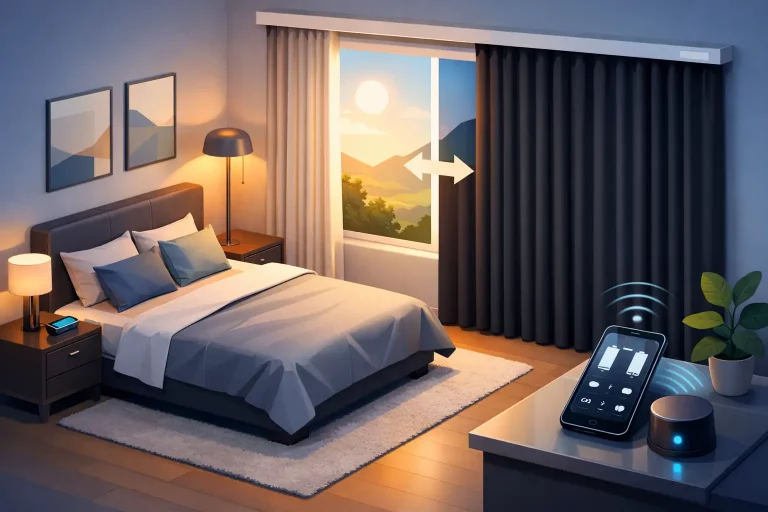
A remote control is simple and familiar, while a wall switch gives the room a more integrated feel. Smartphone control is useful for setting routines, such as closing curtains at sunset or opening them in the morning. Smart home integration can take this further, allowing curtains to work alongside lighting, heating or security settings.
Automation should serve the household rather than add another layer of complication. For someone with restricted mobility, a single, accessible control can remove a daily inconvenience. For a busy family, timed closing can prevent the familiar moment of realising the whole room is visible from the garden after dark. When away on holiday, varying the curtain position can also help the house look lived in.
Keep manual use in mind too. Quality motorised systems are designed for dependable daily operation, but the controls should remain easy for every member of the household to understand. A well-planned system feels intuitive from day one.
Balance the fabric with the extension’s light
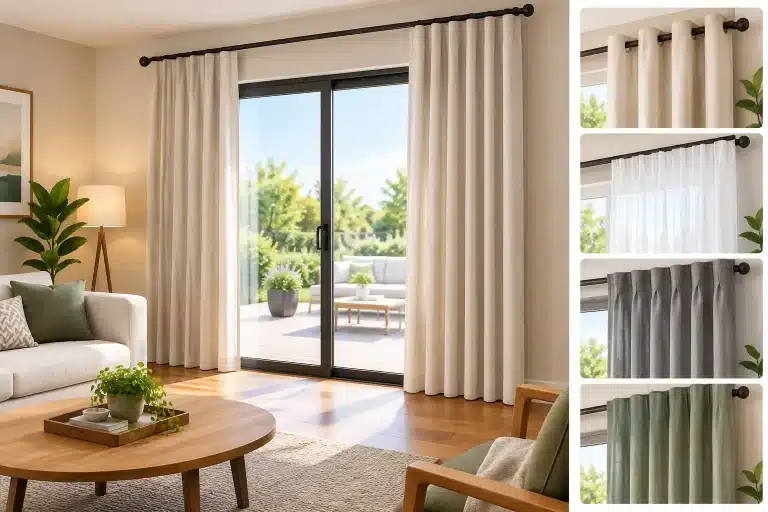
The track provides the movement, but the fabric determines much of the mood. Sheer curtains are a strong choice where privacy is needed without losing all daylight, particularly on overlooked boundaries. They can remain closed through the day, reducing the direct view into the room while retaining a light, relaxed feel.
For evening privacy and thermal comfort, lined curtains are usually the more practical layer. Some homeowners pair sheers with fuller curtains on a double track, using the sheer layer during the day and the main curtains after dark. This gives greater flexibility, though it requires a deeper recess and more room for the curtains to stack.
Consider how the fabric will look against the glass from outside as well as inside. Pale fabrics reflect light beautifully in a bright extension, while deeper colours can make an open-plan living area feel more grounded in the evening. Very heavy fabrics create a luxurious look, but they increase the weight the motor and track must handle. This is why fabric choice and track specification should be considered together.
Measure for the finished room, not just the window
Extensions can change during the build. Flooring depth, plasterboard thickness, steel positions, kitchen units and lighting layouts all affect the available space for a curtain track. Measurements taken too early can leave little allowance for these final layers.
A proper plan considers the full wall or ceiling width, the final ceiling level, recess dimensions, motor position, stack-back space and the finished floor level for curtain length. It should also account for obstructions such as roof lantern blinds, radiators, shelving and opening doors. Smart Curtains can help verify these details, produce fitting drawings and give builders and electricians clear information before the final installation stages.
The most successful electric curtain scheme is rarely the one with the most technology. It is the one that respects how the extension is used, fits the architecture precisely and makes the room more comfortable at the moments that matter. Plan the track early, leave room for the fabric, and your curtains can become one of the quietest and most useful features of the new space.