If your bedroom gets bright far too early in summer, or street lighting keeps finding the gap at the edge of the curtains, the right window treatment can change the room completely. Automated blackout curtains bedroom setups are not just about adding a motor. Done properly, they give you darker mornings, easier daily control, and a more polished finish that feels built into the space rather than added as an afterthought.
Thank you for reading this post, don't forget to subscribe!For many homeowners, the appeal starts with comfort. Press a button, use a wall switch, set a timer, or let your smart home routine handle it for you. But the bigger difference usually comes from the planning behind the system. Blackout performance depends on curtain fullness, track position, overlap, wall-to-wall coverage, and how the curtains meet the window or recess. That is why bedroom automation works best when it is treated as a made-to-measure solution rather than a generic off-the-shelf upgrade.
Why automated blackout curtains in a bedroom make sense
A bedroom is one of the few rooms where daily convenience and environment matter equally. You want privacy at night, reduced light in the early morning, and a calm look that suits the room when the curtains are open or closed. Automation adds ease, but it also improves consistency. Curtains get used properly when they can be opened and closed without effort.
That matters more than people sometimes expect. In a main bedroom, a motorised system can become part of your wake-up and wind-down routine. In a child’s room, predictable opening and closing times can support sleep patterns. In a guest bedroom, it gives the room a more refined, hotel-like feel without asking anyone to wrestle with heavy fabric or awkwardly positioned windows.
There is also a practical security benefit. When you are away, timed curtain movement helps a home appear occupied. That is not the only reason to choose automation, but it is a useful one, especially for households that already value smart lighting or other scheduled home controls.
What makes blackout curtains actually blackout
This is where expectations need to be realistic. Blackout fabric helps block light through the material itself, but total darkness depends on the whole installation. If light is spilling around the top, sides, or centre overlap, the result may still be noticeably brighter than you want.
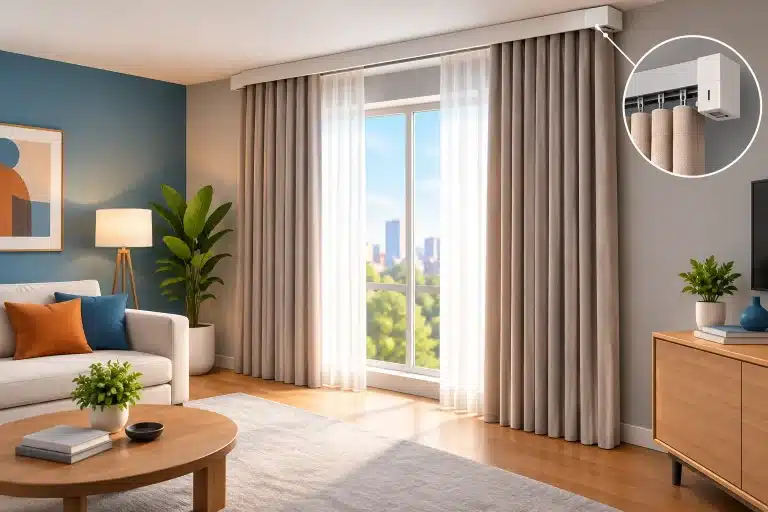
In an automated blackout curtains bedroom design, track placement is a major factor. A ceiling-fixed or carefully positioned wall-fixed track can improve coverage. Wider returns at the sides may reduce light leakage. A proper centre overlap is important on split curtains, and in some bedrooms a wall-to-wall arrangement gives a far better result than a track fitted only to the width of the window.
Fabric choice matters as well. Heavier blackout curtains often hang beautifully and improve light reduction, but they place more demand on the motor and track system. That is not a problem when the specification is correct, though it is one reason bespoke advice matters. The motor needs to suit the curtain weight, track length, and layout.
The best control options for bedroom use
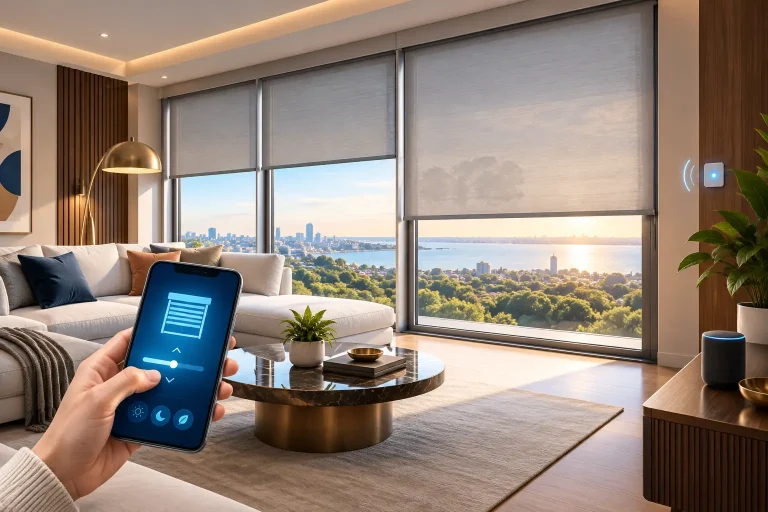
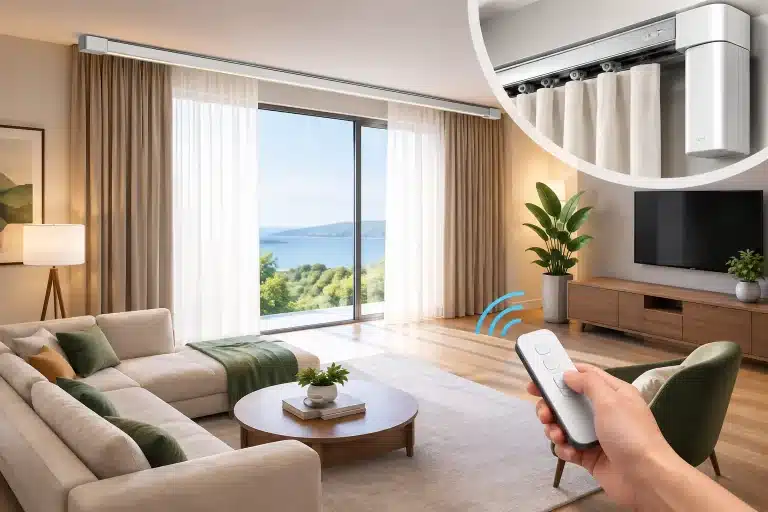
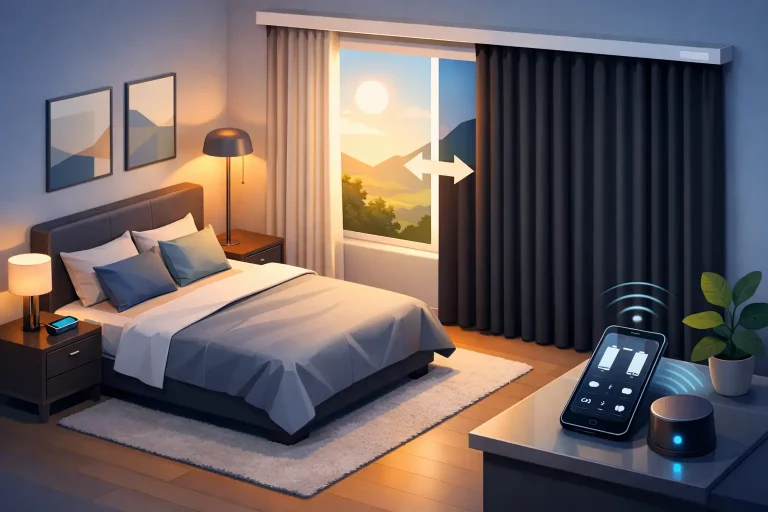
The right control method depends on how you use the room. Some homeowners prefer a simple remote because it is quick and familiar. Others want a wall switch near the bed or by the bedroom door. Smartphone control is popular when schedules are part of the appeal, particularly for weekday routines.
Smart home integration can be the most convenient option if you already use a wider system. Curtains can open gradually with a morning scene, close automatically at sunset, or work alongside lighting and heating. That said, not every bedroom needs full smart home integration. Sometimes a dedicated remote and a timer are the better fit because they keep the system simple and dependable.
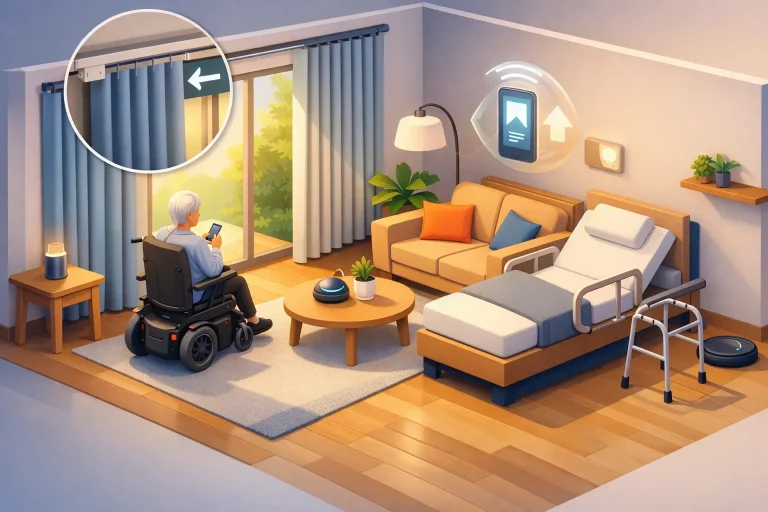
Ease of use should stay at the centre of the decision. For households with restricted mobility, reaching behind furniture or across a wide window can be inconvenient every day. Automated control removes that strain and makes the room more comfortable to live in.
Planning an automated blackout curtains bedroom properly
The difference between a satisfactory result and an excellent one usually comes down to planning. Bedrooms often have details that complicate curtain automation more than people expect. Window boards, radiators, bedside furniture, recessed openings, bay shapes, and limited fixing positions can all affect the final specification.
This is also why made-to-measure systems are so valuable. A bedroom track should be designed around the real space, not forced into standard sizes. Exact measurements help determine stack-back, the amount of room curtains need when open, and whether they will sit neatly without blocking too much glass or interfering with nearby furniture.
In renovation projects or new builds, timing matters too. If power is being provided for a hardwired system, the position should be coordinated early with electricians and builders. If a battery or plug-powered option is more appropriate, that should still be confirmed in relation to access, charging, and the look you want to achieve.
For more complex rooms, such as bays or corner windows, the track layout becomes even more important. Smooth operation through bends and offsets requires the right system from the start. In these cases, specialist guidance can save a great deal of frustration later.
Design considerations beyond the motor
The motor is only one part of the finished result. In a bedroom, appearance matters just as much as performance. You are likely looking at these curtains every day, so they need to sit well with the room scheme when open and when closed.
Fullness is a good example. Curtains that are too flat can look mean and may reduce the sense of softness that bedrooms benefit from. Curtains that are overly bulky may dominate the room or create stack-back issues. The right balance depends on the fabric, the width of the track, and how much wall space is available to either side of the window.
Heading style and lining also affect the final feel. Some headings are better suited to motorised tracks than others, especially when you want reliable movement and a tidy wave or fold. Blackout lining can improve darkness and add substance, but it should be paired with a track and carrier arrangement designed to handle it smoothly.
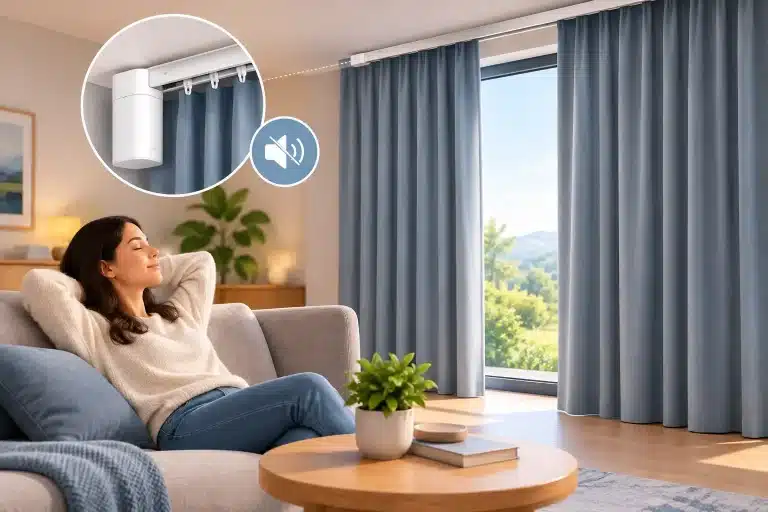
Noise is another point worth considering. A quality motorised system should operate quietly enough for bedroom use. Most homeowners are not looking for theatre. They want calm, reliable movement that feels refined and unobtrusive.
When automation is especially worthwhile
There are bedrooms where automation feels like a luxury, and others where it quickly becomes the sensible option. Large spans of glazing are one example. Heavy curtains across wide doors or wall-to-wall windows can be awkward to handle manually and difficult to keep hanging neatly. Automation makes everyday use much easier.
It is also particularly useful in hard-to-reach spaces, such as windows behind furniture or high-level glazing. In these layouts, manual curtains often end up left closed or partly open simply because they are inconvenient to adjust.
For households focused on accessibility, the value is obvious. Removing the need to pull curtains by hand can make a real difference to comfort and independence. And for anyone investing in a premium bedroom finish, automation supports the overall feel of a well-resolved interior rather than leaving practical elements to chance.
Common mistakes to avoid
The most common mistake is assuming blackout fabric alone will deliver a blackout result. Without proper width, overlap, and placement, light leakage can still be disappointing. Another is choosing a motorised track before confirming fabric weight and curtain style, which can lead to a system that is under-specified or not ideally matched to the application.
A third issue is leaving planning too late. By the time decorating is complete, there may be fewer options for power, fixing positions, or concealment. Early decisions usually lead to a cleaner result.
Finally, there is the temptation to treat every bedroom the same. A main bedroom, nursery, guest room, or loft conversion may all need different solutions. The best system is the one that suits the room, the users, and the level of control you actually want.
For homeowners who want both convenience and a properly finished look, this is where a specialist approach makes the difference. Smart Curtains, for example, focuses on tailored track specification, planning support, and guidance around measurements, layouts, and installation considerations so the finished system works as well as it looks.
Automated blackout curtains are at their best when they solve a real daily problem and feel effortless to live with. If your bedroom needs better darkness, easier control, or a cleaner, more considered finish, it is worth planning the system around the room rather than trying to make the room fit the product.