A curtain that catches on a bay corner, leaves a gap at the edge of the window or stops short of the wall can spoil an otherwise beautifully finished room. This electric curtain track guide explains what to consider before ordering, so your automated curtains look considered, operate reliably and suit the way you live.
Thank you for reading this post, don't forget to subscribe!Motorised curtains are often chosen for the convenience of opening and closing heavy or hard-to-reach window dressings. Yet the best results come from planning the track as carefully as the fabric. The window layout, curtain heading, power position, control preference and space around the window all affect the final specification.
What an electric curtain track does
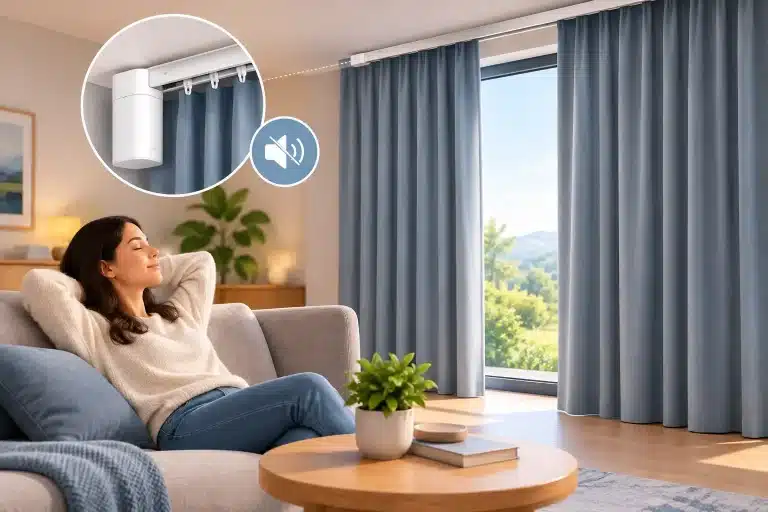
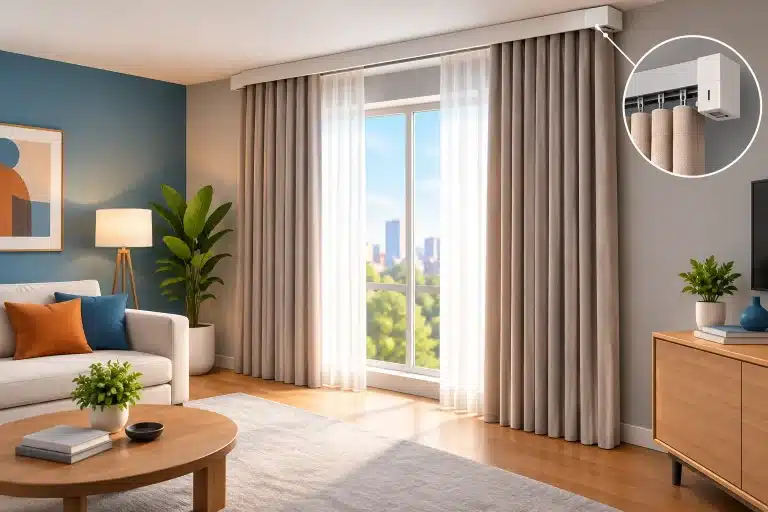
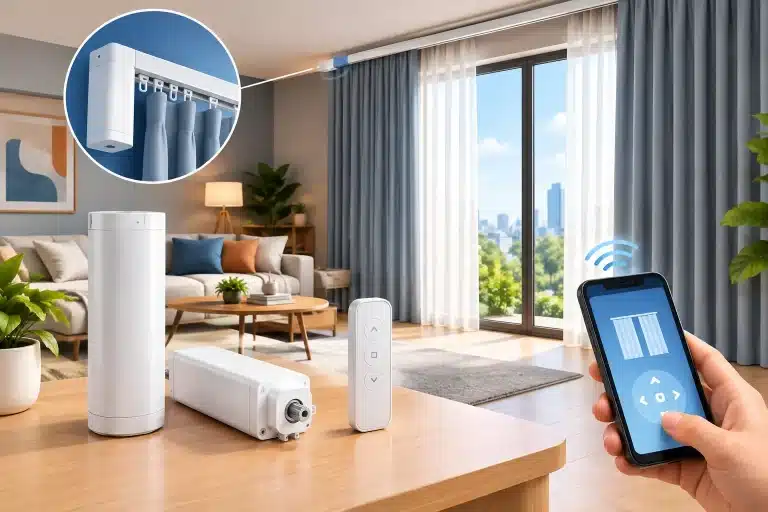
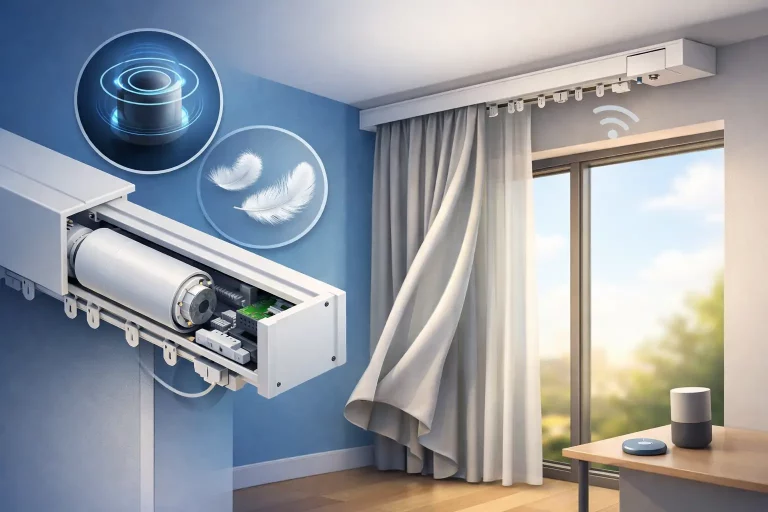
An electric curtain track uses a concealed motor to draw curtains open and closed at the press of a button, on a schedule or through a compatible smart home system. Rather than handling the fabric each morning and evening, you choose how and when the curtains move.
For many households, that starts with simple convenience. Curtains in a bedroom, sitting room or tall stairwell window can be controlled without reaching behind furniture or pulling on heavy fabric. For others, automation supports accessibility, allowing curtains to be operated from a wall switch, remote control or phone without physical effort.
It can also make an empty home feel lived in while you are away. Timed opening and closing is a practical addition to a wider home security routine, particularly during darker months or holidays. The effect is subtle, but the day-to-day benefit is clear: privacy and daylight can follow your routine instead of becoming another task to remember.
Electric curtain track guide: start with the window layout
The first decision is not the motor. It is the route the track needs to take. A straight wall-to-wall arrangement is usually straightforward, but many homes have bay windows, return walls, corners, radiator projections or uneven recesses that need accounting for before manufacture.
A made-to-measure track should be specified to the finished dimensions of the space, not simply the width of the glass. This allows the curtains to stack back correctly and cover the window when closed. If the track is too short, light can creep around the edges. If it is too long without enough room for the fabric to park, the curtains may cover part of the glazing when open.
In a recess, consider whether the curtains need to sit inside the opening or outside it. Fitting within a recess can look neat, but it demands enough depth for the track, curtain heading and fabric to move freely. A face-fixed track outside the recess may provide better coverage and a more generous finish, especially where blackout performance matters.
Bay windows need particularly careful planning. Curved and angled bays are different propositions, and each requires the track to follow the correct line. The same applies to L-shaped rooms, offset windows and tracks that turn a corner. A drawing based on verified measurements is far more useful than trying to estimate a complex layout from a photograph alone.
Choose the opening arrangement before the fabric is made
Curtains can open from the centre, with one panel travelling to each side, or draw to one side only. Neither is automatically better. Centre opening is often the natural choice for a symmetrical window or pair of doors, while one-way opening can be useful where one end of the track has more stack-back space.
The opening arrangement also affects where the motor sits and where the curtains gather when open. This matters around furniture, shelving, window handles and doors. In a bedroom, for example, a curtain stack that lands beside a wardrobe may be preferable to one that sits in front of a window.
Your curtain heading matters too. Wave curtains, pencil pleat curtains and more tailored headings each take up different amounts of space and create a different visual effect. Heavier lined, interlined or blackout curtains need a system capable of handling their weight and width. The track should be selected for the curtain, rather than expecting a standard solution to work for every fabric.
Select a control method that fits your routine
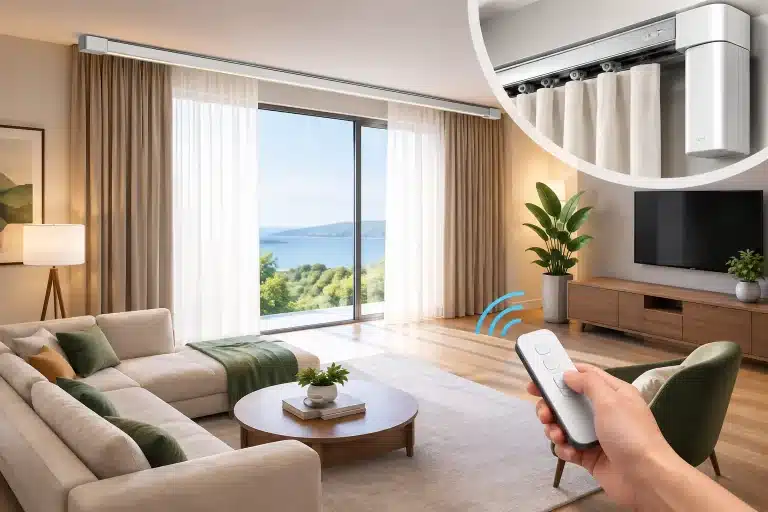
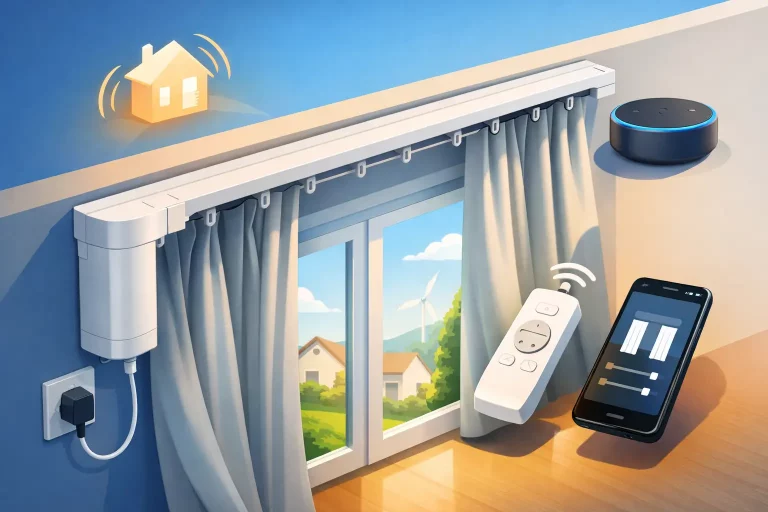
A good electric curtain system should feel simple for every member of the household. A wall switch provides a familiar fixed control point, while a handheld remote is useful from the sofa or bedside. Smartphone control can suit people who want to set routines or check their curtains while away from home.
Smart home integration is worth considering when curtains are part of a wider automation plan. You may want them to close at sunset, open gradually in the morning or work alongside lighting, heating and voice control. The right option depends on the platform already installed, as well as who will use it. A highly connected system is not automatically the best choice if a straightforward remote and switch will meet your needs more reliably.
It is sensible to decide this early. The power supply, motor position and any coordination with an electrician or home automation integrator are easier to arrange before decorating is complete. Retrofitting is possible in many properties, but early planning gives more freedom to conceal cables and position controls neatly.
Plan power and fitting details early
Every motorised track needs an appropriate power arrangement. Depending on the system and room, this may involve a nearby socket or a planned electrical connection. The important point is to establish the requirement before finalising the track position, especially if ceilings are being lowered, joinery is being installed or a pelmet is being built.
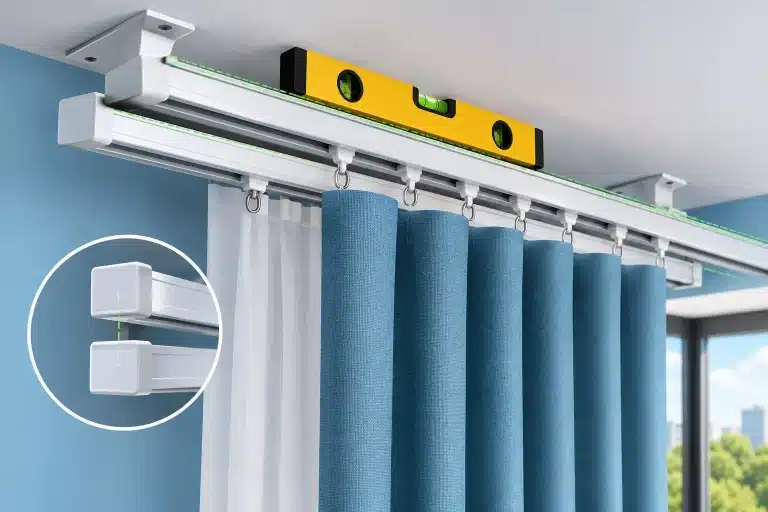
The fixing surface also deserves attention. A track can be ceiling fixed, wall fixed or installed within a purpose-made recess, but the substrate must support both the track and the moving curtain weight. Plasterboard ceilings, steel lintels and uneven walls may need a different fixing approach from solid timber or masonry.
For a concealed, high-end look, some homeowners include a curtain pocket or recess in the ceiling design. This can hide the track and create the impression that the curtains fall directly from the ceiling. It is an effective detail, but only if the recess is deep and wide enough for the selected curtain heading, motor and fabric movement. Leaving this decision until after the plastering is complete can limit the options.
Do not overlook stack-back and light control
The amount of space occupied by curtains when fully open is called stack-back. It is one of the most commonly missed measurements in curtain planning. Full, lined curtains need more parking space than a lightweight sheer, and a narrow wall beside the window may mean the open fabric overlaps part of the glass.
This is not always a problem. In a cosy bedroom, maximum daylight may be less important than full blackout at night. In a kitchen-diner or living space with a view, however, you may want the curtain to clear as much glass as possible during the day.
Consider the complete window treatment as well. Motorised curtains can work alongside blinds, shutters or sheers, but sufficient clearance is needed between each layer. Combining a blackout curtain with a separate blind can offer excellent privacy and light control, provided the controls and fittings are planned as one arrangement rather than added piecemeal.
Why bespoke planning makes a difference
Electric tracks are not a one-size-fits-all home improvement. The visible result may be calm and simple, but the work behind it involves matching dimensions, track shape, curtain weight, fixing method and controls. That is why a measured, consultative approach is valuable.
At Smart Curtains, installation planning can include checking your dimensions, preparing fitting drawings and helping you understand what needs to be agreed with your builder, electrician or automation specialist. This is particularly helpful for bay windows, ceiling recesses, corners and wall-to-wall tracks, where a small measuring error can have a noticeable effect.
Before requesting a quote, gather a few practical details: the overall width and height of the area, photographs of the window and surrounding walls, the preferred fixing position, and any plans for smart home control. If the room is under renovation, include drawings or ceiling plans where possible. These details make it easier to identify potential issues before an order is placed.
The most successful automated curtain installations are rarely the ones with the most complicated technology. They are the ones that have been planned around the room, the fabric and the people using them. Give the track the same attention you would give the curtains themselves, and the finished space will feel effortless every day.