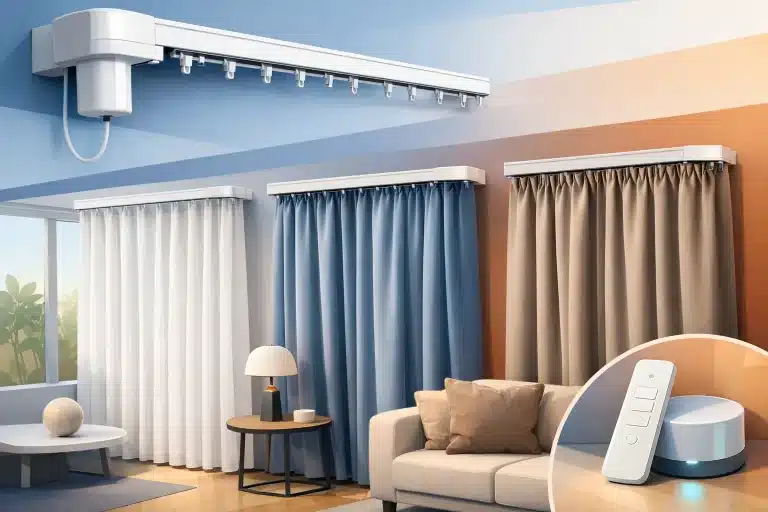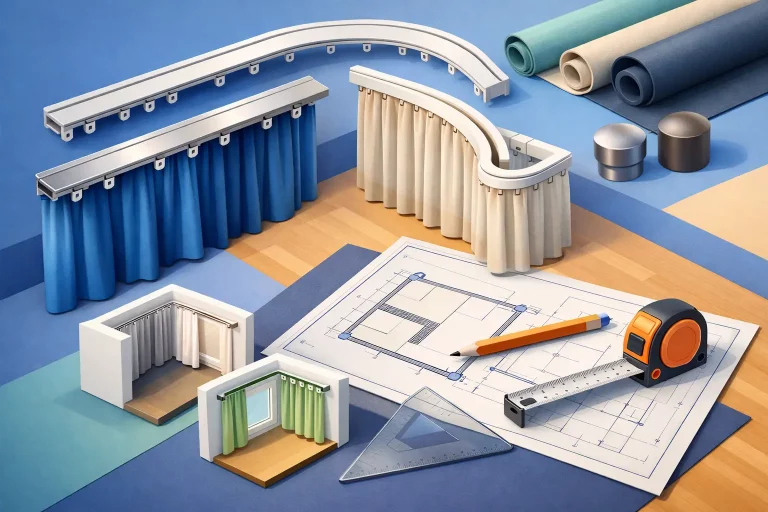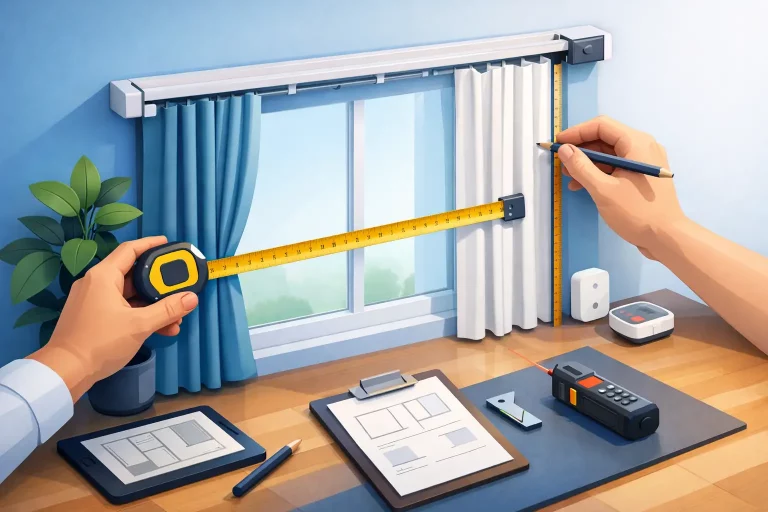
A motorised curtain system can make a wide window feel effortless to live with, but the finished result depends on the measurement taken before anything is ordered. Knowing how to measure electric curtains really means knowing how to measure the track: where it starts and ends, how far it sits from the wall, and whether the curtains have enough room to move freely.
Thank you for reading this post, don't forget to subscribe!For a made-to-measure system, a few millimetres can affect the way curtains stack, whether they clear a radiator, and how neatly they meet at the centre. Measure carefully, take photographs of the space, and treat unusual layouts as a planning conversation rather than a guess.
Start by choosing the track position
Before picking up a tape measure, decide where the motorised curtain track will be fitted. It may sit on the ceiling, within a ceiling recess, or on a wall using brackets. The position matters more than the width of the existing pole or manually operated track, which may not be the right place for a new electric system.
Ceiling fixing often gives the cleanest, most tailored appearance, particularly with full-height curtains. A wall-fixed track can be the practical answer where there is a concrete ceiling, limited fixing space, or an existing pelmet. In either case, check that the proposed line allows the curtain heading to clear window handles, radiators, blinds and projecting sills.
If you are renovating, agree the track position before plastering, installing a false ceiling or finalising lighting. This gives your electrician and builder the opportunity to prepare power in the correct location and ensure there is suitable support for the track.
How to measure electric curtains for a straight window
For a straightforward window, measure the full width of the intended track, not simply the glass or window-frame width. This is the most common point of confusion. Electric curtain tracks should normally extend beyond the window on both sides so that, when open, the curtains clear as much glass as possible and allow more natural light into the room.
Measure from the exact left-hand end of the planned track to the exact right-hand end. Use a steel tape measure and record the dimension in millimetres. Measure twice, ideally at the proposed fixing height, rather than at skirting-board level where walls may not be perfectly square.
The amount by which the track extends beyond each side depends on the room and the available wall space. A generous return creates a more considered look and improves the clear opening, but it may be restricted by a neighbouring wall, shelving, a door opening or a tall cupboard. Do not assume both sides must be equal. An offset track is often the right solution where one side of the window has limited space.
For curtains that meet in the middle, the motor and curtain operation will be planned around a centre opening. Where a single curtain needs to draw to one side, the clear stacking space on that side becomes especially important. Share this preference early, as it affects the layout and where the curtain will gather when open.
Measure the drop separately
Track width and curtain drop are different measurements. The track supplier needs the width and layout to specify the motorised track, while the curtain maker needs an accurate drop to make the fabric panels.
For ceiling-fixed tracks, measure from the underside of the ceiling, or from the finished track position, down to the desired curtain hem. For wall fixing, measure from the underside of the track rather than the top of the bracket. Decide whether curtains should finish just above the floor, lightly touch it, or puddle slightly. For most practical family homes, a small clearance above the floor is easiest to maintain and avoids hems catching on uneven flooring.
Take drop measurements at the left, centre and right of the opening. Floors and ceilings are not always level, especially in older properties. Use the shortest practical drop if you want the curtain hem to remain clear of the floor throughout the width.
Measuring a recess, bay or corner
Complex windows are where professional planning earns its keep. The principle remains simple: measure the route the track must follow, from one end to the other. The details, however, need more care.
Recesses and pelmets
A recessed ceiling detail can conceal the track beautifully, but it must be wide and deep enough for the system and the curtain heading. Measure the internal width, depth and height of the recess at several points. Note any downlights, sprinklers, vents, access panels or boxed-in services that could interfere with movement or fitting.
The track should not be placed so close to the window that fabric rubs against handles or blinds. Equally, a very deep recess can require careful placement so the curtains sit neatly at the front edge. A photograph looking into the recess, alongside dimensions, is invaluable when checking the specification.
Bay windows
For a bay, do not measure a single straight line across the front. Measure each individual wall section along the route of the proposed track. Record the widths in order from left to right and identify whether the bay uses bends or angled joins.
Also measure the angles where possible, particularly on an angled bay. A simple sketch is useful: label each section, show the window, and mark the direction in which each curtain will open. Curved bays, tight returns and mixed angles may need a bespoke bent track, so clear photographs from inside the room are just as useful as the measurements themselves.
Think about curtain stacking as well as the bay shape. Curtains need somewhere to park when open. In a bay with narrow side returns, a system may need to stack towards the centre, draw to one side, or use a layout that is different from the one first imagined.
Corners and wall-to-wall tracks
For an L-shaped or corner layout, measure each run separately and explain whether the curtains should travel around the corner or operate as independent sections. A track that carries curtains through a corner needs an appropriate bend and sufficient clearance from walls, coving and nearby furniture.
For wall-to-wall installations, measure the width at the exact track height in three places: near the ceiling, at the intended fixing line and slightly below it. Use the smallest measurement unless the fixing arrangement has been specifically planned otherwise. This helps avoid discovering that a track will not fit because walls converge slightly at one end.
Check clearance before ordering
Once you have the main dimensions, check the space in front of the track. Curtain fabric needs room to hang and move, particularly with fuller headings or lined, interlined and blackout fabrics. Measure the projection of window handles, blind brackets, radiators and any furniture below the window.
A blind and curtains can often work together, but their positions must be coordinated. The blind usually sits closer to the glass, with the curtain track positioned far enough forward to prevent contact. If you have shutters, a deep sill or a large radiator cover, include these in your photographs and measurements.
Also consider the motor location. Although compact, the motor requires space at one end of the track and access for installation or future servicing. It should not be hidden behind an immovable cupboard, blocked by a return wall, or squeezed into a recess that leaves no practical access.
Record the details that a measurement alone cannot show
A good measurement sheet combines dimensions with context. Alongside the track width and drops, note the fixing surface, whether power is already available, the preferred opening direction and any obstacles. If power is not yet in place, identify the nearest practical route before decorating is complete.
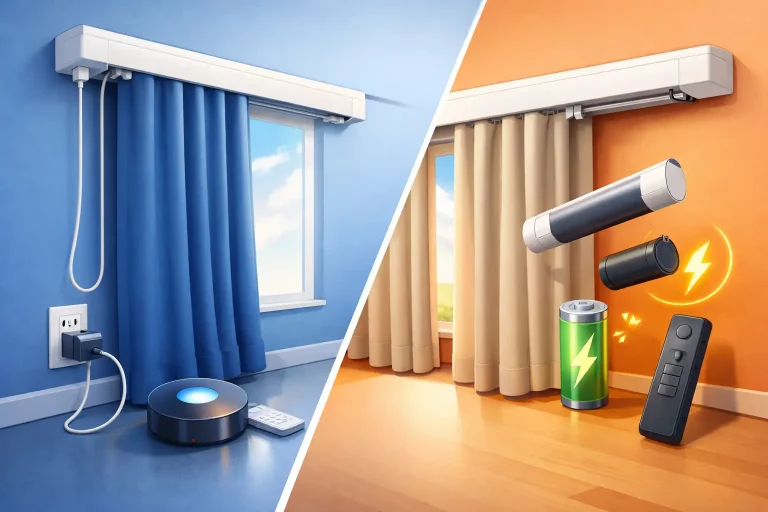
For smart-home control, it is sensible to decide early whether you want a wall switch, remote control, app scheduling or integration with a wider automation system. The track measurement itself does not change, but the power arrangement, motor position and installation sequence may do.
At Smart Curtains, dimensions can be checked as part of the planning process, with fitting drawings prepared for more involved layouts. This is particularly helpful for bays, ceiling recesses, corners and projects being coordinated with electricians or interior professionals.
A final check that protects the finished look
Before requesting a quote, read every number back against the room: left to right, track position, opening direction and curtain drop. If a dimension feels unusually tight, or one end is obstructed, flag it rather than rounding it up or hoping it will work on site. A made-to-measure electric curtain system should be planned around the room you have, giving you the quiet convenience, privacy and polished finish you want from the moment the curtains first move.