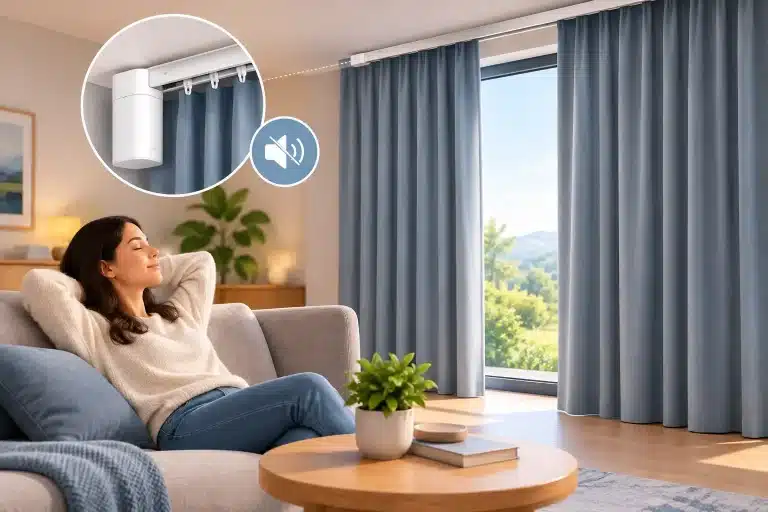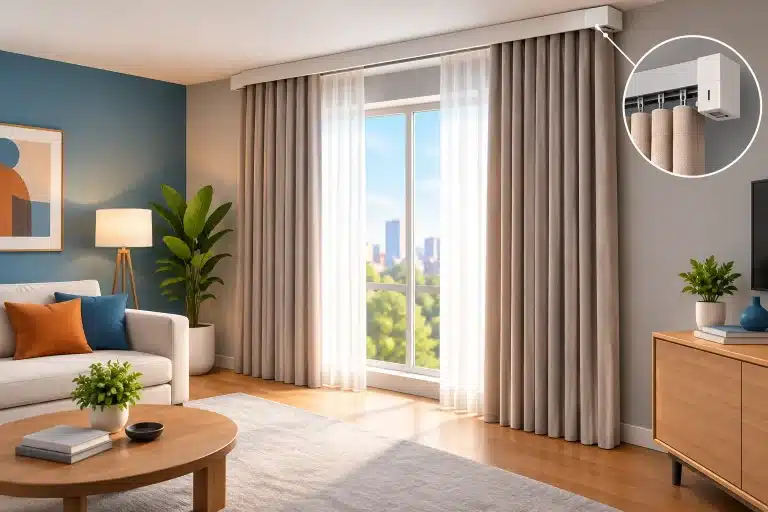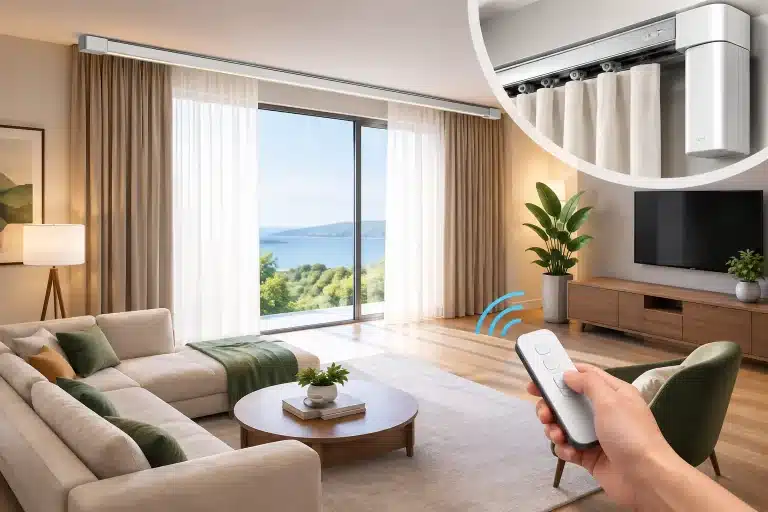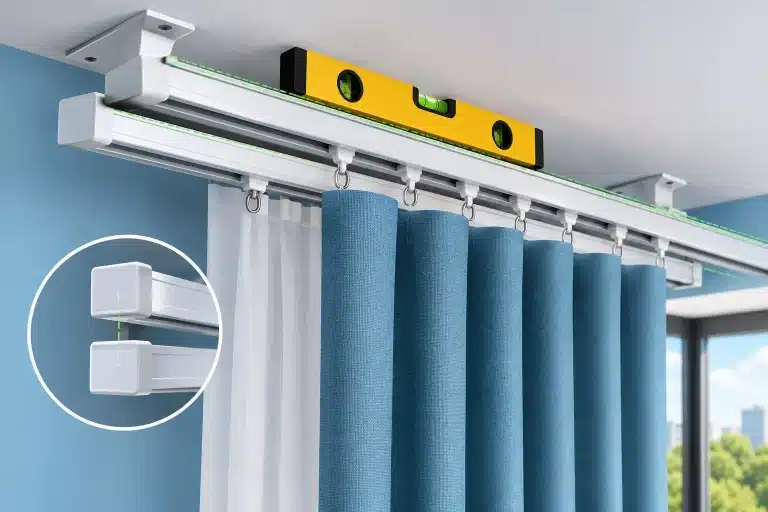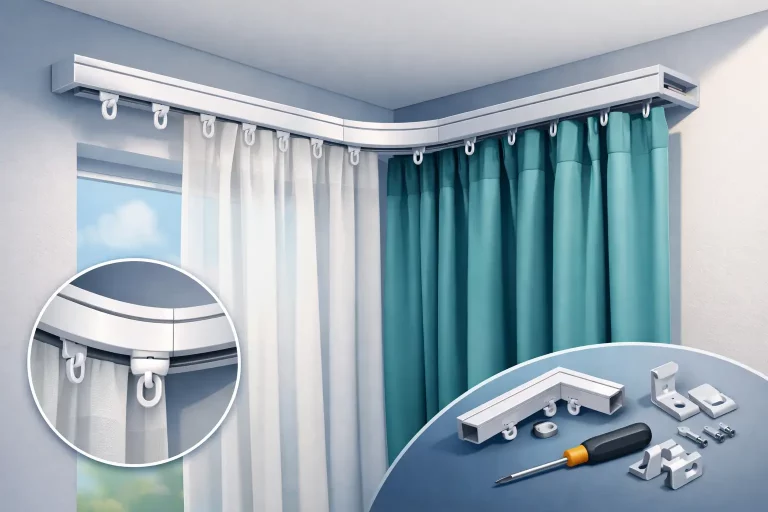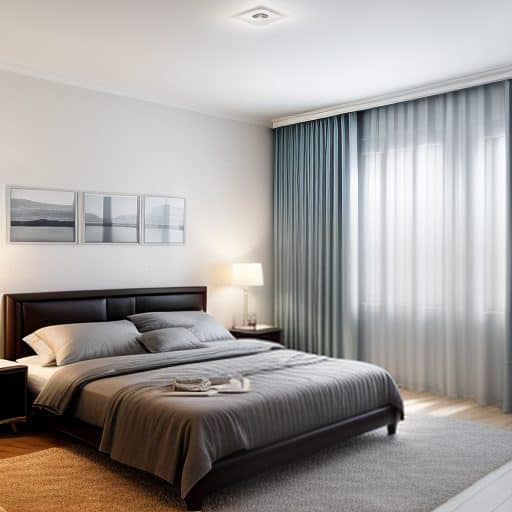
A wide glazed wall can be the best feature in a room – until heavy curtains are difficult to draw, stack awkwardly at the edges or leave gaps when closed. The right curtain track for wide windows turns that expanse of glass into something easy to manage, whether it is a wall-to-wall living room window, patio doors or a run of sliding doors. The answer is rarely an off-the-shelf rail. It is a well-planned, made-to-measure system that accounts for the span, fabric weight, fixing position and how you want to control it.
Thank you for reading this post, don't forget to subscribe!Why wide windows need more careful planning
A wider opening places more demand on every part of a curtain system. The track must stay level and properly supported across its full length. The gliders need to travel smoothly under the combined weight of the curtains. And the curtains themselves must stack back neatly without reducing light or obstructing a door.
This is why a long track is not simply a standard track with extra length added. A weak or poorly supported rail can bow over time, particularly with lined, interlined or blackout curtains. Joins can become noticeable in operation, and an unsuitable motor may struggle with a heavy treatment. These issues are avoidable when the layout is specified before the curtains and track are ordered.
For many homeowners, motorisation is particularly valuable on wide windows. One touch can open or close a large curtain span evenly, without reaching across furniture or pulling fabric by hand. Scheduled operation also makes the room feel lived in when you are away, while timed closing helps protect privacy after dark.
Choosing the right curtain track for wide windows
The best system depends on the shape of the opening, the intended curtain style and the structure available for fixing. A straight track across one wall is usually the simplest arrangement, but wide windows often include returns, corners, recesses or a change in ceiling level. Each detail affects the final track design.
Start with the finished curtain position
Before measuring, decide where the curtains should sit when they are open and closed. A ceiling-fixed track often gives a clean, contemporary appearance and can make the room feel taller. It also works well where the aim is to cover a wide wall from ceiling to floor.
Face fixing may be more appropriate where the ceiling construction is unsuitable or a pelmet and existing architectural features dictate the position. For recess-mounted curtains, the available depth matters. There must be enough room for the track, the curtain heading and the fabric to move without catching on handles, blinds or the window frame.
The track should normally extend beyond the glazed area, allowing the curtains to clear as much glass as possible when open. This is especially worthwhile on patio and bifold doors, where a poorly planned stack-back can reduce access or interrupt the view.
Consider the fabric weight, not just the window width
Width is only one part of the calculation. Full-length curtains in a dense blackout fabric, with lining and generous fullness, can be considerably heavier than lightweight sheers. The motor and track must be selected to suit the total curtain weight and the way the panels are configured.
A lightweight voile across a broad window may need a different solution from a pair of heavy, wave-headed curtains in a cinema room. The latter may need more powerful motor support and carefully positioned brackets. Specifying the track before the curtain maker confirms fabric quantities and heading style prevents unwelcome compromises later.
Plan how the curtains will open
Curtains can draw from the centre, stack to one side or use a split arrangement to suit doors and furniture. Centre opening is popular for symmetrical windows, while one-way opening can be useful when one side of the window needs to stay clear.
For exceptionally wide spans, a centre-opening layout can reduce the distance each curtain travels. It can also create balanced stack-backs at either end. However, it is not always the most practical option if a doorway, radiator, shelving or a fixed piece of furniture occupies one side. The correct choice should serve the room, rather than follow a standard layout.
Support, fixing and track joins
A made-to-measure track may require additional support points across a long run. These supports are not a drawback: they are part of creating a stable, durable installation. Their position should be planned around the track design and the structure above it, particularly where there is a ceiling void, plasterboard or a recessed lighting detail.
The fixing surface deserves attention early in a renovation. A solid timber noggin, suitable lintel or properly planned ceiling support gives installers a secure fixing point. If the room is still being built, coordinating the track position with the builder and electrician is far easier than adapting the design once the plastering and decorating are complete.
Long tracks may be manufactured in more than one section for transport and handling. With a quality system and correct installation, the join is designed to allow the curtain gliders to continue their travel smoothly. Yet it must be considered as part of the complete specification, rather than treated as an afterthought. The track route, number of brackets and motor position all need to work together.
Motorised control makes large curtains simple
The greater the curtain span, the more noticeable the benefit of electric operation. Instead of manually pulling a large volume of fabric each morning and evening, the curtains can be controlled using a wall switch, remote control or smartphone. Timers can follow your daily routine, opening the curtains in the morning and closing them at dusk.
For a connected home, some systems can also form part of wider smart home automation. That may mean curtains close when lighting scenes change, respond to a voice-controlled routine or operate alongside other home features. The level of integration is a personal choice. A simple remote-controlled system can be ideal for one household, while a renovation with central automation may call for a more coordinated approach.
Motor placement should be decided alongside the room layout. It needs a suitable power supply and should be positioned where it does not interfere with curtain stack-back, coving or other fittings. A discreet installation is entirely achievable, but it benefits from early planning.
Measurements that lead to a better fit
For wide windows, a single width measurement is not enough. The full track length, ceiling height, recess depth, wall returns, obstructions and preferred stack-back positions all contribute to the design. On bays, corners and offset runs, photographs and a simple sketch can be as useful as dimensions.
It is also sensible to check whether floors and ceilings are level. In older properties especially, small variations are common. Full-length curtains make these differences more visible, so the finished look may depend on how the track is set out rather than relying on one measurement taken at the middle of the window.
At Smart Curtains, installation planning and fitting drawings help turn these details into a clear, practical specification. This is useful whether you are working with an electrician, builder, curtain maker or fitting the system as part of a wider refurbishment.
Common mistakes to avoid
The most frequent mistake is leaving the track decision until after the curtains have been made. By then, the fabric weight, heading and finished drop may limit the options. Another is assuming every ceiling can carry a long, motorised track without checking the fixing structure.
Avoid positioning the track too close to the window where handles, blinds or deep window boards may obstruct the curtains. Equally, do not overlook where the fabric will sit when open. A beautiful wide window loses impact if the curtains cover a substantial portion of it throughout the day.
Finally, do not treat power as a last-minute detail. A mains-powered motor needs a planned electrical point, ideally concealed and accessible. Discussing this before first fix keeps the finished room tidy and avoids visible cables.
A wide window should feel effortless
Large windows bring light, views and a sense of scale. Their curtains should enhance those qualities, not become a daily chore. With the correct track layout, sufficient support and a motor matched to the fabric, opening and closing a broad expanse of curtains becomes quiet, controlled and dependable.
If you are planning a new extension, updating a glazed living space or refining a bedroom with wall-to-wall curtains, gather your dimensions, photographs and room plans early. A little specialist planning at that stage gives you more freedom over fabric, finish and control – and a result that looks considered from every angle.