A dark front room at 7pm every night can tell the wrong story. So can curtains that stay closed all weekend, or a bedroom window left exposed long after sunset. Automatic curtains for home security help you avoid those small signals that make a property look empty, predictable or overlooked.
Thank you for reading this post, don't forget to subscribe!For many homeowners, security upgrades start with cameras, alarms and smart locks. Those all have their place, but window management is often missed. Curtains affect what can be seen from outside, when a home appears occupied, and how consistently that pattern is maintained when nobody is there to do it manually. When handled properly, automated curtains become part of a wider security routine rather than a gadget added for novelty.
Why automatic curtains for home security make sense
Most opportunistic intrusion is exactly that – opportunistic. People notice routines. They notice homes that look unoccupied, and they notice windows that make it easy to see valuables, empty rooms or the absence of movement inside.
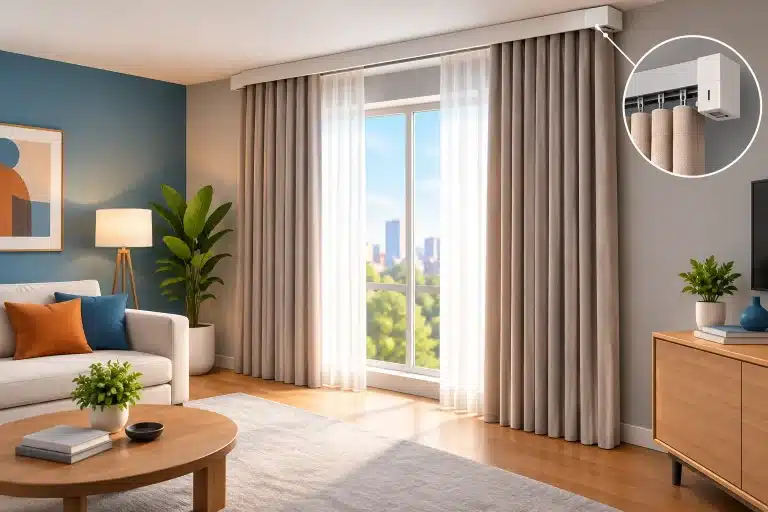
Automatic curtains address that in two ways. First, they improve privacy by controlling visibility into the home at the times it matters most, especially in the evening. Second, they help create a lived-in appearance by opening and closing on schedule, even when you are away.
That matters more than many people expect. A house that behaves normally is less likely to attract attention than one that clearly sits in the same state for days. Timed curtain movement can suggest occupancy without requiring lights to be left on unnecessarily or neighbours to intervene.
This is particularly useful during holidays, winter evenings and work travel, when patterns change and homes may be left unattended for longer periods. It is also helpful for everyday life. If curtains close automatically at dusk and open in the morning, privacy and presentation become consistent rather than dependent on whoever remembers first.
What automated curtains actually do in a security setup
Automated curtain systems are not a substitute for a proper alarm or physical security measures. They work best as a supporting layer. Their role is visual deterrence, privacy management and routine control.
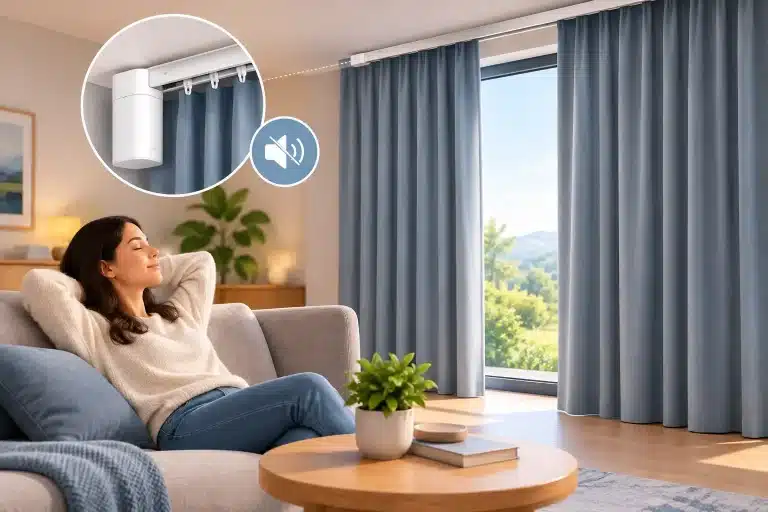
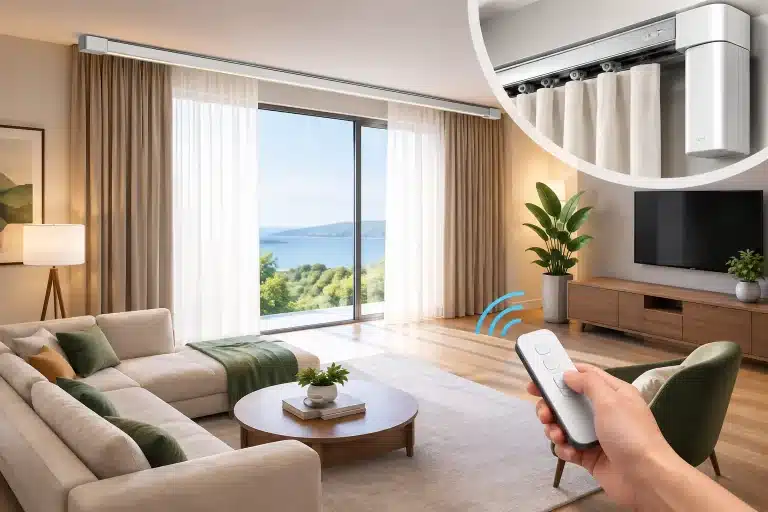
A good setup allows curtains to open and close by timer, wall switch, remote control or app, depending on how you want to use them. If integrated with a wider smart home system, they may also operate alongside lighting scenes or occupancy schedules. That gives you more than convenience. It gives you repeatability.
Repeatability is the real advantage. Manual habits are easy to break. You go away, stay out late, forget to close a room, or leave one side uneven because the track is awkward to reach. Automation removes those weak points.
In practical terms, homeowners tend to use security-focused curtain automation in three ways. Some want evening privacy every day without thinking about it. Others want the house to look occupied while they are away. A third group wants both, while also improving access for tall windows, bay arrangements or difficult-to-reach spaces.
The difference between basic automation and a well-planned system
Not every motorised curtain setup will give the same result. For security use, reliability matters more than novelty. If a curtain catches, leaves gaps, or fails to close properly because the track layout was poorly specified, the effect is weakened.
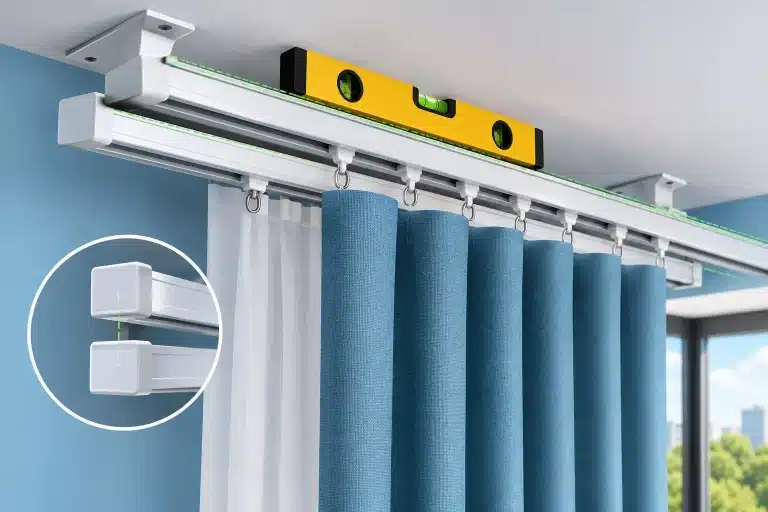
That is why made-to-measure planning matters. Curtain weight, stack-back, track shape, recess depth and whether the curtains meet cleanly in the centre all affect how well the system performs. In bay windows, corners or wall-to-wall installations, these details become even more important.
A well-planned system should close smoothly and consistently, with the curtain covering the intended area without manual correction. It should also suit the room. Security is stronger when the solution looks natural, works quietly and becomes part of the home rather than something improvised.
This is where specialist advice earns its place. A bespoke system is not just about getting a motor onto a curtain rail. It is about making sure the automation works with the actual room, the fabric and the way the home is used.
Choosing the right rooms first
If you are considering automatic curtains for home security, start with the rooms that matter most from the street-facing side of the property. Ground floor lounges, front-facing reception rooms and bedrooms visible from neighbouring homes are usually the most obvious priorities.
That said, the right choice depends on the layout of your property. Some homes are more exposed at the rear, particularly where gardens back onto shared access routes or open land. Others have large glazed areas where evening privacy is the main concern. In those cases, automated curtains can reduce visibility while still fitting neatly into a smart home routine.
There is also a strong case for prioritising rooms where manual curtain operation is inconvenient. If a curtain is hard to reach, behind furniture or simply awkward to use, it is less likely to be used consistently. Automation solves that, which strengthens the practical security benefit over time.
Smart timing matters more than constant movement
One common mistake is assuming more activity always means better security. It does not. Curtains opening and closing at odd times can look less natural than a simple, believable pattern.
The best approach is usually to mirror realistic household behaviour. That might mean opening curtains in the morning, closing them around dusk, and varying some timings slightly when you are away. If your system allows scheduled control through an app or integrated smart home platform, you can build those routines in advance.
For some households, pairing curtain movement with lighting makes the effect more convincing. A softly lit room with closed curtains in the evening can suggest normal occupancy without broadcasting the interior. In the morning, opening selected curtains can make the property feel active again.
It depends on the property and the season. In summer, very early opening times may not make sense if the household would normally still be asleep. In winter, a room left open after dark may expose too much. Good automation should reflect real living patterns, not a fixed rule copied from somewhere else.
Privacy, visibility and the limits of automation
Automatic curtains can improve security, but they are not a guarantee against unwanted attention. If a room is brightly lit and sheer fabrics are used, privacy may still be limited. If valuables are displayed clearly near uncovered side windows, the curtain schedule alone will not solve that.
Fabric choice matters. Fullness matters. So does overlap in the centre and return at the wall. These are not only decorative decisions. They affect how completely the window is screened.
There is also the question of power and control. Some homeowners prefer a straightforward remote and timer arrangement. Others want app control and integration into a broader smart home system. Neither is automatically better. The right option depends on how much flexibility you want and how comfortable you are managing devices and routines.
A simpler system may be ideal if the goal is dependable daily operation with minimal input. A more integrated setup may suit a renovation, a larger home or a household already using automation for lighting, heating or security. The key is not adding complexity for its own sake.
Why bespoke support makes the process easier
Security-focused curtain automation sounds simple at first, but specification can quickly become technical once real windows are involved. Recesses can be shallow. Bay windows need careful track planning. Ceiling details, pelmets and curtain headings all affect how the finished system performs.
That is why many homeowners prefer guidance rather than trying to piece everything together themselves. Having dimensions checked, layouts reviewed and fitting details considered early can prevent expensive mistakes later. It also helps if you are coordinating with an electrician, builder or smart home installer during a renovation.
For homeowners who want confidence before ordering, that consultative approach is often the difference between a system that merely works and one that feels properly integrated. Smart Curtains supports that process with made-to-measure planning and practical advice, which is especially useful where the window arrangement is more complex than a straight run.
A practical upgrade with everyday value
The strongest case for automated curtains is not fear. It is consistency. You get regular privacy, a more lived-in appearance when the house is empty, and easier control day to day. Security improves because the home behaves as though someone is there and because visibility into key rooms is better managed.
That sits alongside other benefits homeowners already value: convenience, accessibility, reduced strain and a more polished finish across the room. In other words, this is one of those upgrades that does more than one job well.
If you are already investing in your home, it makes sense to choose systems that improve how the house feels while also supporting how it protects itself. Automatic curtains are not the whole answer to home security, but in the right rooms, with the right planning, they are a very sensible part of it.
The best security features are often the ones that become part of normal life so naturally that you would not want to go back.