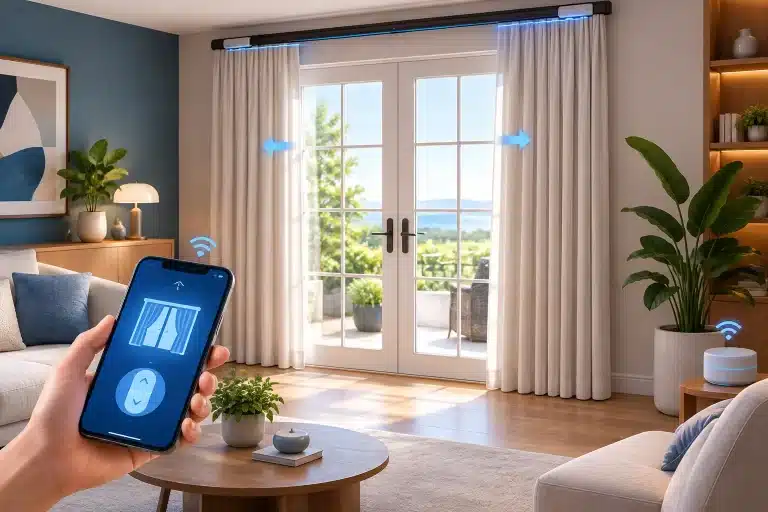
French doors are designed to bring in light and create a generous connection to the garden, terrace or balcony. That openness is lovely until you are reaching across furniture to close heavy curtains every evening, or leaving the house wondering whether the room is on display. Learning how to automate French doors turns a small daily task into a planned part of how your home works.
Thank you for reading this post, don't forget to subscribe!For most homes, the answer is not a motor fitted to the door itself. It is a made-to-measure motorised curtain track, positioned above the doors and controlled by a wall switch, remote, mobile phone or wider smart home system. The right arrangement depends on the door opening, the space above it, your curtain style and how you want to use the room.
How to Automate French Doors: Start With the Track Layout
A motorised curtain track allows curtains to open in the morning and close at the touch of a button, to a timer or as part of an automation routine. For French doors, the track is normally fitted above the full opening so the curtains can stack clear of the glazed doors when open.
The simplest layout is a straight, wall-to-wall track with curtains that meet in the middle and draw to each side. This gives a balanced look and keeps the centre of the doors clear. In some rooms, however, there may only be suitable stacking space on one side. A single-draw arrangement can work well where furniture, a return wall or a radiator makes a pair of curtains impractical.
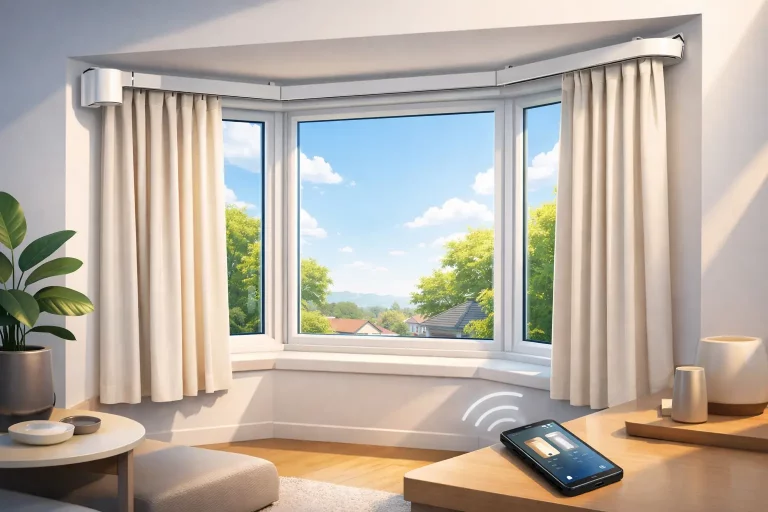
Where French doors sit within a bay, near a corner or beneath a low ceiling, the planning becomes more specific. A bent, corner or offset track may be needed to preserve access to the doors and give the curtains somewhere sensible to park. This is where a standard, off-the-shelf rail can lead to compromises in coverage or appearance. A bespoke track can follow the room rather than asking the room to work around it.
Check the clearance before choosing a system
Start by looking at the space above and around the doors. You need room for the track, curtain heading and the curtain stack when open. If the doors open inwards, check that the chosen fabric and heading will not interfere with handles or the door swing. If they open outwards, consider whether a curtain stack will restrict the route to the garden when the curtains are drawn back.
Also think about adjacent features. A tall cabinet, a wall-mounted television, a pelmet, coving or a ceiling beam can all affect where the track sits. The motor itself needs a discreet but accessible position, usually at one end of the track. Planning this before decorating or fitting joinery avoids expensive alterations later.
Measure for Coverage, Not Just the Door Frame
The visible door frame is only one part of the measurement. To block light effectively and maintain privacy, curtains should extend beyond both sides of the glazed area. A wall-to-wall track is often the best option because it creates a more finished look and gives curtains maximum stacking space.
Measure the intended track width, not simply the width of the French doors. Then measure the drop from the proposed track position to the floor, allowing for the curtain heading you plan to use. Whether you prefer a neat floor clearance, a light break on the floor or a more luxurious pooled finish is a design choice, but it should be agreed before curtains are made.
For recesses, bays and corners, photographs and clear dimensions are particularly useful. The most accurate installations come from checking the measurements against a fitting drawing before the system is made. It gives you an opportunity to confirm motor position, bracket locations, track direction and the final stack-back before anything arrives.
Choose a Power and Control Method That Suits Your Home
Most automated French door curtains use a mains-powered motor. This is a reliable choice for larger or heavier curtain runs and suits homeowners who want regular timed operation. Ideally, the power supply is planned while building work or redecoration is underway, with a switched fused spur positioned close to the motor end of the track.
If the room is already finished, do not assume automation is out of reach. Depending on the system and installation, cable routing can sometimes be planned discreetly through a ceiling void, alongside existing features or within a purpose-made recess. The practical question is not just whether power is available, but whether it can be provided in a way that keeps the finished room looking considered.
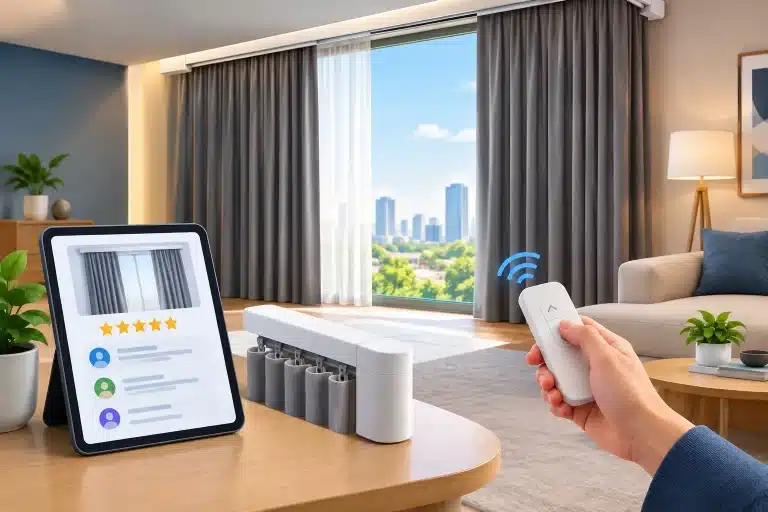
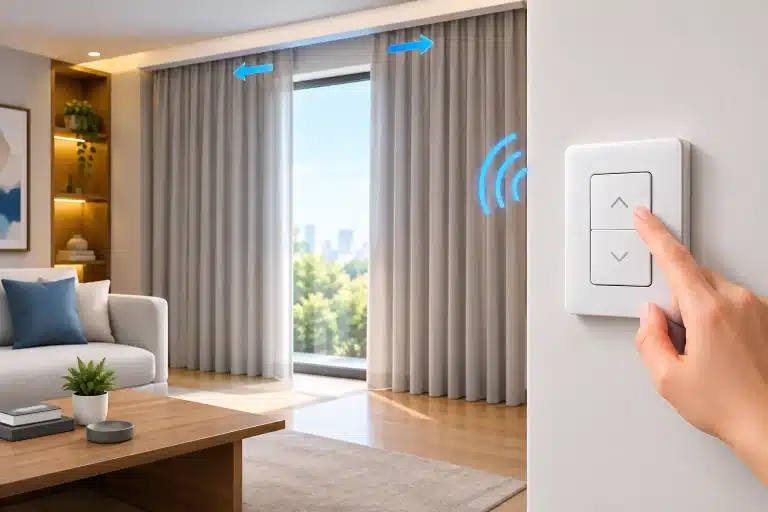
Control should reflect how you live. A remote control is straightforward and familiar, while a wall switch gives a dependable, fixed point of control by the door or room entrance. Mobile phone control is useful when you want to operate the curtains from elsewhere in the house or while away. For a connected home, integration can allow the curtains to work alongside lighting, heating and voice control.
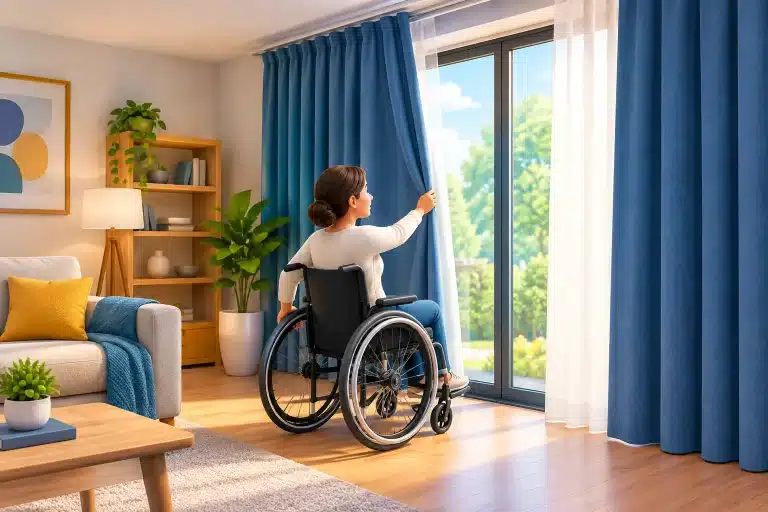
There is no need to add every control option. A family room may benefit most from a simple wall switch and timer, while a principal bedroom may suit scheduled opening and closing. If accessibility is a priority, placing a switch at a convenient height or using voice and app controls can make French doors far easier to manage independently.
Use Automation for More Than Opening and Closing
The real value of automated curtains is in the routine. A timer can close curtains at dusk during the darker months, reducing the feeling of an exposed room without anyone having to remember. They can open at a chosen time in the morning, bringing natural light into a kitchen or living area before the household is fully awake.
When you are away on holiday, scheduled operation can also make a home appear occupied. It should not be treated as a replacement for proper home security, but it is a sensible additional layer that avoids curtains remaining in exactly the same position for days.
For rooms that become warm in direct sun, closing curtains during the brightest part of the day can help manage glare and protect furnishings from fading. The result depends on fabric choice, lining, glazing and the orientation of the room, so it is worth setting expectations realistically. Curtains will improve comfort, but they are not a substitute for external shading where solar gain is severe.
Select Curtains That Work Well With a Motorised Track
Motorised tracks are designed to handle substantial curtains, but the fabric and heading still matter. Heavy interlined curtains, wide spans and very full gathers increase the load on the system. A correctly specified motor will account for this, whereas underestimating the total weight can make operation slower or less satisfactory over time.
Wave headings are a popular choice for French doors because they create a clean, even ripple and move predictably along the track. Pencil pleat and pinch pleat curtains can also be suitable when specified with the correct carriers and hook positions. The best option is partly aesthetic and partly practical: a more decorative heading may require more allowance above the glass and more room when stacked back.
Consider the fabric’s purpose as well. A lined curtain can improve privacy and help reduce draughts around older doors, while a blackout lining may be useful in a bedroom. In a bright garden room, a lighter fabric may preserve the airy feel of the doors while still softening glare. The motor and track should be chosen around the finished curtain specification, rather than treating the curtains as an afterthought.
Plan Installation Alongside Other Works
Automating French doors is easiest when it is considered alongside electrical work, plastering, decorating or a renovation. The electrician needs to know the proposed motor location and power requirement. Your curtain supplier or installer needs confirmed measurements, ceiling details and any information about coving, recesses or obstructions.
This coordination matters even more with ceiling-mounted tracks. The fixing surface must be sound enough for the brackets and the weight of the curtains. If a recess or pelmet is being built, it needs sufficient depth and access for fitting and future servicing. A narrow detail may look tidy on a drawing but leave no room for the motor or the curtain heading to operate freely.
Smart Curtains supports this planning process with made-to-measure track layouts and fitting guidance, helping homeowners, builders and electricians work from the same specification. It is a more reliable route than choosing components in isolation and hoping they align on site.
A Better Way to Live With French Doors
The best automated French door setup should feel almost unnoticeable. Curtains open when you want daylight, close when you want privacy and remain easy to control even when your hands are full or mobility is limited. The key is not choosing the most complicated technology, but matching the track, fabric, power and controls to the room from the outset.
If you are planning new curtains or renovating the space around your French doors, take a little time to assess the whole opening rather than just the glass. A properly planned motorised track can give the room a calmer, more polished finish every day.