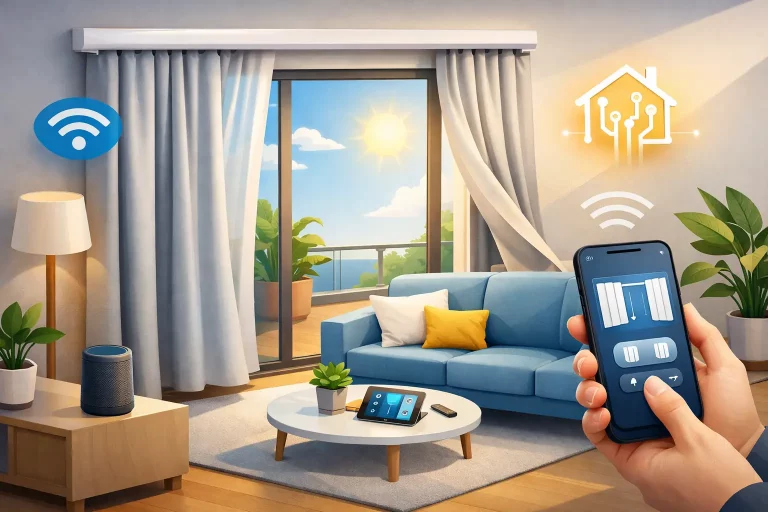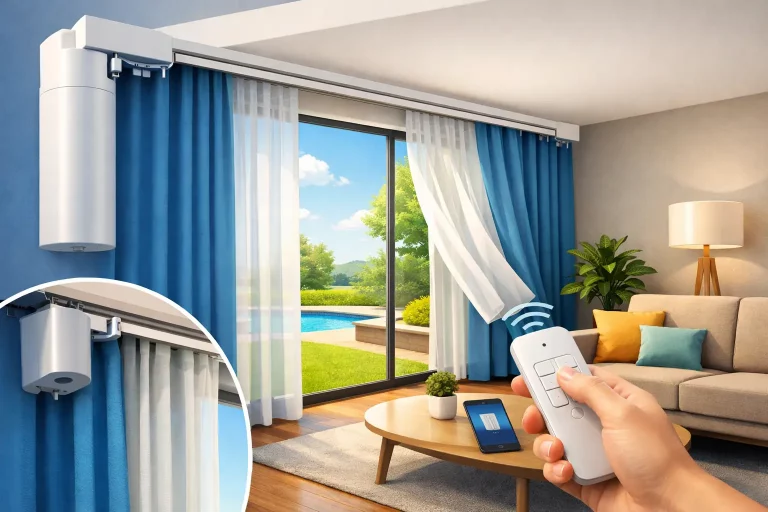
A curtain track can look beautifully simple once it is installed, but the control method chosen behind the scenes affects how it behaves every day. When considering Zigbee versus WiFi curtain control, the better option is not simply the one with the longest feature list. It is the one that suits the size of your home, the smart devices you already use and the level of control you expect from your made-to-measure curtains.
Thank you for reading this post, don't forget to subscribe!For some homeowners, pressing a button in an app is all that is needed. For others, curtains need to respond reliably to a voice command, a wake-up routine, dusk, occupancy or an alarm setting. Understanding the difference before specifying a motor and track helps avoid unnecessary compromises later.
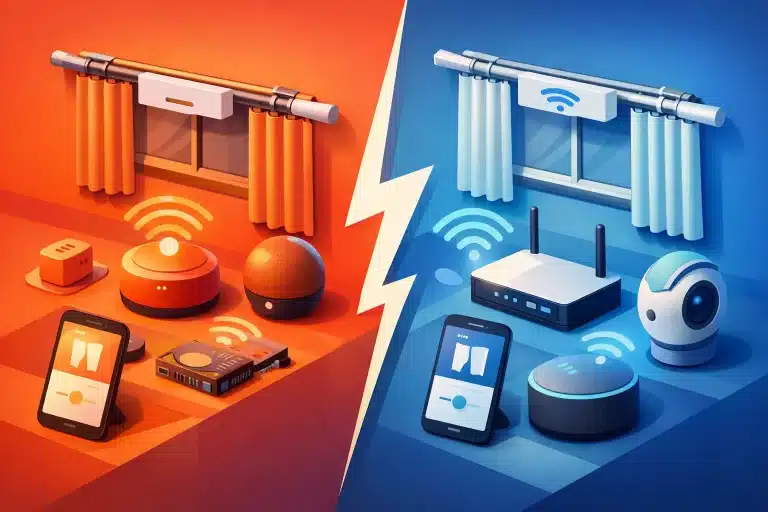
Zigbee versus WiFi curtain control: the key difference
WiFi curtain control connects a motor, bridge or controller to your home WiFi network. It can normally be operated through the manufacturer’s app, and often through wider smart-home platforms where compatibility is provided. Its appeal is familiar: most homes already have WiFi, and a straightforward setup may not require a separate smart-home hub.
Zigbee is a low-power wireless protocol designed for smart-home devices. Rather than each device relying solely on the router, Zigbee devices can communicate through a dedicated hub or controller. Many mains-powered Zigbee products also help form a mesh network, passing signals onwards to improve coverage across a larger property.
That distinction matters most when several automated devices are working together. A single pair of curtains near the router may be perfectly happy on WiFi. A home with smart lighting, sensors, blinds, heating controls and multiple curtain tracks may benefit from Zigbee’s purpose-built approach.
Neither choice changes the value of a properly specified curtain system. The track still needs to suit the weight and fullness of the curtains, the stacking arrangement, the window shape and the available fixing position. Wireless control is one part of the overall design, not a substitute for careful planning.
When WiFi curtain control makes sense
WiFi is often the practical choice for a homeowner who wants app-based operation without building a wider automation system. If the signal is strong where the motor or controller will sit, it can offer convenient scheduling and remote control from a phone. This is especially useful for opening curtains before getting out of bed, closing them in the evening, or checking that rooms look occupied while you are away on holiday.
It can also be a sensible solution in a smaller flat, a straightforward refurbishment or a home where the router is centrally located and the number of connected smart devices is modest. There is less to explain to guests and family members who are already comfortable using a familiar app.
WiFi does have limits to consider. A busy household may already have phones, televisions, speakers, cameras, laptops and appliances competing for wireless capacity. Modern routers cope well with many devices, but signal quality is not equal in every room. Thick walls, foil-backed insulation, large mirrors, steelwork and distance from the router can all affect performance.
It is worth avoiding the assumption that WiFi means no planning. Some curtain systems require a compatible app, a bridge or a particular network band. Many smart-home products work on 2.4 GHz WiFi rather than 5 GHz, which can catch people out during installation. Checking these details at the quotation and planning stage is far easier than troubleshooting them after the decorators have left.
Why Zigbee appeals in a connected home
Zigbee is particularly attractive where curtain automation is part of a broader smart-home plan. It is designed for short, regular commands such as open, close, pause and set-position, rather than high-bandwidth tasks such as video streaming. That makes it well suited to sensors, switches, lamps and window treatments working as part of one coordinated system.
A Zigbee mesh can be helpful in larger homes, properties with more challenging layouts or rooms that are distant from the internet router. The actual result depends on the placement and number of compatible mains-powered Zigbee devices, so it should not be treated as a cure for every coverage issue. However, it can provide more flexible coverage than asking one WiFi router to reach every corner of a house.
Zigbee also commonly uses a hub. This is an extra item to purchase, position and maintain, but it has advantages. The hub can create a central place for automations and keeps the curtain system separate from the general demands placed on your WiFi. In the right setup, commands and schedules may continue to work locally even if the broadband connection drops, although this depends on the specific hub, motor and automation platform.
The trade-off is compatibility. Zigbee is a protocol, not a guarantee that every Zigbee-branded device will offer every feature together. Before choosing a motor, confirm whether it works with your intended hub, whether opening percentages are available, and whether it can take part in the scenes or routines you want to use. A simple “close curtains” command is not the same as reliable control of several rooms at different times and positions.
Consider the home, not just the technology
For a single living-room track, a dependable remote and wall switch may matter more than whether the system uses Zigbee or WiFi. For a renovation with curtain tracks in bedrooms, a media room and wide glazing, centralised automation may be worth specifying from the start.
Think about the people using the home too. Physical wall control remains valuable for children, visitors and anyone who does not want to reach for a phone. It is also an excellent accessibility feature for people with restricted mobility. Voice and app control are useful additions, but the most comfortable homes offer more than one easy way to operate the curtains.
Reliability is about the whole installation
The most reliable setup is rarely the one with the most advanced label. It is the one with a suitable power supply, a carefully routed track, sensible wireless coverage and controls that are correctly paired and tested. If a motor is mains powered, arrange the electrical provision early, particularly where the track is recessed into a ceiling or hidden behind a pelmet.
Curtain design has a practical role here as well. A heavy, lined curtain on a long wall-to-wall track needs a motor and track system suited to that load. Bay windows, bends, corners and offset layouts require accurate drawings so that the curtains stack where expected and do not conflict with radiators, furniture or window handles. A control protocol cannot compensate for a track that has been chosen without considering the room.
There is also a distinction between internet access and local control. WiFi systems may rely more heavily on the router and, in some cases, a cloud service for remote functions. Zigbee systems may use local hub-based communication for everyday commands. Product design varies, so ask what happens if broadband is unavailable, whether manual operation is possible, and how the system behaves after a power cut.
Security, privacy and updates
Remote curtain control can support security by making an empty home appear lived in. Timed opening and closing should look natural rather than following exactly the same pattern every day. Pairing curtain operation with lighting scenes can make the effect more convincing.
As with any connected home device, account security matters. Use a strong, unique password for the relevant app, protect your home WiFi with current security settings and keep the router, hub and apps updated. If you choose WiFi, consider whether the manufacturer requires a cloud account for remote access. If you choose Zigbee, confirm how the hub is managed and updated.
The objective is not to make a home overly complicated. It is to choose a system with a level of connectivity you are happy to live with, then have it installed and configured in a way that remains understandable months later.
Which option should you choose?
Choose WiFi curtain control when you want a straightforward app-led system, have dependable coverage at the window and do not need a large network of connected devices. It can be an excellent fit for one or two rooms and for homeowners who value simple remote scheduling.
Choose Zigbee when you are building or expanding a smart home, expect to use sensors and scenes, or want a dedicated low-power network for several devices. It is often the stronger long-term choice for larger projects, provided the chosen hub and automation platform are confirmed before purchase.
For many homes, the decision should start with the desired everyday experience: a bedside button, a hallway switch, sunrise opening, privacy at dusk, voice control, or all of these together. Smart Curtains can help turn that requirement into a made-to-measure track layout, a practical power plan and a control specification that feels effortless to use. The right system is the one you will barely think about, because your curtains simply move when and how you need them to.