A corner window can be one of the most striking features in a room, until standard curtain poles leave a gap at the corner or force two curtains to stop short of each other. The best tracks for corner windows are designed around the exact angle, the available fixing surface and where the curtains need to stack when open. With the right layout, the curtains travel neatly around the turn and the finished result looks intentional rather than improvised.
Thank you for reading this post, don't forget to subscribe!For motorised curtains, planning matters even more. The track shape affects how smoothly the curtain moves, where the motor sits and whether the fabric can clear the glazing without catching on a sill, handle or radiator. A made-to-measure solution removes much of this uncertainty before fitting begins.
What makes a corner window track work well?
A corner track needs to do more than follow the wall. It must support the weight of the curtains, allow the runners to pass through or stop at the corner as intended, and leave sufficient room for a tidy curtain stack at each end.
The first question is whether the curtains should operate as one continuous treatment or as two separate runs. A continuous track takes the curtain around the corner, which can create a particularly elegant look on an L-shaped glazed wall. Separate tracks are often preferable where each window needs independent privacy or daylight control, or where the corner is obstructed by a structural column, cabinet or opening window.
The angle itself also determines the specification. Many corners are close to 90 degrees, but few properties are perfectly square. Older homes, extensions and architect-designed spaces can all have angles that need checking rather than assuming. Measuring the actual wall line is far more useful than relying on a plan alone.
The main corner track options
Curved motorised tracks
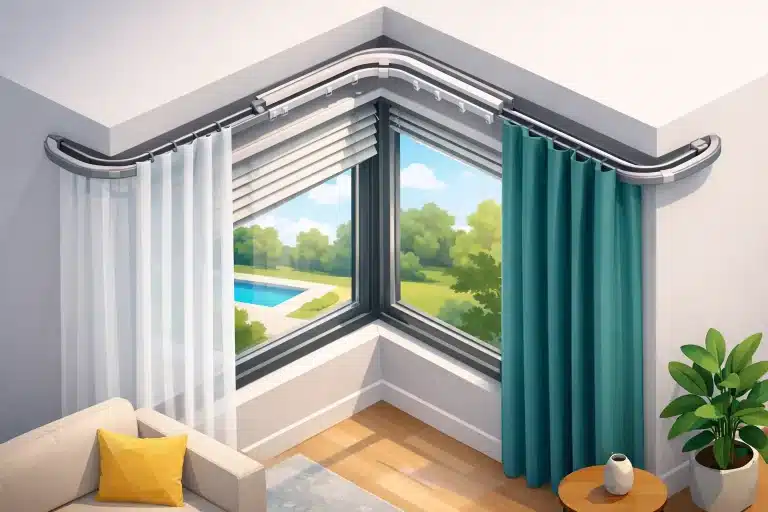
A curved track is often the most refined option for a corner window. Rather than creating a sharp change in direction, the aluminium track is formed into a gradual radius. This allows the runners to travel smoothly around the bend and gives curtains a softer, more continuous line.
This approach works particularly well for glazed corners, bay-style returns and rooms where the curtains will be opened and closed frequently. It is also a strong choice for heavier fabrics, as a gentle curve places less strain on the carriers than a tight turn.
The trade-off is space. A curve needs enough room either side of the corner, and the curtain will follow that radius rather than sitting tightly into the angle. In a compact recess or a narrow side return, a curved layout may not be practical.
Angled tracks with a corner join
For a crisp 90-degree layout, two straight track sections can be joined at the corner. Depending on the system and intended operation, the curtains may stop at either side of the join, or specialist components may allow carriers to continue through it.
An angled track can suit contemporary interiors with clean architectural lines, especially where a true curved track would project too far into the room. It is also useful when two sets of curtains need to be controlled independently, such as a living room corner where one side faces a garden and the other overlooks a neighbouring property.
However, not every corner join is suitable for curtains to travel across. This is one of the details worth confirming at the planning stage. If a single curtain needs to pass around the corner, the bend, carrier type and fabric weight must all be compatible.
Two independent straight tracks
Two separate straight tracks are the simplest answer when each side of the corner has a different purpose. You might want blackout curtains on bedroom glazing and a lighter decorative curtain on an adjacent side window. Equally, a patio door may need a different opening arrangement from a fixed pane beside it.
Separate tracks offer clear control and straightforward installation. They can each have their own motor, remote channel or smart-home routine. The visual compromise is that the curtains do not form one unbroken run through the corner. With careful fabric choice and stack positioning, though, this can still look polished.
Choosing between ceiling and wall fixing
Where the track is fixed changes the look of the entire window treatment. Ceiling fixing is often ideal for corner windows because it gives the track a clear route around the room and allows full-height curtains to make the space feel taller. It can also conceal the track more effectively, particularly if it sits behind a pelmet or within a ceiling recess.
Wall fixing may be the better option where the ceiling is not suitable for secure fixings, where there is a deep ceiling feature, or where the curtain needs to sit forward of a projecting window board. The brackets must be positioned carefully around the bend, with enough support to prevent movement under the weight of the fabric.
It depends on the construction of the room. Plasterboard ceilings, steel lintels, boxed-in services and recessed lighting can all influence the fixing method. This is why fitting drawings and a review of site photographs are useful before ordering a bespoke motorised track.
Plan the curtain stack before finalising the track
The most common disappointment with corner curtains is not the bend itself. It is discovering that the open curtains cover too much glass. Every curtain needs somewhere to stack, and thicker lined or blackout fabrics need more room than lightweight sheers.
For a corner layout, decide where each curtain will park when open. It may stack away from the corner at the outer ends of both windows, or one curtain may draw around the bend and stack on a longer wall section. The preferred arrangement depends on which view you want to preserve and how the room is used.
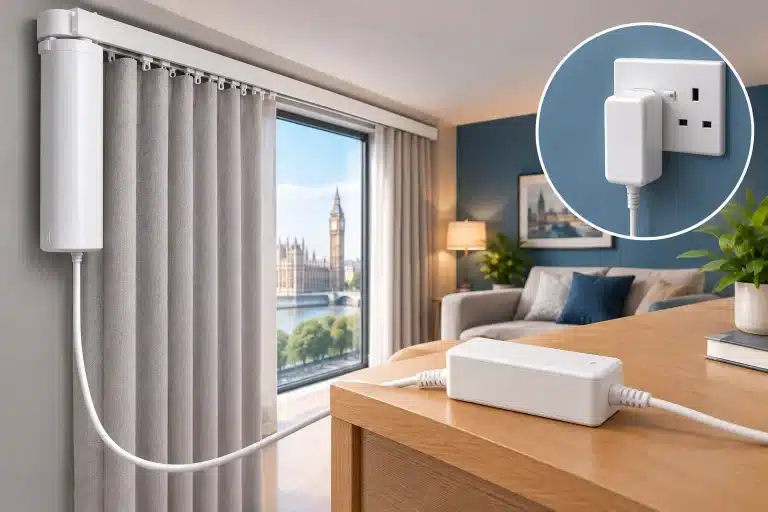
Motor position should be considered at the same time. A motor may sit at one end of the track, but it needs clearance for installation, future access and a sensible cable route if mains power is being used. Hiding the motor is achievable in many schemes, but it should never mean making maintenance unnecessarily difficult.
Fabric weight, heading and daily use
A quality motorised track can handle substantial curtains, but fabric still affects the specification. Interlined drapes, wide pinch pleats and full blackout linings create a more luxurious finish while increasing the load and the amount of stacking space required. A long corner run may also need more brackets and a motor selected for the total curtain weight.
For a relaxed, lighter treatment, wave heading often complements a curved corner track beautifully. The folds remain even as the curtain follows the track, creating a clean and contemporary appearance. Pencil pleat and pinch pleat curtains can also work well, provided the heading, hooks and carrier spacing are planned for the chosen system.
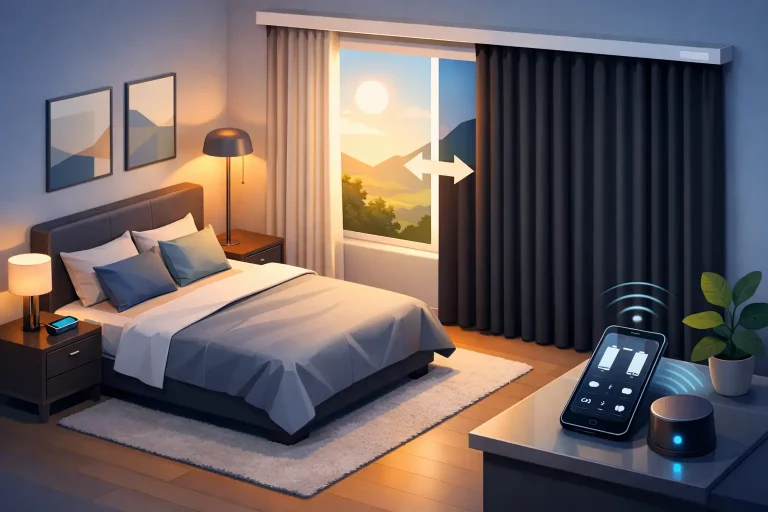
Think about how the room works day to day. In a family kitchen-diner, automation can open the curtains in the morning and close them at dusk without anyone reaching around furniture. In a bedroom, a timer can support a gentler wake-up routine. For homeowners with restricted mobility, motorised operation makes even a large corner arrangement practical to use every day.
Smart control for a corner curtain layout
Corner windows often involve more than one track, which makes flexible control especially valuable. Two tracks can be operated together for a whole-room scene, separately for targeted privacy, or scheduled to move automatically at set times.
A wall switch provides a familiar, simple option near the entrance to the room. Remote controls are convenient from the sofa or bed, while smartphone control helps when you are away from home. Integration with a wider smart-home system can coordinate curtains with lighting, heating or security routines.
The best control method is the one that fits your household rather than the one with the longest feature list. A straightforward remote may be perfect for one room; a fully integrated system may make more sense during a larger renovation with an electrician and smart-home installer already involved.
Measurements that should be checked early
Corner window tracks should be measured as a layout, not as two unrelated window widths. The overall run, corner angle, track projection, fixing positions and stack-back areas all need consideration. It is also wise to check for opening casements, door handles, radiators, cabinetry and air vents before setting the track position.
If the track sits in a recess, confirm the recess depth and any unevenness in the walls or ceiling. If it is face-fixed, establish how far forward it must sit for the curtains to clear obstructions. A few millimetres can make a difference where the track turns close to glazing or a side wall.
At Smart Curtains, this planning can be supported with dimension checks and fitting drawings, helping homeowners, builders and electricians work from the same arrangement before the track is made.
A well-planned corner curtain system should make the architecture feel calmer, not more complicated. Start with the way you want the curtains to open, the view you want to keep and the fixing space available, then let the track layout follow those practical decisions.