A recess can make curtains look beautifully considered: fabric sits close to the window, light is better controlled and the room retains clean wall lines. But choosing curtain tracks for recesses is not simply a case of measuring the opening and ordering a track to match. The track position, curtain stack, window handles and motor location all need to work together before anything is made.
Thank you for reading this post, don't forget to subscribe!For a motorised system, good planning matters even more. A made-to-measure track should open and close reliably every day, without curtains catching on a handle, blocking access to a window or leaving an awkward gap at the side. A few decisions at the survey stage can make the difference between a polished finish and a compromise you notice every morning.
Start with the recess, not the curtain fabric
The first question is whether the curtains are intended to sit inside the recess or cover it from the wall in front. Both approaches can work, but they produce different results.
An inside-recess track is often chosen where there is sufficient depth and a crisp, fitted appearance is the priority. It can be particularly effective for modern windows, deep reveals and rooms where a wall-to-wall curtain is not required. The track is usually fixed to the recess ceiling or lintel area, depending on the construction and available clearance.
A face-fixed track positioned outside the recess gives more freedom. The curtains can overlap the opening at each side, helping to reduce light gaps and allowing them to clear the window more fully when open. This is often the better choice for shallow recesses, outward-opening windows, prominent handles or heavy fabrics.
There is no universal right answer. The best position depends on what is inside the recess and how you want the curtains to behave, not only how the window looks from the front.
Choosing curtain tracks for recesses with enough depth
Recess depth is the most useful measurement to establish early. Measure from the front edge of the recess to the furthest projecting point within it. This may be a handle, trickle vent, blind, radiator shelf or window board rather than the glass itself.
A track and curtain heading need space to operate. Even a slim motorised track has a physical depth, while the curtain heading and fabric will project forwards as it gathers. If the track is too close to a window, the curtain may rub against handles or fail to hang naturally. If it is too far forward, it can look visually disconnected from the opening.
As a practical principle, allow clearance between the curtain and anything it must pass. That includes decorative handles which may be used only occasionally. A system that works when the window is shut but catches whenever ventilation is needed will quickly become frustrating.
The type of heading also affects the space required. Wave curtains create a smooth, contemporary ripple but need room for the fabric to travel. Pencil pleat and pinch pleat headings have their own projection and stacking characteristics. The chosen fabric can add further bulk, especially with blackout lining or interlining.
Plan where the curtains will stack
When curtains open, the fabric does not disappear. It gathers at one or both ends of the track, creating a stack that needs somewhere to sit. In a narrow recess, this can reduce the visible glass area or obstruct part of the frame.
For a centre-opening arrangement, each curtain stacks at its respective side. With one-way opening, all fabric stacks on one side, which can be useful where one side has more wall space or where access is needed at the other end. However, a one-way system concentrates the full fabric bulk in one place.
Consider the view when curtains are open, especially for patio doors, French doors and windows where natural light is a priority. If the fabric stacks within the recess, it may cover more of the opening than expected. Extending the track beyond the recess is often the neatest way to keep the glass clearer, provided there is suitable wall or ceiling fixing space.
This is also where made-to-measure advice is valuable. Curtain width, heading style, fabric fullness and the desired opening direction all influence the finished stack. A track length alone does not tell the whole story.
Choose the fixing position carefully
Most recess installations use either top fixing into the recess ceiling or face fixing to a vertical surface. The right method depends on the structure above the window and the clearances around it.
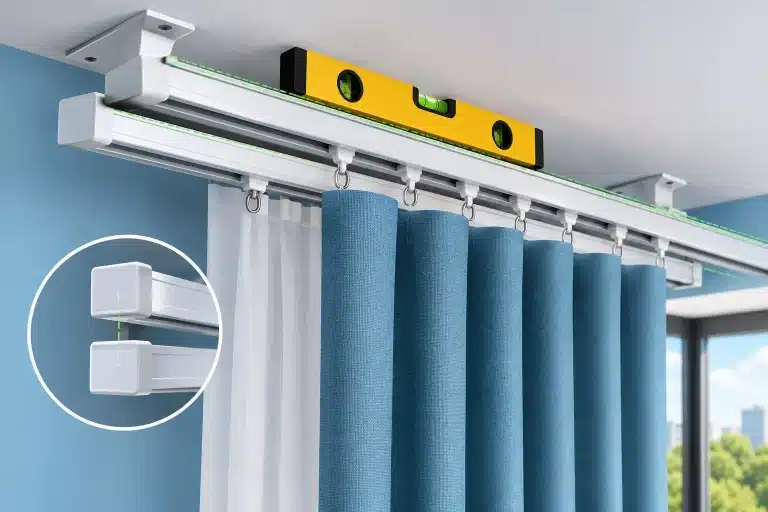
Top fixing can give a discreet appearance, particularly when the track sits close to the upper recess line. It is a strong option where there is a sound, level fixing surface and sufficient recess depth. Before choosing it, check for steel lintels, uneven plaster, concealed services and any limitation on screw depth.
Face fixing may be more practical where the recess ceiling is shallow, unsuitable for fixings or occupied by a blind. A face-fixed bracket can bring the track forward to clear obstructions, but it needs to be positioned accurately so the curtains fall correctly and do not catch on the sill or handles.
For new-build, renovation and extension projects, discuss the track early with the builder or electrician. A simple allowance for a secure fixing zone and a nearby power supply can avoid visible wiring and last-minute adjustments later on.
Decide where the motor will sit
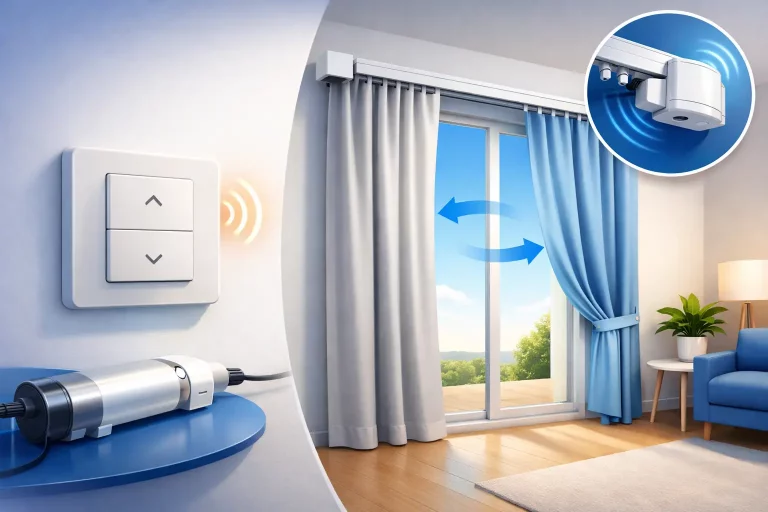
A motorised curtain track needs a motor at one end, so it is not perfectly symmetrical in the way a manual pole may be. The motor should be planned around the room, the power source and the direction in which curtains will stack.
Where possible, place it where it is discreet and does not interfere with adjacent cabinetry, pelmets or corner returns. For some layouts, the motor can sit beyond the recess on a return wall. In others, it must remain within the recess footprint, which may influence whether a left-hand or right-hand motor position is preferable.
Think about future access too. Motors are designed for everyday use, but the location should not be permanently boxed in without sensible provision for servicing. This is especially relevant where a ceiling detail, joinery or decorative pelmet is planned around the track.
Mains-powered systems require a suitable electrical connection. Battery options can suit certain applications, but for larger, heavier or frequently used curtains, a professionally planned mains supply is often the most convenient long-term choice. The best route depends on the track length, curtain weight, room use and the wider smart home setup.
Do not overlook blinds, radiators and ventilation
Recesses often contain more than a window. A roller blind, Venetian blind or plantation shutter may already occupy the front part of the reveal. Layering curtains with a blind can look excellent and improve privacy or blackout performance, but each treatment needs its own operating clearance.
Radiators deserve attention as well. Curtains that fall directly in front of a radiator are common, but they can affect how heat moves into the room. Where a recess has a projecting radiator or shelf, the track may need to sit further forward, or the curtain arrangement may need reconsidering.
Trickle vents and opening sashes can be easily missed during measuring. If curtains are intended to remain closed overnight, make sure the ventilation strategy still works for the room. The aim is not simply to fit a track into the available space, but to preserve how the window and room need to function.
Measure more than once before ordering
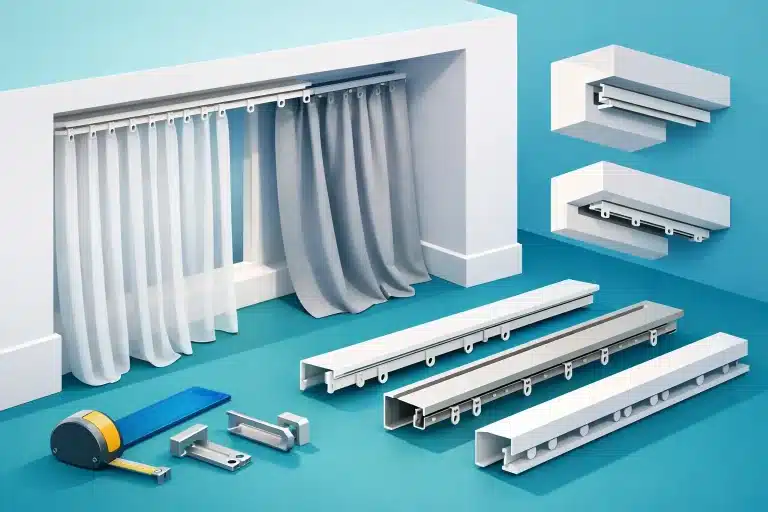
Recesses are rarely perfectly square. Measure the width at the top, middle and bottom, then use the smallest measurement if the track must fit between two side walls. Measure the depth at several points too, as plasterwork, tiles and timber linings can vary.
Record the height from the proposed track position to the floor, window board or radiator shelf. Photograph the recess straight on and from each side, including handles, blinds, sockets and nearby corners. These details make it much easier to identify a potential clash before the track is manufactured.
For automated systems, it is worth sharing the planned curtain fabric, heading style and any drawings with the track supplier. Smart Curtains can review measurements and fitting details as part of the planning process, helping homeowners and installers specify a track that suits the real conditions on site rather than an idealised sketch.
A recess should make life easier
A well-planned recess track gives you more than tidy window dressing. It lets curtains close at the touch of a wall switch, remote or smartphone timer, brings privacy when the evening draws in and can make daily routines easier for anyone with restricted mobility. With the right clearances and a track built for the space, the technology stays quietly in the background while the room simply feels better finished.