A curtain that catches on a bay window return, needs a firm tug to cross a wide span, or is left closed while you are away can make a beautiful room feel less considered. When weighing up corded versus motorised curtains, the right choice is rarely just about how the curtains open. It is about how the room is used, who uses it, and how much you want your window treatments to do for you.
Thank you for reading this post, don't forget to subscribe!Cord-operated tracks remain a practical solution for some homes. Motorised systems add a different level of everyday ease, timed privacy and smart home control. Both can be made to measure and both can create a clean, elegant finish. The meaningful differences lie in operation, planning and the long-term experience of living with them.
Corded versus motorised curtains: the main difference
A corded curtain track uses a continuous cord to move the curtain carriers. Rather than handling the fabric directly, you pull the cord to open or close the curtains. This can be especially useful for heavier curtains or windows where reaching the leading edge of the curtain is inconvenient.
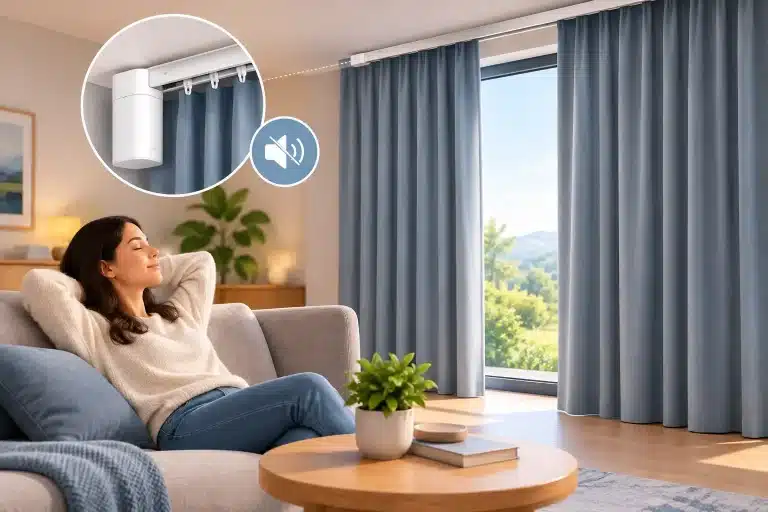
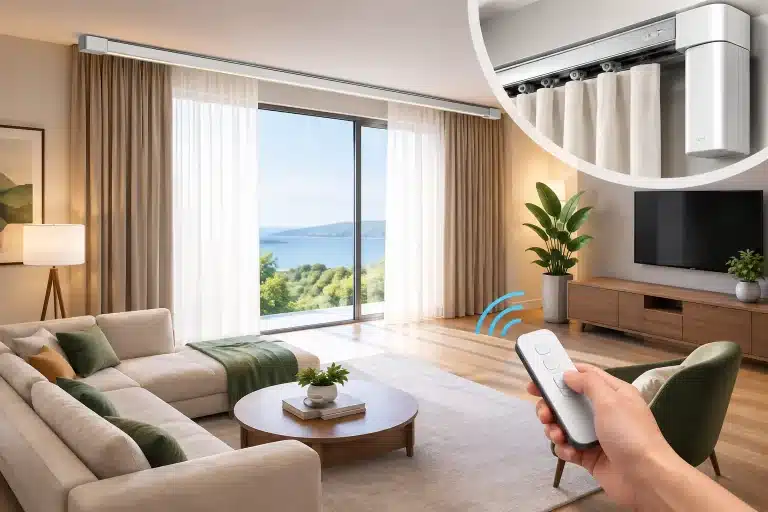
A motorised curtain track uses an electric motor to move the carriers. Control can be as simple as a wall switch or remote control, or it can include a smartphone app, scheduled timers and integration with a wider smart home system. One command can open a large pair of curtains, close several tracks at once or run a daily routine without any manual input.
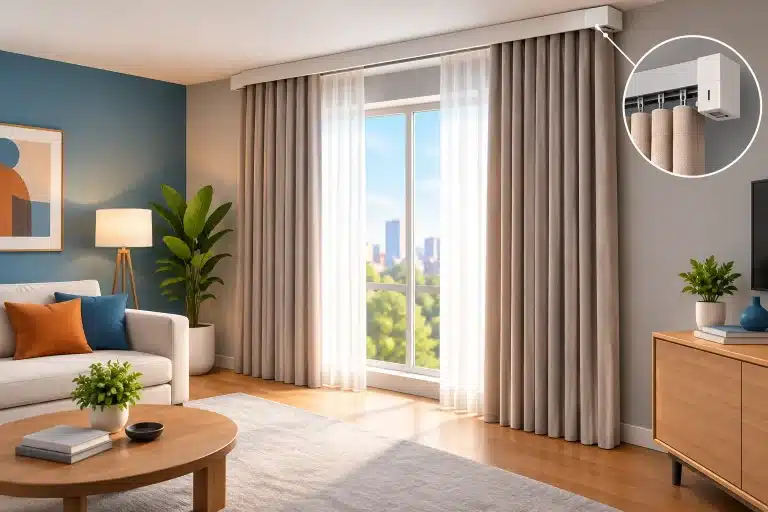
The visual result need not be different. In either case, the track can be discreetly fitted in a recess, behind a pelmet or within a ceiling detail. The choice is principally about the experience of control and the level of planning required behind the finish.
When a corded track makes sense
Corded curtains suit homeowners who want smoother operation than hand-drawn curtains without introducing power or automation. They are a sensible option for a straightforward window where the curtains are opened and closed regularly, but there is no need for timers, remote control or integration with other devices.
They can also work well where a renovation is already complete and adding a nearby electrical supply would be disruptive. For a single, accessible window with moderately weighted curtains, a corded track offers a familiar, mechanical solution.
There are trade-offs. The cord needs a suitable position on the wall and must be safely secured, particularly in family homes. The user still needs to be physically present to operate it, and the cord can become another visible element in an otherwise minimal interior. On a very wide opening, a tall window or a room with several curtain tracks, pulling cords individually can soon feel less convenient.
A corded system also does not address the moments when convenience matters most: closing curtains from bed, managing an awkward stairwell window, or making the home look occupied while you are on holiday.
Why homeowners choose motorised curtains
Motorised curtains are often chosen because they remove small daily frustrations. A button press, a voice command or an automated schedule can control curtains that would otherwise require stretching, pulling or walking across the room. That is valuable on large glazed doors, wide wall-to-wall windows, high-level tracks and shaped layouts such as bays or corners.
The benefit is not solely about technology. It is about making a home easier to use. For someone with restricted mobility, motorisation can turn a difficult daily task into a simple, independent action. For families, it can make evening routines calmer: curtains close at the same time as lights dim, without anyone going from room to room.
Motorisation also brings consistency. Curtains can open at a chosen time each morning and close at dusk, according to your preferred routine. During darker months, this can make privacy effortless. When the property is empty, scheduled movement gives a more lived-in impression than curtains that remain in the same position for days.
Control can be simple or fully connected
Not every motorised curtain system needs a complex smart home installation. Many homeowners begin with a remote control or dedicated wall switch. This offers immediate convenience while keeping operation clear for every member of the household and for guests.
Others prefer smartphone control, allowing them to check or adjust curtains when away from home. Timers are useful if you want reliable opening and closing without relying on changing habits. For a connected property, motorised tracks can also be specified to work alongside lighting, heating, blinds or a home automation platform.
The best control method depends on how you live. A simple switch may be ideal in a guest bedroom; app control and schedules may be more useful in a main living space with large glazing. Good planning allows for the controls you need now without making the system feel overcomplicated.
Better suited to difficult windows and heavier curtains
Curtain weight, track length and layout should influence the decision. A pair of lightweight bedroom curtains on a standard window places very different demands on a track than interlined curtains crossing a six-metre wall of glass.
Motorised tracks are particularly effective when the fabric is heavy, the span is long or the curtain heading creates substantial stack-back. They provide even movement without repeated handling of the fabric, helping curtains retain a neater appearance over time. They are also well suited to multiple-track arrangements, where sheers and blackout curtains need separate control.
Bay windows, L-shaped corners, offset tracks and recessed ceilings need careful specification whichever operation method you choose. With motorisation, the position of the motor, access for future servicing, cable routes and electrical supply need to be considered early. These details are not obstacles, but they are reasons to plan the track before plastering, ceiling work or joinery is finalised.
Cost, installation and long-term value
A corded track will usually have a lower initial cost because it does not require a motor, power supply or smart controls. For a simple room with modest practical requirements, that may be the right balance.
Motorised curtains involve a greater upfront investment, particularly for made-to-measure tracks, complex bends and integrated controls. Yet the comparison should include more than the purchase price. If the curtains are difficult to reach, exceptionally heavy or used several times a day, the added ease can be felt immediately. In a renovation or new-build project, arranging power during first fix is generally far simpler and neater than revisiting it later.
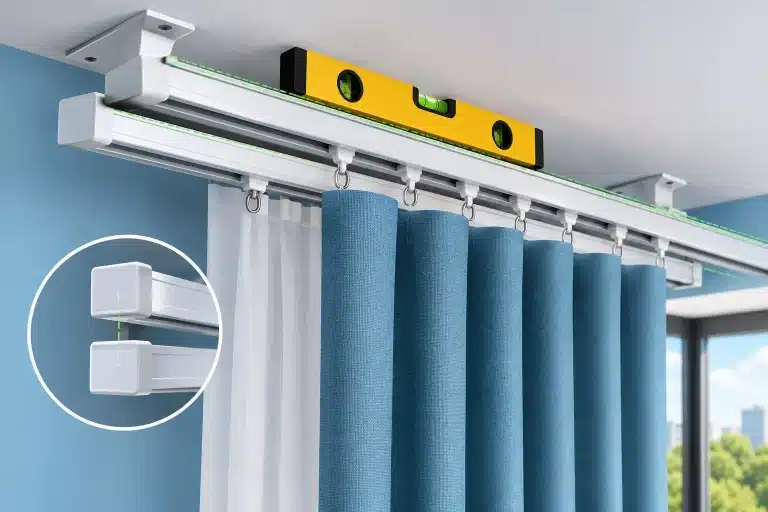
There is no one-size-fits-all installation route. Some motors can use a plug-in supply where this suits the room, while others are designed for a more concealed electrical connection. A professional plan should identify where the motor will sit, how the track will be supported and whether there is enough allowance for curtain stack-back, especially near doors, radiators and furniture.
For homeowners coordinating builders, electricians and interior designers, this is where specialist guidance makes a material difference. Smart Curtains helps customers verify measurements and produce fitting drawings, so the finished track is considered as part of the room rather than treated as a last-minute addition.
Questions to ask before choosing
Start with the everyday moment you are trying to improve. If you simply want to avoid touching delicate curtains and the window is easy to access, a corded track may be entirely sufficient. If you want curtains to react to your routine, operate safely from a distance or work with your smart home, motorisation is likely to be the stronger fit.
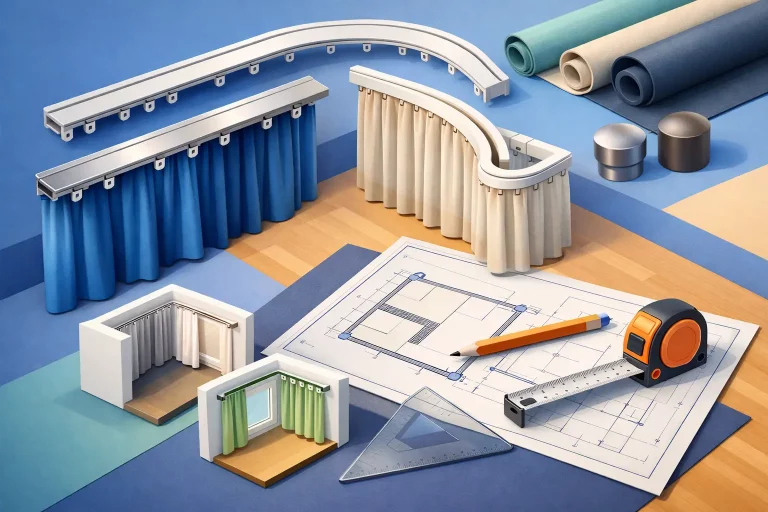
Consider the window itself as well. Measure the full track run rather than just the glass width, and account for returns, bends and the space needed when curtains are open. Think about fabric weight, lining and heading, as these affect how the track must be specified. Finally, decide whether electrical provision is possible now. Even if you choose basic controls initially, planning for a motorised track during renovation can preserve more options later.
The right choice should feel effortless
Corded curtains provide controlled, dependable operation for straightforward spaces. Motorised curtains offer a more flexible answer where accessibility, security, large glazing or a refined smart home routine matter. Neither is automatically better in every room.
The most successful installation begins with the room, the curtain fabric and the way you want to live there. A correctly measured, thoughtfully planned track will make the final choice feel natural every time the curtains move.