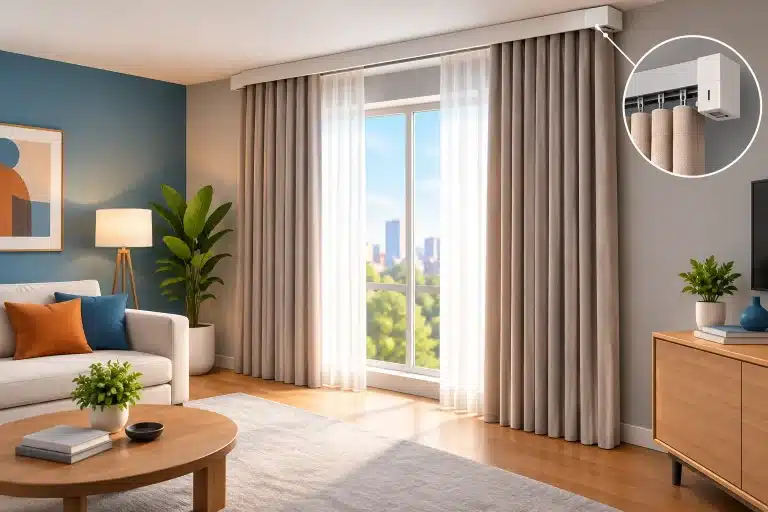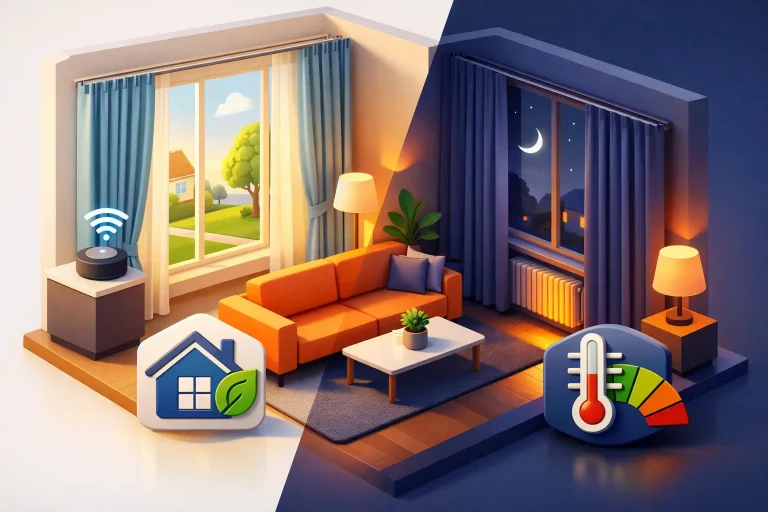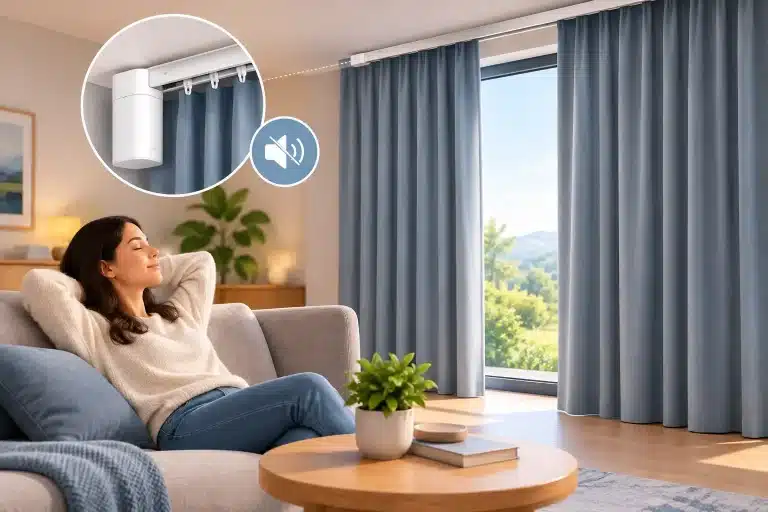
A quiet motor matters most at the moments curtains are meant to disappear into the background: opening gently with the morning light, closing a bedroom at night, or providing privacy during a film. This silent curtain motor guide explains what “silent” realistically means, what affects the sound you hear, and how to plan an automated curtain system that feels considered rather than intrusive.
Thank you for reading this post, don't forget to subscribe!For most homeowners, the right result is not a motor that makes no sound at all. It is a system that moves smoothly, starts without a jolt and produces a soft, unobtrusive operating sound. That outcome depends on more than the motor alone. The track, fabric weight, installation surface and curtain layout all have a part to play.
What makes a curtain motor quiet?
A quality electric curtain motor uses controlled gearing to move the track’s carriers at a steady speed. Rather than pulling the fabric abruptly, it applies consistent force and slows naturally at the ends of the track. The result is a measured movement that is far less noticeable than a poorly specified or badly fitted system.
The motor is only one element of the sound profile. The carriers must travel cleanly within the track, without catching or rattling, while the curtains need to hang correctly and have enough clearance from walls, radiators, pelmets and window handles. A well-engineered track and accurate fitting are often as significant as the motor specification.
It is also worth being cautious of absolute claims. Every motorised curtain system makes some operational noise, particularly in a very quiet bedroom late at night. The aim is a low, refined sound that does not interrupt conversation, sleep or relaxation. A heavier interlined curtain will also create a different sound from a lightweight sheer, even on the same track.
Why track design matters as much as the motor
A motor can perform only as well as the track it is driving. Made-to-measure aluminium tracks are designed around the opening and the way the curtains will stack, which helps avoid unnecessary resistance. A track that is too short, poorly supported or forced into an unsuitable layout can create dragging, carrier noise and uneven movement.
Straight windows are usually the simplest arrangement, but quiet operation is just as achievable with more complex spaces when they are planned properly. Bay windows, curved sections, corners and offset returns require the correct track geometry and carrier arrangement. Trying to make a standard straight system work around a difficult wall shape is where compromise often becomes audible.
Wall-to-wall curtains need particular attention. The track must allow the fabric to stack without fouling at either end, while leaving appropriate space for the motor. Recess installations need adequate depth so that curtain headings and fabric do not rub against the window or surrounding finishes. These are small details on a drawing, but they make a clear difference to the finished experience.
The installation surface can amplify sound
Motors transfer a small amount of vibration when running. A secure fixing into a suitable ceiling or wall structure keeps this controlled. A loose bracket, uneven ceiling or inadequate fixing point can amplify vibration and turn a quiet motor into something more noticeable.
This is one reason installation planning should happen before decorating is complete, particularly where a ceiling recess, pelmet or boxed-out detail is being created. Agreeing track positions, power locations and access for fitting in advance avoids awkward alterations later.
Choosing the right motor for your room
The best motor is not necessarily the most powerful option. It should be matched to the track length, curtain weight, fabric type and opening style. A motor working comfortably within its capability is more likely to provide controlled, reliable movement than one pushed close to its limit.
Bedrooms and living rooms are the spaces where quietness tends to matter most. In a bedroom, a gentle timed opening can be a more pleasant alternative to an alarm, while a quiet closing routine supports a calmer evening setting. In a living room, discreet operation preserves the atmosphere when curtains close for privacy or to reduce glare.
For wide glazed doors or very heavy, lined curtains, the planning focus may shift towards capacity and track support. This does not mean accepting excessive noise. It means ensuring the system is specified correctly from the outset, rather than expecting a smaller motor to handle a demanding application.
Motor placement deserves consideration too. The motor is normally positioned at one end of the track, so its location can be coordinated with the room layout, curtain stack and available power supply. In some designs, concealing it within a pelmet or purpose-built recess produces a particularly clean visual finish. Concealment should not prevent future access for servicing or adjustment.
Control options that keep the experience calm
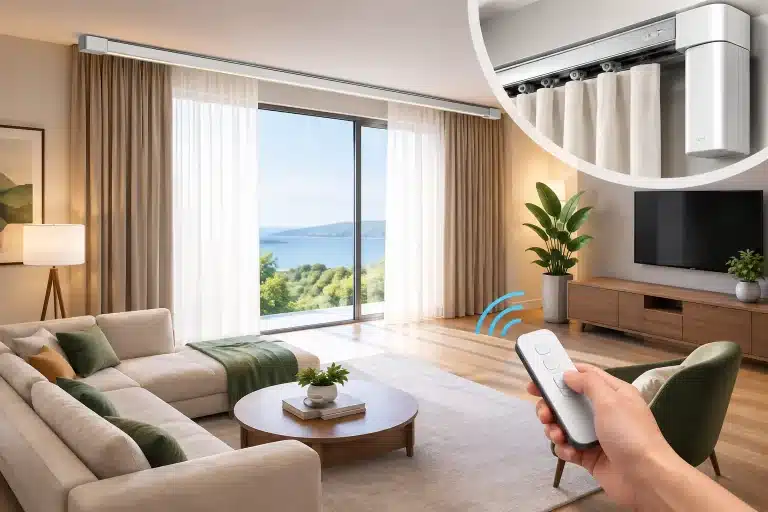
A quiet curtain system should also be straightforward to use. A wall switch offers a familiar control point and can be ideal where you want a simple, dedicated operation near the doorway or bedside. A handheld remote provides flexibility without needing a phone, while app control allows timers and scenes to fit around daily routines.
Automation can be especially useful when the house is empty. Timed opening and closing gives the impression of an occupied home, while removing the need to leave curtains open or closed for an entire holiday. For households with restricted mobility, the ability to control curtains from a switch, remote or smartphone can make a meaningful everyday difference.
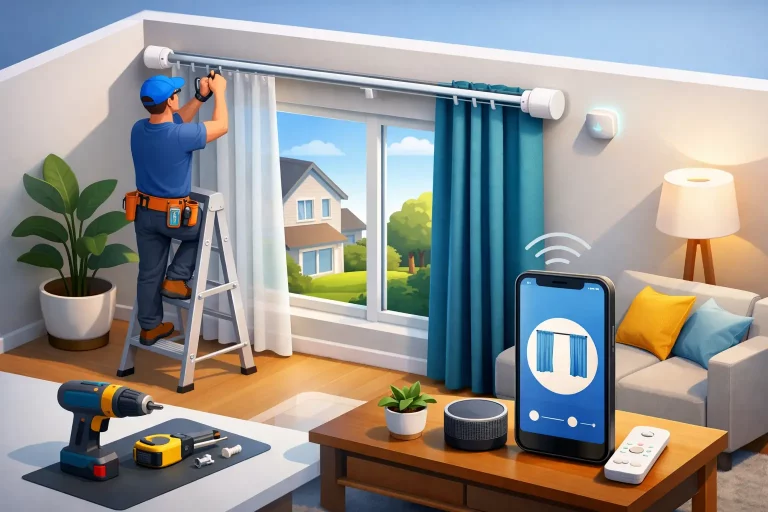
Smart home integration is worthwhile when it solves a genuine need. You may want curtains to close with a lighting scene, respond to a voice command, or operate alongside other shading and security routines. If a simple remote is all that is required, that can be the better choice. The most successful system is one everyone in the household will use confidently.
Planning for quiet, dependable operation
Before ordering, measure more than the visible glass. Consider the full width needed for the curtains to draw clear of the window, where the fabric will stack, whether there are returns at the sides and any obstructions that could interfere with movement. For ceiling-mounted tracks, check the available depth and identify a suitable fixing zone.
Power should be planned early. Depending on the system, this may involve a nearby socket or a dedicated electrical provision arranged by a qualified electrician. The cable route and motor position can then be kept discreet, particularly in a newly renovated room. It is far easier to coordinate this before plastering, joinery or final decoration than after the room is complete.
Curtain weight is another essential detail. Fabric samples may feel light in the hand, but a full-width pair with lining, interlining and generous fullness can become substantial. Share the intended fabric specification during planning so the track and motor can be selected with confidence.
For a practical specification, it helps to provide:
- the overall opening width and desired track position
- photographs showing the window, surrounding walls and ceiling
- details of recesses, bays, corners, radiators and handles
- the approximate curtain fabric, heading and lining choice
- your preferred controls and any smart home system already in use
This information allows a specialist to identify potential issues before manufacture. At Smart Curtains, fitting drawings and measurement checks are used to help homeowners, builders and electricians work from the same plan, reducing the risk of last-minute compromises.
Common reasons motorised curtains become noisy
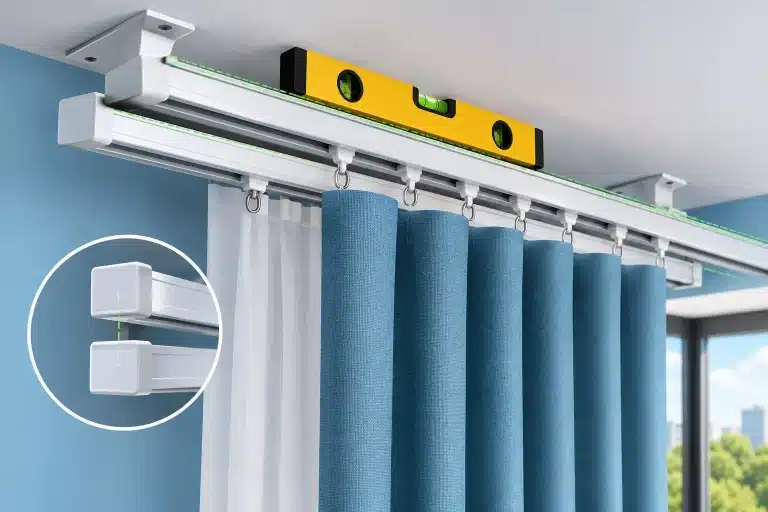
Noise is not always a fault with the motor. Fabric rubbing against a wall, a curtain heading catching on a pelmet, carriers placed incorrectly or a track installed out of level can all create unwanted sound. So can attempting to operate curtains that are simply too heavy for the chosen system.
Maintenance is usually light, but it should not be ignored. Keep the track free from dust and debris, avoid hanging items from it, and do not force the curtains by hand while the motor is operating unless the system is specifically designed for that use. If movement changes over time, investigate early rather than allowing a small alignment issue to become a larger one.
The quietest installations tend to be those treated as part of the room design, not as an accessory added at the end. Give the track, power point and curtain stack the same consideration as lighting positions and joinery, and the automation can feel effortlessly at home from the first day.