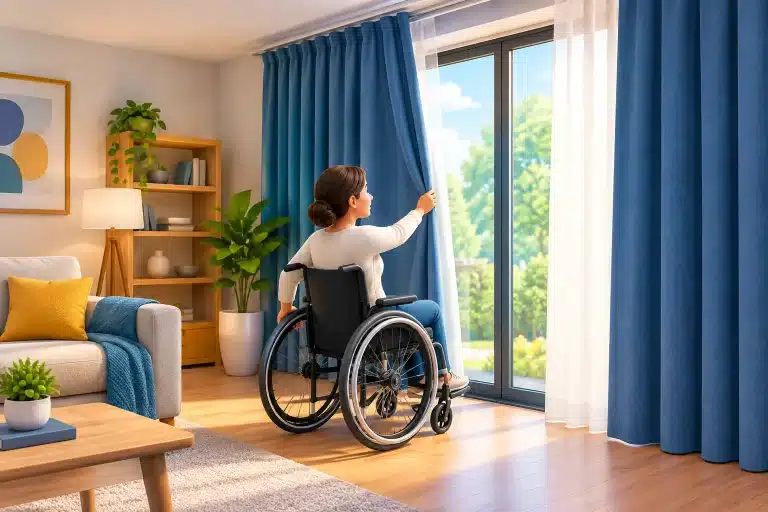
A curtain that looks beautiful but cannot be reached is not doing its full job. For someone who uses a wheelchair, a high window, deep bay, heavy fabric or furniture placed near the track can turn a simple daily task into an unnecessary struggle. Wheelchair friendly curtains remove that friction by putting privacy and daylight control within easy reach – often without needing to reach at all.
Thank you for reading this post, don't forget to subscribe!The right solution is rarely just a matter of choosing a longer pull cord. It is about considering the complete window: where the curtain opens, how the room is used, who needs to control it and whether the system will remain practical as needs change. A made-to-measure motorised curtain track can make a meaningful difference while retaining the warmth, softness and style that curtains bring to a home.
What makes curtains wheelchair friendly?
Wheelchair-friendly design is about independent operation. Traditional curtains may need a person to stand close to the window, pull fabric with enough force to move it, and reach around furniture or radiators. Even a lightweight pair can become awkward when the track is wide, the curtains are lined, or the window sits behind a sofa, bed or dining table.
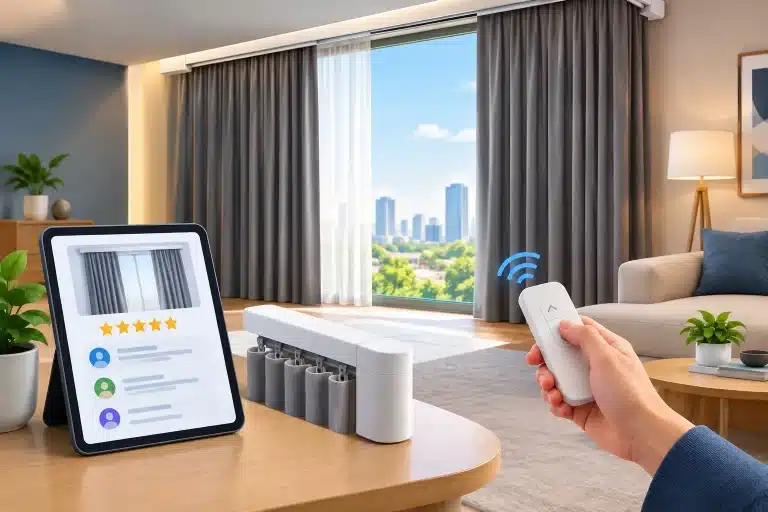
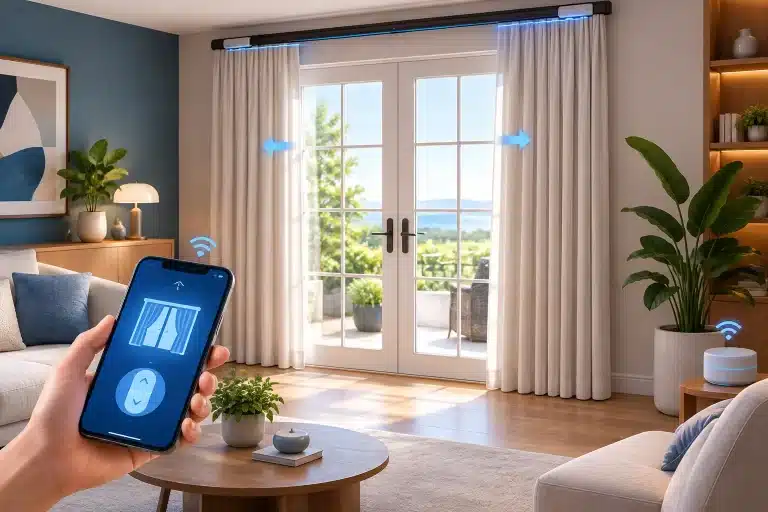
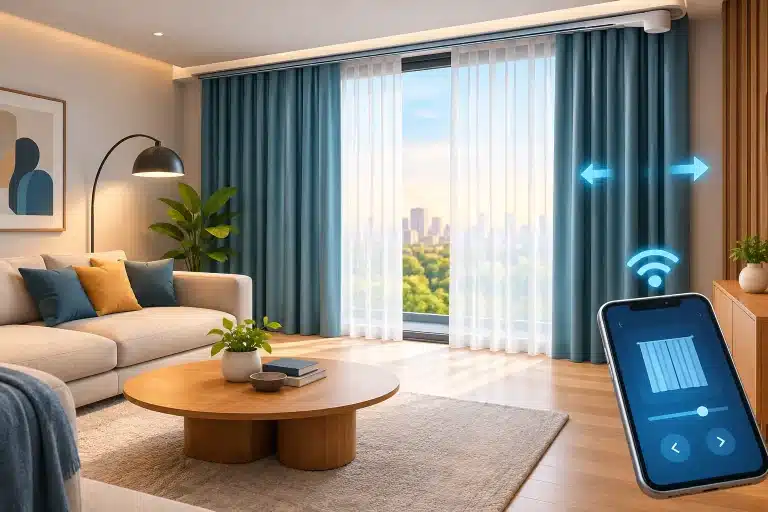
Motorised curtains replace that physical effort with a chosen control method. The curtains can be opened or closed using a wall switch fitted at an appropriate height, a handheld remote, a smartphone or a voice-enabled smart home system. Timers can also operate them automatically, which is particularly useful for bedrooms, living rooms and homes where maintaining privacy at a set time matters.
This is not only about convenience. It can reduce reliance on assistance for a routine task, avoid difficult reaching and turning movements, and make a room feel easier to live in from morning to night.
Choose the control around the person, not the product
There is no single best control option for every household. The practical choice depends on hand movement, reach, confidence with technology and whether more than one person uses the room.
Wall switches at a practical height
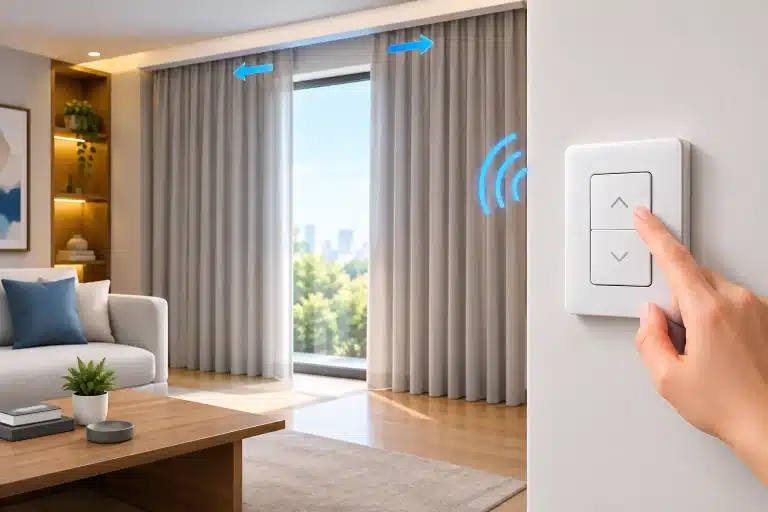
A wall switch provides a familiar, fixed point of control. It can be positioned where it is comfortably accessible from a wheelchair, rather than being dictated by the location of the window. This may suit a person who prefers a simple press-button solution over an app or remote.
The location deserves proper thought before electrical work is completed. Consider approach space beside the switch, door swings, furniture layouts and whether the user can operate it without stretching across a worktop or around a chair. A good position is not merely technically possible – it should feel natural in everyday use.
Remote controls for flexibility
A remote can be kept on an armrest, bedside table or coffee table, allowing the curtains to be controlled from where the person is sitting. This is a straightforward choice where wiring to a new switch would be disruptive, or where multiple people want to use the same curtains easily.
The trade-off is that remotes can be misplaced. Some homeowners choose a wall switch as the main control and keep a remote as an additional option, giving them both a reliable fixed control and flexibility around the room.
App, timer and smart home control
Smartphone control can be useful for people who already manage lighting, heating or security through an app. It also enables schedules: curtains can open with the morning routine and close before dusk, without anyone needing to remember.
Voice control can be especially helpful where pressing a small button or holding a remote is difficult. However, it should be viewed as an extra layer of convenience rather than the only way to operate the curtains. A physical switch or remote remains valuable if the internet is unavailable, a phone is out of charge or voice recognition is inconsistent.
Consider the whole window layout
Accessibility can be lost in the details of the installation. A standard straight track may be ideal for one window and entirely unsuitable for another. Bay windows, corners, wall-to-wall curtains and offset layouts all need planning so the fabric stacks neatly and the motor sits in a sensible position.
For example, the stack-back – the space occupied by curtains when open – matters more than many people expect. If fabric gathers on the side where a wheelchair needs to turn, approach a bedside cabinet or access a patio door, the room can feel more restricted even though the curtains work perfectly. Planning the opening direction and stacking position early can prevent this.
Curtains should also open far enough to preserve the useful width of doors and windows. This is particularly relevant for French doors, sliding doors and garden access, where limited clearance can affect day-to-day movement. A made-to-measure track helps ensure the finished system works with the room rather than simply fitting above the window.
Fabric weight, lining and daily use
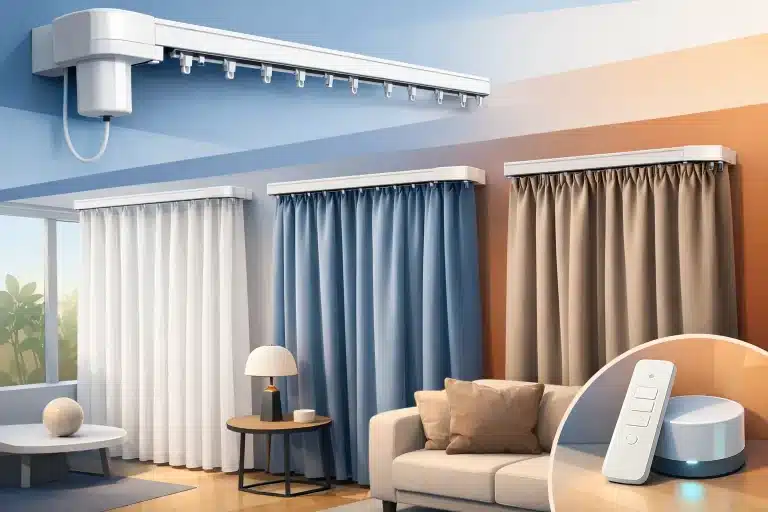
Motorisation is well suited to heavier, fuller curtains that can be difficult to move manually. Blackout linings can improve sleep, while thermal linings can help make a room more comfortable in colder months. Both add weight, so the track and motor need to be specified for the finished curtain rather than estimated from the window size alone.
Fabric choice still matters. Very thick curtains may create a luxurious look but take up more stacking space. Delicate fabrics can look elegant but may need careful handling and an appropriate heading style. There is usually a balance between visual impact, insulation, light control and the clearance available around the window.
For bedrooms, a reliable blackout arrangement may be the priority. In a lounge, the focus may be on reducing glare on a television or creating privacy after dark. In either case, automation allows the household to use the treatment as intended instead of leaving curtains in one position because moving them feels inconvenient.
Make access easier without compromising safety
Any automated system should be installed with safety and durability in mind. The track needs secure fixing to a suitable surface, whether that is a ceiling, wall or purpose-built pelmet. The power supply, cable route and control positions should be agreed alongside the wider renovation or decorating plan, particularly if walls are being opened or electrics are being updated.
It is sensible to discuss what should happen during a power cut and how the curtains can be operated if a control device is unavailable. Requirements vary by system, so this is worth clarifying at specification stage rather than assuming every motor works in the same way.
Corded curtain solutions can appear to offer a lower-cost answer, but they do not always solve the reach and effort issue. They can also introduce additional considerations around cable management. For many households, a properly planned motorised track is the more dependable long-term option because it removes the need to pull, tug or manoeuvre fabric by hand.
Planning for a renovation, adaptation or new build
The best time to plan wheelchair-friendly curtains is before the final decorating and electrical decisions are made. This allows the track position, power supply, recess depth and control points to be coordinated with builders, electricians, curtain makers and smart home installers.
That said, automated curtains can also be introduced to an existing home. The route will depend on the room, access to power and the desired finish. Some projects call for a concealed track within a ceiling recess for a refined appearance; others suit a surface-mounted track that can be fitted with less disruption. Neither approach is automatically better. The right answer depends on the structure, budget and level of finish required.
Accurate measurements are essential, especially for bays and wall-to-wall runs. Width alone is not enough. The planning needs to account for returns, brackets, projections, obstructions, curtain heading and where the motor will be housed. This is where specialist support can save time and avoid an expensive compromise after installation.
Smart Curtains helps homeowners turn these practical questions into a clear made-to-measure specification, with fitting drawings and planning guidance before an order is finalised. That reassurance is particularly valuable when accessibility, interior design and building work all need to align.
A small change that can restore everyday choice
The value of accessible curtain control is often felt in ordinary moments: adjusting glare without leaving the sofa, closing the bedroom curtains independently, or setting the house up for the evening before visitors arrive. These are small actions, but they shape how comfortable and self-sufficient a home feels.
When planning wheelchair friendly curtains, start with the person’s route through the room and the moments when control is needed most. A carefully positioned, made-to-measure automated system can make those moments simpler, while leaving the room looking exactly as considered as the rest of the home.