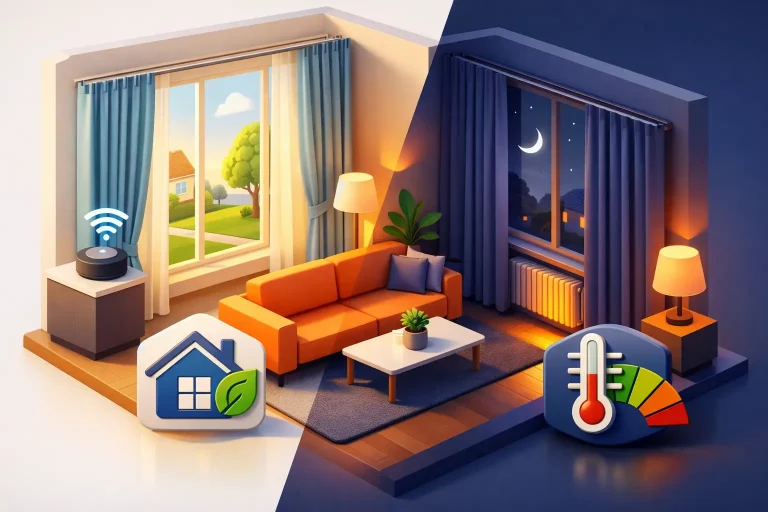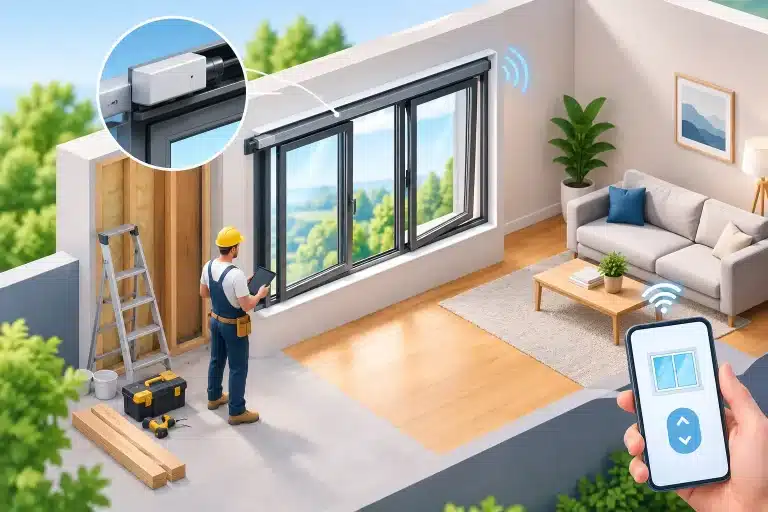
A renovation can look finished on the day the decorators leave, yet still feel incomplete when every evening involves walking around the room to close curtains. Window automation for renovations is easiest to plan before surfaces are finished, but it is also entirely achievable in a completed home. The key is choosing the right track layout, power approach and control method for the way you actually live.
Thank you for reading this post, don't forget to subscribe!For many homeowners, automated curtains begin as a convenience upgrade. They quickly become part of the everyday rhythm of the home: opening gently in the morning, closing at dusk for privacy and helping the house look occupied while you are away. When they are designed around the window rather than added as an afterthought, the result is practical, discreet and properly considered.
Why plan window automation during a renovation?
Renovation work creates a rare opportunity to make decisions that are difficult or disruptive later. If walls are open, ceilings are being altered or new electrics are being installed, you can consider where a motor will sit, how it will receive power and whether the track should be recessed into a pelmet or ceiling detail.
This does not mean every project needs complicated smart home wiring. Many motorised curtain tracks can be specified with straightforward mains power and controlled by a remote, wall switch or app. Battery-powered options can also suit certain situations, particularly where chasing walls is not desirable. The best answer depends on the room, the curtain weight, your preferred controls and how much building work is already planned.
Early planning also protects the finished look. Curtain tracks often need to extend beyond the window so the curtains can stack neatly clear of the glass. This matters for daylight, but it also affects where sockets, radiators, shelving and ceiling features can sit. A made-to-measure plan avoids discovering too late that a motor clashes with a cornice or that the curtains cannot draw fully around a bay.
Start with the room, not the technology
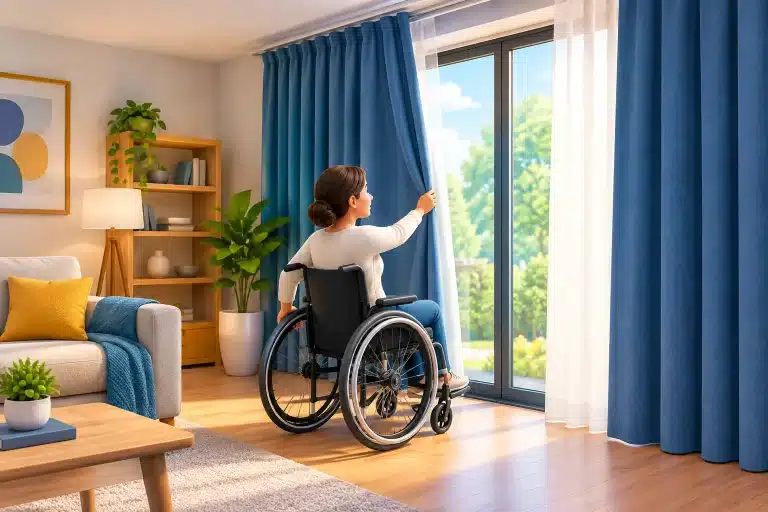
The most successful automated window treatments begin with a simple question: what should this room do better? In a bedroom, the priority may be privacy, blackout lining and a timer that suits your wake-up routine. In a living room, it may be managing a wide run of curtains without interrupting the furniture layout. In a home with limited mobility, the value may be reliable control without reaching, pulling or stretching.
Think about the times when you use the curtains, not just how they look during the day. A south-facing room may benefit from timed closing to reduce glare in the evening. A front lounge may need curtains that close automatically when the household is out. In a cinema room or open-plan extension, several tracks may need to work together from a single control.
This approach helps avoid buying features that sound impressive but do not improve daily life. Voice control can be useful, for example, but a well-positioned wall switch is often the control people use most. Likewise, app control is excellent for holiday settings and schedules, while a remote remains reassuringly simple for guests and children.
Decide how you want to control your curtains
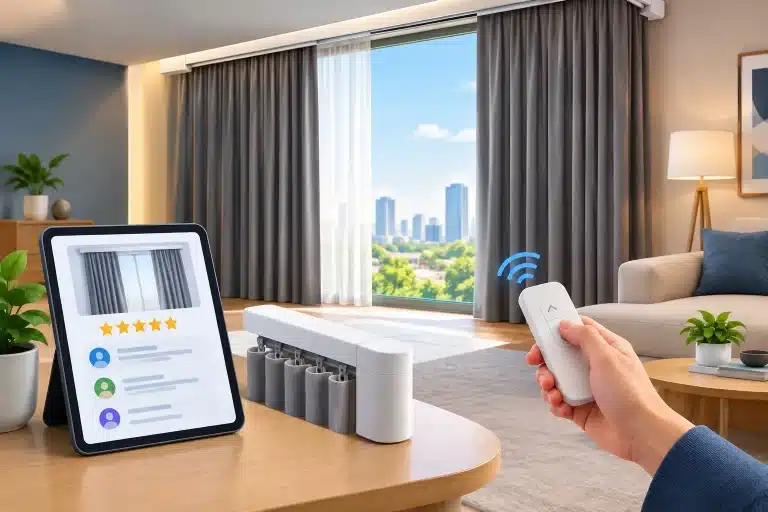
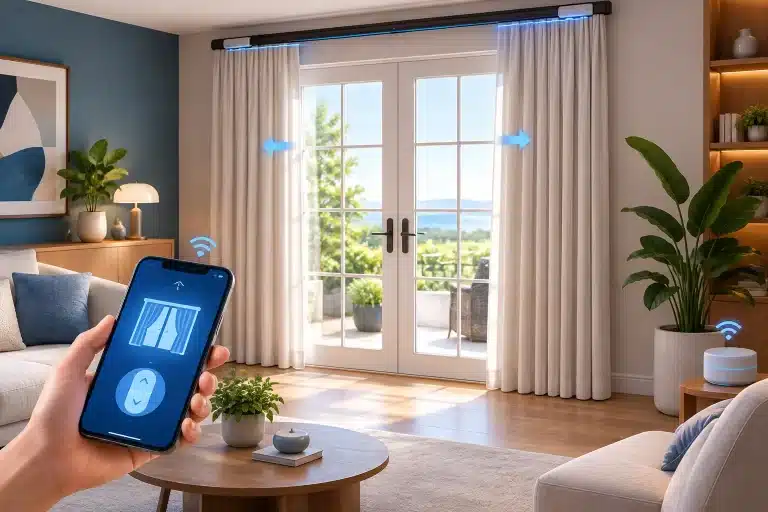
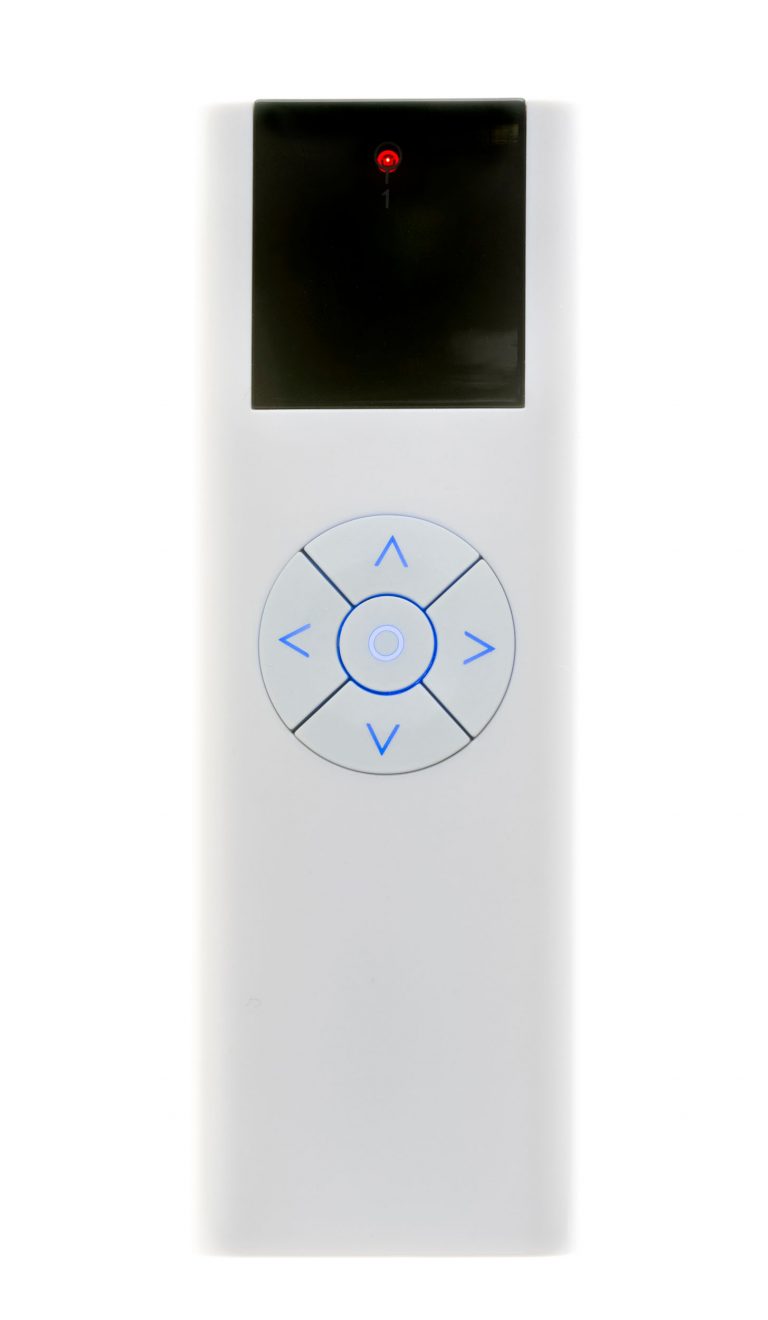
There is no single best control option. A remote control is uncomplicated and works well where the track is the only automated item in the room. A wall switch creates a familiar, built-in feel, especially when coordinated with lighting controls. Smartphone control allows schedules and operation from anywhere, while smart home integration can bring curtains into wider routines alongside lighting, heating or security.
For renovations, it is sensible to decide this before your electrician finalises the first-fix plan. If you want a wall switch, agree its location early. If a home automation installer is involved, make sure they receive the proposed track drawings and motor details. Small conversations at this stage can prevent last-minute compromises.
Power planning without unnecessary disruption
Power is one of the first practical considerations, but it should not become a source of anxiety. A motorised track needs an appropriate power solution, and the neatest route will vary from one property to another.
In a major refurbishment, a concealed mains supply can usually be arranged near the motor end of the track. The position needs to be accessible enough for future servicing but discreet enough to preserve the window treatment. If the motor is housed behind a pelmet or within a ceiling recess, the electrician and installer need to work from the same drawing.
For lighter-touch renovations, an existing nearby socket may provide a suitable route, depending on the room and track design. Battery options can reduce the need for visible cabling, although they introduce a charging routine and may not be the right choice for every large or heavily dressed curtain. This is where specification support is valuable: a solution that works perfectly on a standard window may not be appropriate for a long, curved or wall-to-wall track.
Do not assume that a socket directly beside the window is always ideal. The motor may be positioned at the opposite end, and the curtain stack may conceal or obstruct part of the layout. Measure the whole wall, not only the window opening.
Get the track layout right before ordering curtains
Curtains and tracks need to be planned together. Automated tracks are made to your dimensions, and their route should reflect both the architecture and the fabric treatment. A straight track across a standard wall is relatively simple. Bays, corners, angled returns and offset layouts need more detailed thought.
A bay window can be an excellent candidate for automation, particularly if it has several separate curtain sections that are awkward to operate manually. However, the track must follow the intended line precisely, with enough room for the curtain heading, brackets, motor and returns. In some bays, the track sits inside the recess; in others, it runs across the front to create a cleaner, more generous drape.
Ceiling-mounted tracks are popular in renovated rooms because they can make ceilings feel higher and allow curtains to fall close to the wall. They are particularly effective in extensions with large glazing. Wall mounting can be equally effective where ceiling construction, lighting details or a traditional pelmet dictate the arrangement.
Check the finished dimensions, not the dimensions before plasterboard, insulation or decorative panelling. A few centimetres can change whether a motor clears an obstruction or whether curtains stack where intended.
Make space for the curtain stack
When curtains are open, they need somewhere to go. This is often overlooked in beautiful renovation schemes, especially where glazing runs close to a side wall or built-in cabinetry.
The amount of stack-back space depends on fabric thickness, fullness, lining and heading style. Heavier interlined curtains take up more room than a lighter wave heading. If preserving the full width of a view is important, discuss this from the outset so the track can extend appropriately beyond the frame.
This is also relevant for doors. Curtains should not interfere with handles, bifold operation or access to a terrace. Where a door is used frequently, automation can make the arrangement easier, but it cannot solve a layout that leaves no practical space for fabric to sit when open.
Build automation into the finished design
A carefully designed installation should not make the room feel technical. Ideally, the motor disappears into the overall scheme and the control feels intuitive. Consider the surrounding details: the depth of a pelmet, the position of downlights, the line of a cornice, the location of curtain poles in adjoining rooms and the fabric chosen for the curtains.
For a minimal, contemporary look, a recessed track can create the impression that curtains fall directly from the ceiling. For a more traditional interior, a pelmet can conceal the system while adding softness and proportion. Neither choice is automatically better. The right one is the one that suits the property and leaves proper access for the track.
At Smart Curtains, installation planning is approached as part of the specification, rather than a separate problem to solve after ordering. Accurate measurements, fitting drawings and coordination with your builder or electrician give you a clearer route from renovation plans to a finished room.
Avoid the common late-stage problems
The most expensive mistakes tend to happen when window treatments are left until the final weeks. Decorative plasterwork may be complete before anyone has allowed for a power feed. A ceiling recess may be too shallow for the curtain heading. Joinery may occupy the exact space needed for the open curtains.
The practical remedy is simple: raise curtains during the design stage, alongside lighting, flooring and joinery. Share window measurements, photographs and proposed room plans with your automation specialist. If the room includes a bay, a corner or an unusually wide opening, ask for a track drawing before work begins.
It is also worth agreeing who is responsible for each part of the installation. Your electrician may provide power, your builder may form a recess or pelmet, and your curtain installer may fit the track and dress the curtains. Clear responsibilities keep the project moving and reduce avoidable rework.
A renovation is full of choices that are visible only once. Automated curtains are different: their greatest benefit is felt every morning, evening and time you leave the house. Give them a place in the plan early, and the finished home will feel easier to live in from the first day.