A nursery window is one of the first places parents tend to scrutinise. Loose pull cords, hanging chains and furniture positioned beneath the window all deserve attention. So, are automated curtains child safe? In many homes, a well-specified motorised curtain track can be a safer choice than a manual system with accessible cords, but safety depends on the complete design, installation and everyday use.
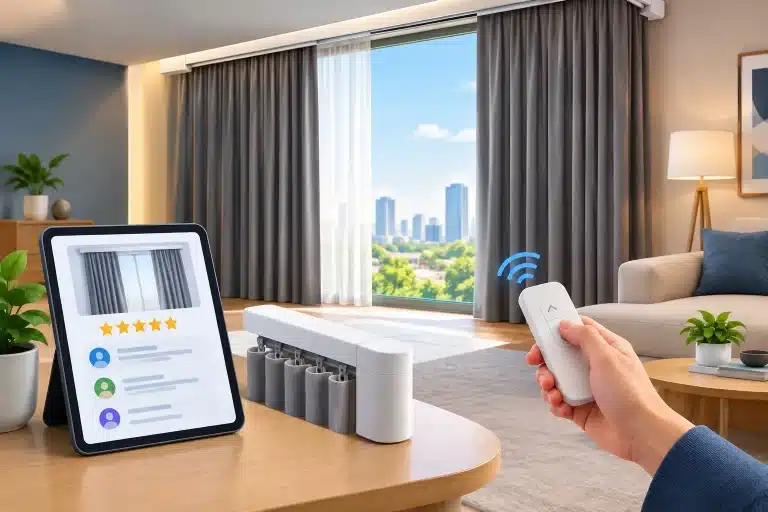
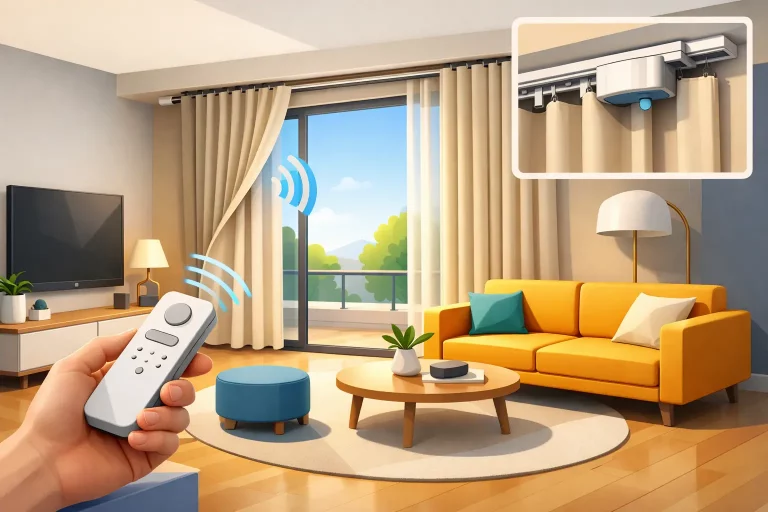
Thank you for reading this post, don't forget to subscribe!The biggest benefit is straightforward: an automated curtain system removes the need for a looped operating cord at the window. Curtains open and close using a concealed motor and track, controlled from a wall switch, remote control, app or smart home routine. That can reduce a familiar hazard while making the room easier to manage at busy times of day.
Are automated curtains child safe in a family home?
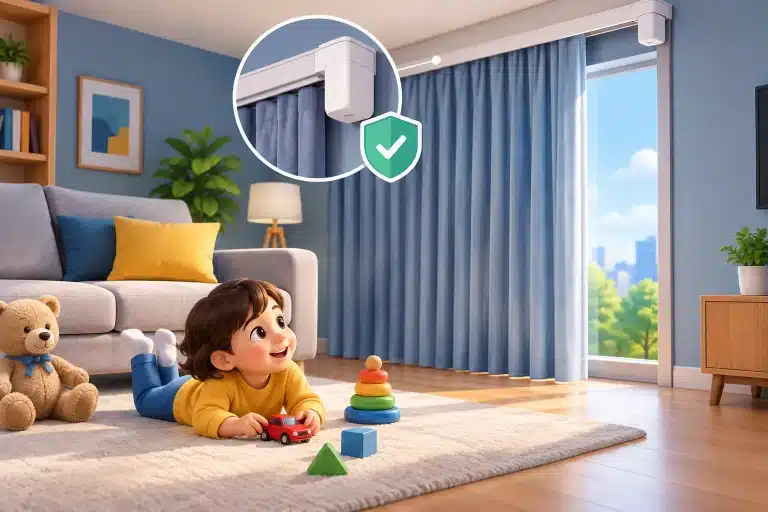
Automated curtains can be an excellent child-conscious option because the moving mechanism is usually contained within the track, above head height. There is no dangling chain to pull, wrap around or become tangled in. For bedrooms, playrooms and living spaces where children spend time, this cleaner arrangement is a meaningful advantage.
That said, motorisation does not make every curtain installation automatically safe. The system still needs to be selected for the room, fitted securely and used with sensible safeguards. A motorised track moves a substantial fabric treatment, particularly on wide, lined or blackout curtains. Children should not be encouraged to hold, climb on or play with curtains while they are operating.
The most reassuring approach is to consider safety before the track is ordered. That means confirming where the motor will sit, how power will be supplied, where controls will be positioned and whether the curtain stack will interfere with furniture, a cot or a door. A made-to-measure plan is particularly useful for bays, recesses and wall-to-wall tracks, where a poor layout can create awkward gaps or snag points.
Why cordless operation matters
Manual curtains can be perfectly practical, but some systems use cords or chains that need thoughtful placement and maintenance. Motorised tracks replace the daily pull with powered movement. For parents, that can mean fewer accessible components around the window and less temptation for small hands.
It also removes the repeated tugging that can cause a poorly fitted manual track or pole to work loose over time. With an automated system, the curtains move at a controlled pace, and the track is designed to carry the specified fabric weight. Correct fixing is still essential, especially where the track is mounted to a ceiling, into a recess or beneath a pelmet.
Cordless operation is not only helpful for young children. It creates a neater finish in guest rooms, open-plan spaces and homes where accessibility matters. The window treatment looks more considered because the control method does not need to dominate the room.
Plan controls with children in mind
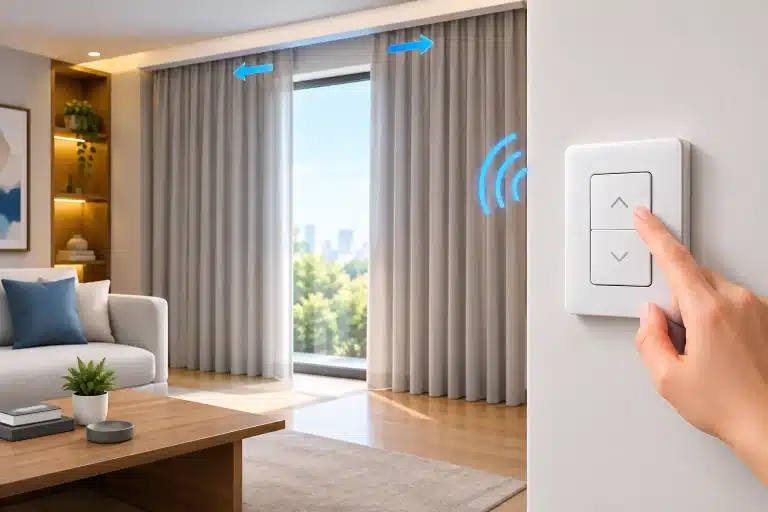
Control choice has a real bearing on how an automated curtain system works for your household. A wall switch placed out of reach of younger children gives adults a simple, reliable way to operate curtains without leaving a remote on a coffee table. It is often the best choice for a nursery or child’s bedroom.
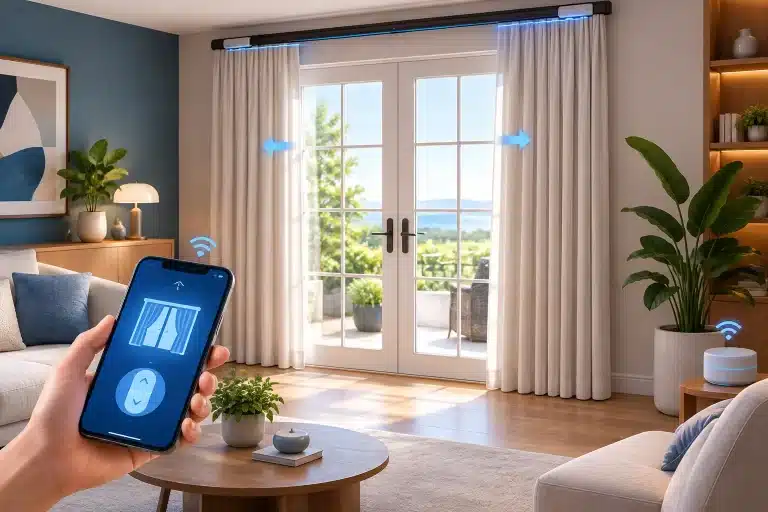
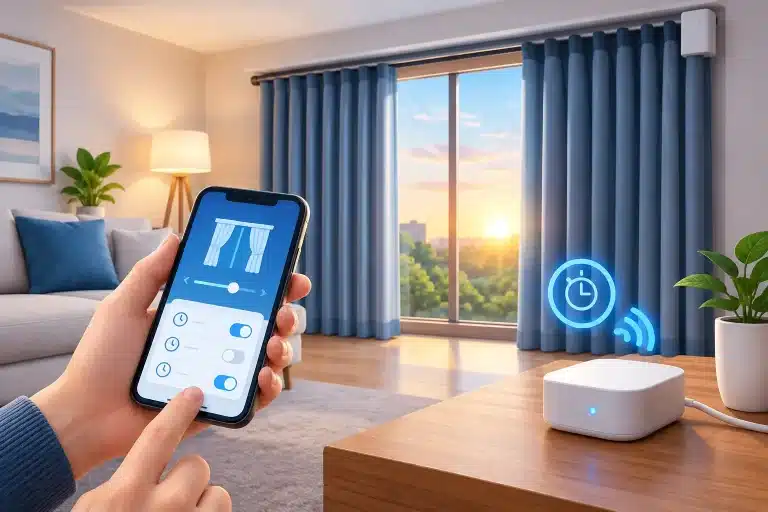
Remote controls offer flexibility, but should be kept somewhere sensible rather than treated as a toy. Smartphone control and scheduled timers can be equally useful, allowing curtains to close at bedtime or open in the morning without anyone needing to reach the window. If the system is connected to wider smart home controls, it is worth setting permissions carefully so that children cannot trigger routines unexpectedly from a shared device.
For many families, a combination works best: a fixed wall switch for everyday operation, with app or timer control for convenience. The right arrangement depends on the room and who will use it. A ground-floor living room may suit scheduled privacy settings, while a nursery may benefit most from a straightforward wall control and a predictable bedtime routine.
Avoid relying on automation alone
Timed opening and closing can make family life easier, but it should not replace adult judgement. Do not set curtains to operate at a time when a child may be climbing near the window, playing behind the fabric or sleeping in a cot positioned too close to it. Automation is there to reduce effort, not to remove the need for a safe room layout.
If your system offers an obstruction or resistance response, treat it as an added feature rather than a guarantee of protection. Performance varies by motor, curtain weight, track layout and what is caught in the path. Always follow the manufacturer’s operating guidance and supervise young children around moving window treatments.
Installation details that make a difference
The safest motorised curtain system starts with a track that is properly matched to the opening. An off-the-shelf track that is too short, poorly supported or unsuitable for a heavy pair of curtains may not operate as intended. In contrast, a made-to-measure track allows the motor position, brackets, returns and curtain overlap to be planned around the room.
Secure fixing is fundamental. The track and brackets must be attached to a suitable structure using the correct fixings for the ceiling or wall. This deserves particular care in older properties, plasterboard ceilings and bay windows, where the fixing point may not be obvious. Heavy interlined curtains place greater demand on the installation than lightweight sheers.
Power should also be considered early. Depending on the system, this may involve a discreet socket, a hard-wired supply or a rechargeable option. Any electrical work should be planned and completed appropriately, ideally before decorating is finished. Avoid trailing leads or improvised extension arrangements near a child’s room.
At Smart Curtains, installation planning focuses on these practical details before a system is specified. Checking measurements, track layouts and motor locations in advance helps prevent the compromises that can affect both finish and usability.
Keep the room layout as safe as the track
Even a cordless, professionally fitted curtain system needs a sensible surrounding layout. Keep cots, beds, chairs, toy storage and climbable furniture away from windows where possible. This reduces the chance of a child reaching the track, leaning against glass or using the curtains as part of a game.
Choose curtain fabrics and headings with the full room in mind. Long, full-length curtains can look beautiful and improve blackout performance, but they should fall freely without catching on radiator covers, toy baskets or furniture. In a child’s bedroom, it is worth checking that the leading edge closes cleanly and that neither curtain can be easily pulled into a cot area.
Parents should also explain, in age-appropriate terms, that motorised curtains are not for playing with. A quiet track can make the movement feel novel at first, so a clear household rule helps: stand back while they open or close, and ask an adult if something gets caught.
Questions to ask before choosing a system
When comparing automated curtain options, focus on more than the motor. Ask whether the track is designed for the weight and style of your curtains, how it will be fixed, how it is powered and which controls suit the room. For a nursery or young child’s bedroom, also ask where the wall switch will be located and whether automated schedules can be paused or adjusted easily.
It is sensible to request clear fitting guidance for unusual windows, including bays, corners and recessed openings. These are not reasons to avoid automation, but they are situations where precise planning matters most. The aim is a system that runs smoothly, keeps control components tidy and looks like part of the interior rather than an afterthought.
Automated curtains can support a safer, calmer family home when they remove accessible cords and are planned around the people using the room. Give the same care to the track, controls, power supply and furniture placement as you do to the curtain fabric, and the result can be both beautifully finished and genuinely practical for everyday family life.