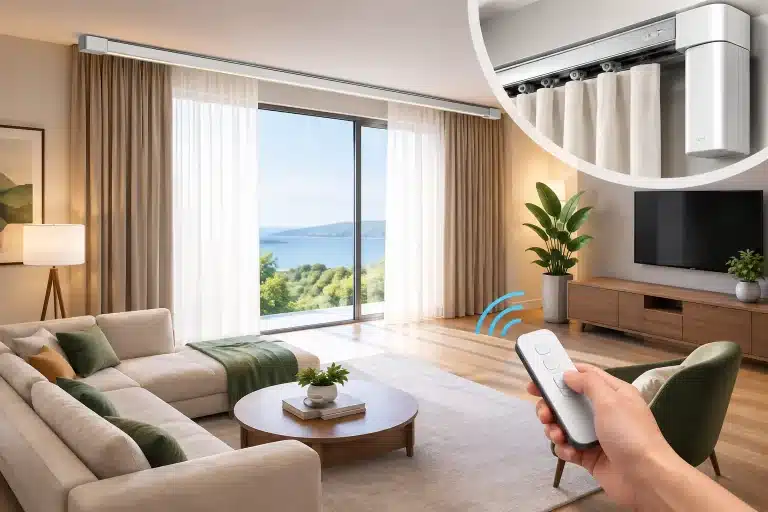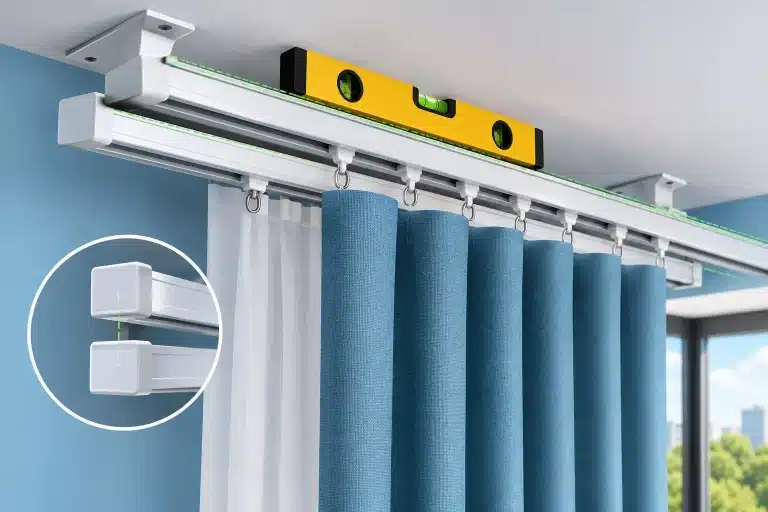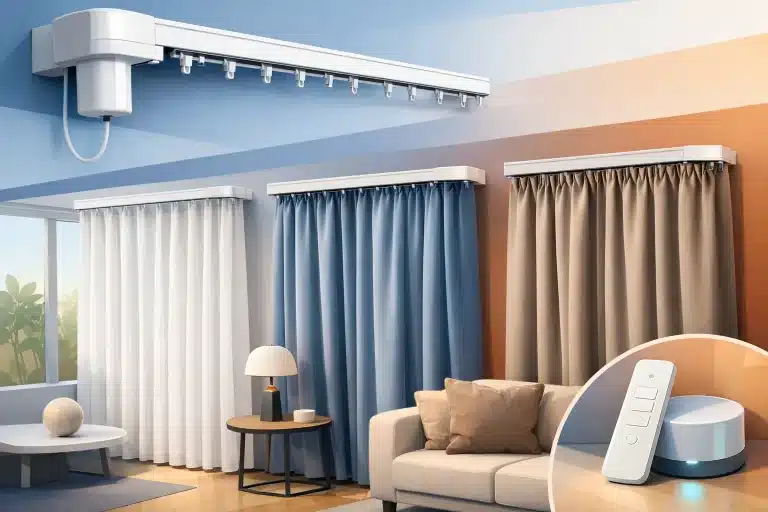
A motorised track can make opening and closing curtains effortless, but the result still depends on the curtains themselves. Homeowners often ask which curtains suit electric tracks when they have already chosen a fabric they love or are planning a full renovation. The reassuring answer is that most curtain styles can work beautifully, provided their heading, weight, fullness and fit are specified for the track.
Thank you for reading this post, don't forget to subscribe!Electric curtain systems are designed to carry made-to-measure curtains, from light sheers to substantial lined drapes. The key is not simply choosing the lightest fabric. It is choosing curtains that move freely, stack neatly and stay within the track and motor’s recommended carrying capacity.
Which curtains suit electric tracks best?
Curtains with a heading that runs smoothly in a track are usually the best choice. Wave curtains are especially popular with electric tracks because their evenly spaced carriers create a clean, consistent fold. They open in a controlled, uniform way and give windows a contemporary, hotel-style finish.
Pencil pleat curtains can also be fitted to an electric track, particularly where a softer, more traditional appearance is preferred. They need to be made and hooked correctly so the weight is distributed evenly across the gliders. For many homes, this is a practical route to automation without changing an established interior style.
Pinch pleat and goblet-style curtains can be suitable too, but they require more careful planning. Their tailored headings and deeper folds can create a larger stack when open, so the available space at the sides of the window matters. This is particularly relevant in a recess, beside a balcony door or where furniture sits close to the window.
In most cases, the strongest combination of appearance and performance is a made-to-measure wave curtain on a correctly specified electric track. That does not make it the only good option. A period property, for example, may suit interlined pinch pleats far better than waves, while still benefiting from motorised control.
Curtain weight matters, but it is not the whole story
Every motorised track has a maximum curtain weight, and this should be checked before an order is finalised. A pair of full-length, lined velvet curtains can be considerably heavier than they look. Wide glazing, tall ceilings, blackout linings and generous fullness all add weight.
However, total weight is only part of the calculation. A curtain that is within the stated weight limit can still perform poorly if the fabric catches, the track layout is unsuitable or the stack-back has not been allowed for. Conversely, a well-made heavier curtain can travel very smoothly when it is matched to the right motor and track design.
As a guide, lightweight voiles and sheers are easy for most systems to operate. Medium-weight linen blends, cottons and lined decorative fabrics are common choices for living rooms and bedrooms. Heavy blackout, wool, velvet and interlined curtains usually need a higher-capacity motor, especially across large openings or around bends.
Fabric choice should also reflect how the curtains will be used. A bedroom curtain that closes every evening needs reliable blackout and a quiet movement. A living room overlooking the garden may benefit from a lighter, more relaxed fabric that can be scheduled to open with the morning light. For wide bi-fold or sliding doors, the priority may be a track that handles the curtain weight across the full span without a visible centre obstruction.
Choose a heading made for track operation
The heading determines how the curtain connects to the carriers, how it gathers and how much room it takes up when open. It is therefore one of the most important choices for automated curtains.
Wave headings
Wave curtains are made to a fixed spacing, with cords or tape connecting the carriers. This keeps each fold aligned as the motor pulls the curtain across the track. The finish is neat from both inside and outside, and the curtains tend to stack back predictably.
They are an excellent choice for modern homes, floor-to-ceiling glazing and wall-to-wall tracks. They also work well when the track is recessed into a ceiling, where the fabric appears to fall directly from the ceiling line.
Pencil pleat headings
Pencil pleat is flexible, familiar and suited to a wide range of fabrics. It can work well on electric tracks, but it should be professionally gathered to the right width and attached using suitable hooks. Overly tight gathering or uneven hook placement can make a curtain pull less smoothly.
This heading is often a sensible choice where homeowners want to retain existing curtain fabric, although its condition and actual weight should be assessed first.
Pinch pleat headings
Pinch pleats offer a more formal, structured look and work well in traditional or premium interiors. Because each pleat is fixed, the curtains require accurate fabrication and a track layout that allows for the open stack. They are particularly effective on straight runs where there is enough wall space beyond the window.
Lining, blackout and thermal comfort
Lined curtains are very suitable for electric tracks. In fact, lining is often worth considering because it improves drape, protects the face fabric from sunlight and can help with warmth and privacy. In bedrooms, blackout lining is a popular option for darker mornings and a more restful night’s sleep.
The trade-off is additional weight and bulk. A blackout lining may be modest in a small bedroom, but on a wide, full-length pair of curtains it can affect motor selection and the amount of space needed when the curtains are open. Interlining creates an even more luxurious look and can improve insulation, although it is generally best paired with a system designed for heavier treatments.
If energy efficiency is a priority, consider the whole window arrangement rather than lining alone. A curtain fitted close to the wall or within a well-planned recess can reduce draughts more effectively than one that leaves large gaps at the top and sides. Automated schedules can also help you close curtains at dusk in winter, without needing to remember each room individually.
Plan for stack-back before choosing fabric
Stack-back is the amount of space the curtains occupy when fully open. It is easy to overlook, but it can decide whether a finished installation feels generous or cramped.
A thicker fabric, more fullness and a deeper heading all create a wider stack. On a narrow window, this may cover part of the glass when the curtains are open. On patio doors, it could reduce the clear opening. Wave curtains generally offer a more predictable stack, while heavy pinch pleats can need significant room at either side.
This is why exact measurements should include more than the window width. The position of radiators, light switches, alcoves, door handles, cabinetry and adjacent walls all affect where the track can start and finish. A ceiling recess may look particularly refined, but it must be wide and deep enough for both the moving curtain and the track mechanism.
Straight windows, bays and corners need different approaches
Straight tracks are the simplest arrangement, yet bay windows and corners can be automated very successfully with the right planning. The curtain fabric does not need to change simply because the track turns, but the track layout, carrier movement and curtain split must all be considered together.
A bay may use a shaped track that follows the window line, allowing curtains to draw around the angles. In some rooms, separate tracks for each section provide better control and a more manageable curtain weight. Corners and offset returns can also be designed so the curtains stack where they are least intrusive.
For these layouts, avoid choosing curtains in isolation. A fabric sample can tell you how the colour and texture will look, but it cannot show whether a finished pair will clear a corner, gather comfortably at one side or fit inside a planned pelmet. Dimensions and fitting drawings should guide the final curtain specification.
Can existing curtains go on an electric track?
Sometimes, yes. Existing curtains may be suitable if they are in good condition, compatible with track hooks or carriers, and within the motor’s weight capacity. They may need altering in width or heading, particularly if they were previously hung from a pole with eyelets or rings.
Eyelet curtains are generally not suitable for an electric curtain track because the eyelets are designed to run directly on a pole. Tab-top curtains have the same limitation. Both can occasionally be remade, but the cost and outcome should be considered against commissioning curtains made correctly for the new system.
It is also worth checking whether older curtains provide enough fullness once fitted to a track that extends beyond the window. A motorised system often looks best when the curtains cover the track ends and close with a little overlap, which may require more fabric width than the original arrangement.
A better result starts with coordinated specification
The best curtains for an electric track are the ones designed around the room, not simply selected from a rail display. Fabric, heading, lining, fullness, track position, motor capacity and control method should work together. Whether you want a wall switch by the bed, a remote in the lounge, timed opening while on holiday or integration with a wider smart home system, the curtain treatment must move reliably first.
At Smart Curtains, installation planning helps turn those separate decisions into a practical specification, including advice for recesses, bays, corners and wall-to-wall installations. A well-planned track gives you the freedom to choose curtains for their look and comfort, with the confidence that they will perform as beautifully as they hang.
Before settling on a fabric, share the window measurements, intended curtain style and any site constraints with a specialist. That small planning step can prevent a beautiful curtain from becoming an awkward fit, and help your finished room feel considered every time the curtains open.