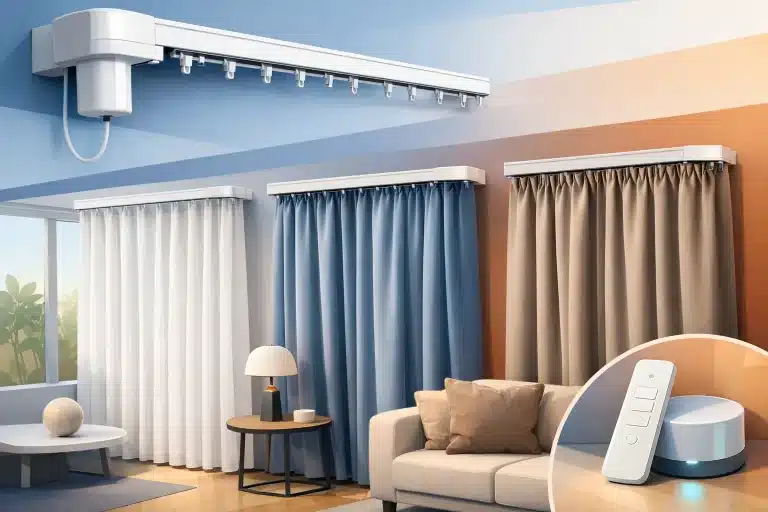
A beautiful wall-to-wall curtain can lose some of its impact if a power lead has nowhere discreet to go. So, do motorised curtains need wiring? Not always – but the power option you choose will affect how the system looks, how often it needs attention and how easily it can be integrated into your home.
Thank you for reading this post, don't forget to subscribe!For most homeowners, the best answer is to plan power early, particularly during a renovation, extension or new build. That said, motorised curtains can still be a realistic upgrade in an existing room where chasing walls or lifting floors is not on the agenda. The right arrangement depends on the window, the curtain weight, the controls you want and the finish you expect.
Do motorised curtains need wiring?
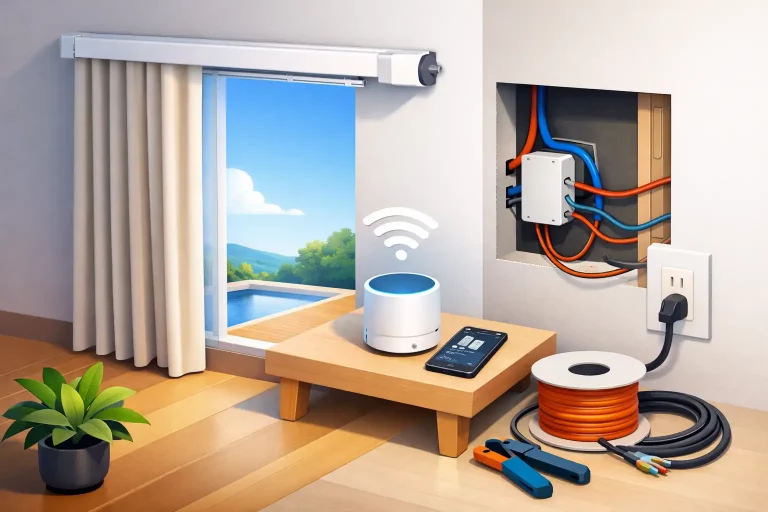
Motorised curtains need a source of power, but that does not automatically mean they need to be hardwired into your electrical installation. Most systems fall into three broad categories: mains-powered tracks connected to a concealed electrical supply, plug-in tracks powered from a nearby socket, and battery-powered tracks with rechargeable batteries.
A mains-powered system is usually the preferred choice for made-to-measure installations where a clean, permanent finish is the priority. The motor is powered continuously, so there is no battery to charge, and it is well suited to larger or heavier curtains, frequent daily use and smart home control.
Plug-in and battery options can be particularly useful where the room is already decorated or electrical work needs to be kept to a minimum. They can provide the same day-to-day convenience, although there are practical compromises to consider.
Mains wiring: the polished long-term option
If you are refurbishing a room, installing a new ceiling or working with a builder, providing a dedicated power point for the curtain motor is often the most elegant route. Typically, a qualified electrician installs a suitable switched fused connection unit or socket close to the motor position. The motor then connects to this supply, with the cable concealed within a curtain recess, pelmet, ceiling void or other planned detail.
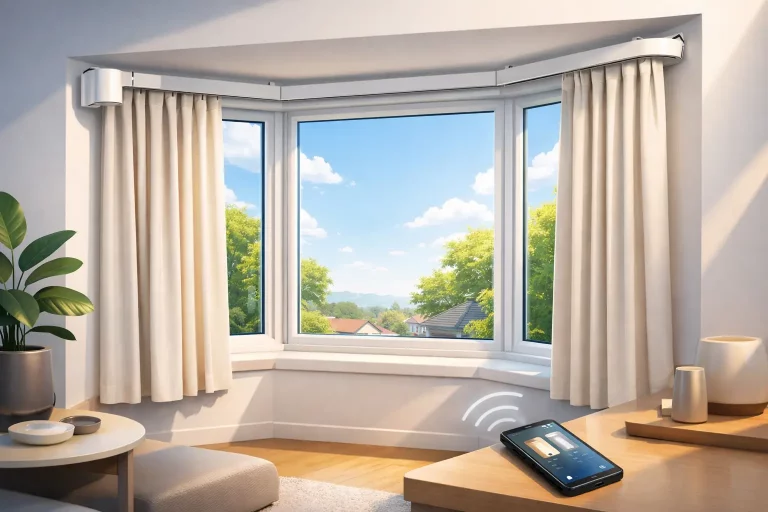
The exact position matters. Curtain motors are usually located at one end of the track, but the correct end depends on the track design, how the curtains stack back, nearby walls and furniture, and where power can be sensibly brought in. A bay window, corner track or wall-to-wall installation may need more careful coordination than a straightforward window.
Mains power is the strongest choice when curtains will be opened and closed on timers every day, controlled from a wall switch, or included in a wider home automation system. It is also a sensible option for tall, wide or lined curtains that place greater demand on the motor.
Hardwiring does require early discussion with your electrician. It should be considered alongside lighting, sockets, plastering and joinery, rather than treated as a final decorative detail. Getting this right before the walls are finished is usually easier and less disruptive than finding a solution afterwards.
Where should the power supply go?
The power supply should sit close enough to the motor for a tidy connection, while remaining safely accessible for maintenance where possible. In many installations it is hidden above the curtain line, inside a recess or behind a pelmet. The aim is to keep the motor, track and cable visually quiet, so the curtains and the room take centre stage.
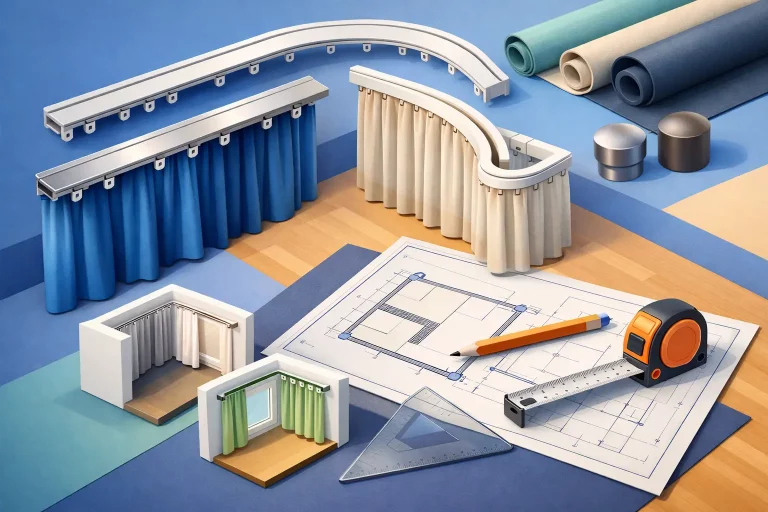
It is worth sharing the proposed track drawing with the electrician before any work begins. A drawing confirms the motor end, the track route and the space required around the installation. This avoids a common frustration: a power point placed neatly at the wrong end of the window.
Plug-in motorised curtains: less electrical work, more planning
A plug-in motorised curtain track draws power from an existing socket. It may be a practical option in a bedroom, lounge or home office where you do not want to alter the electrical installation. The key question is whether the cable can be routed discreetly from the motor to the socket.
In some rooms, this is straightforward. A socket may already be positioned near the window, behind furniture or below a radiator shelf, allowing the cable to be managed neatly. In others, the cable route could be visible across a wall or interfere with the way curtains hang. A visible lead is not ideal in a carefully finished interior, especially around a statement window.
Plug-in power can suit a homeowner who wants reliable mains operation without the cost or disruption of adding a new spur. However, it should not be chosen simply because there is a socket somewhere in the room. Consider the cable length, the position of the motor, the curtain stack and whether the route will still look considered once the room is furnished.
Battery-powered curtains: flexibility for existing rooms
Battery motors are designed for situations where wiring is difficult, undesirable or impossible. The battery is usually mounted close to the motor or integrated into the system, and it can be recharged periodically. This makes battery power particularly attractive for completed rooms, listed properties where alterations are limited, rental homes and windows that are far from a suitable electrical supply.
The benefit is flexibility. There is no need to chase a wall or install a new socket solely for the curtains, and the finished installation can remain free from visible leads. For smaller or moderately sized curtain sets used once or twice each day, battery operation can be an excellent solution.
The trade-off is maintenance. Recharge intervals vary according to curtain weight, track length, usage, motor specification and whether the curtains are operated through schedules or automation. A battery system is convenient, but it is not fit-and-forget in the same way as a mains-powered track. You will need to be comfortable charging it when required.
Battery power may also be less suitable for very large, heavy curtains or locations where reaching the motor would be inconvenient, such as high-level windows. In those cases, the apparent simplicity at installation can become less convenient over time.
Wiring for smart home and wall-switch control
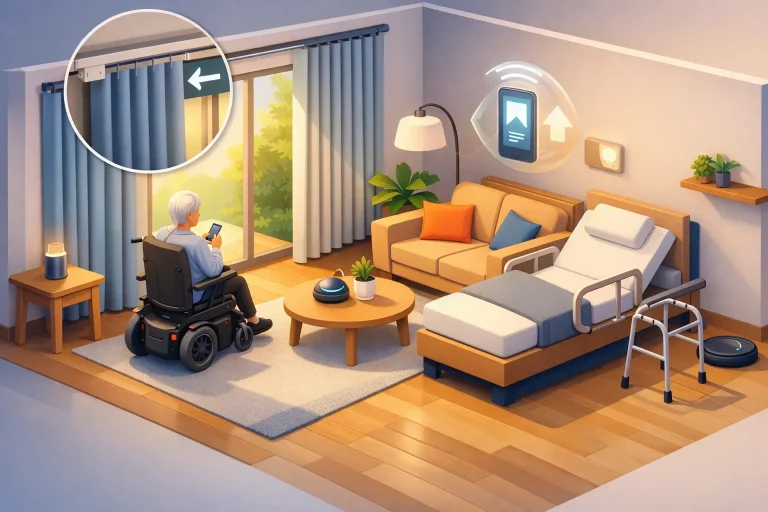
Motorised curtains can be controlled by remote control, a wall switch, smartphone app, timer or compatible smart home system. Your preferred controls can influence the wiring plan, but not always in the way people expect.
A wireless remote or app does not normally require a cable to run from the switch or phone to the curtain track. The control signal is wireless. The motor still needs power, either from mains electricity or a battery, but a wall switch can often be positioned without the extensive cabling associated with a traditional wired switch.
For a fully integrated smart home installation, your automation provider may have additional requirements. They may need to know the motor type, communication method and final track layout before commissioning the system. This is especially relevant when curtains are intended to react to scenes such as “Good morning”, “Cinema” or “Away from home”.
Planning these details together prevents a technically capable system from feeling awkward in daily use. A switch by the bedroom door, for example, may be more useful than one placed beside the window. Timers may make sense for privacy and security, while a handheld remote can be ideal for a guest room.
Plan the track before the electrics
Power is only one part of a successful motorised curtain installation. The track must be specified for the shape and size of the window, the heading and fullness of the curtains, and where the fabric needs to stack when open. These details influence the motor position and therefore the electrical point.
Bay windows, curved arrangements, corners, offsets and ceiling recesses all need accurate planning. So do wall-to-wall tracks, where the motor may need to sit in a narrow return at one end. A few millimetres can make a difference when space is tight around coving, bulkheads or cabinetry.
Before arranging electrical work, confirm the following with your curtain specialist: the finished track dimensions, the motor end, the intended cable route, the available recess depth and whether access will be possible after installation. If curtains are being made at the same time, also check where they will stack back so they do not cover a switch, clash with a wardrobe or reduce the light from the window more than expected.
At Smart Curtains, installation planning is treated as part of the specification, not an afterthought. Clear dimensions and fitting drawings help homeowners, builders and electricians work from the same plan before the track arrives.
Choosing the right power option for your home
Choose mains wiring if you are renovating, want the most discreet finish, expect frequent use or are investing in smart home integration. It is generally the most dependable, low-maintenance choice over the long term.
Choose plug-in power if a suitable socket is close to the motor location and the cable can be hidden or managed neatly. It offers continuous power without necessarily changing the fixed wiring.
Choose battery power if preserving existing decoration is the main concern, there is no sensible cable route or the installation is relatively light-duty. Just allow for periodic charging as part of ownership.
The best system is not simply the one with the least wiring. It is the one that suits the room now and still feels effortless years from now. Decide where the curtains should sit, how you want to control them and what level of finish you expect, then let the power plan follow from there.