A motorised curtain system should feel quietly dependable: curtains open at the right time, close smoothly at dusk and never become another household worry. This automated curtain safety guide explains the practical decisions that make that possible, from choosing a correctly specified track to setting up controls that suit your family, home and daily routine.
Thank you for reading this post, don't forget to subscribe!Safety starts with the right specification
Most safety issues are prevented before the track reaches your home. A made-to-measure motorised curtain track needs to be matched to the curtain weight, heading style, window layout and the structure it will be fixed to. A system that is too light for heavy, lined curtains may strain, run unevenly or stop short. One that has been specified accurately will move the fabric smoothly without excessive pulling or noise.
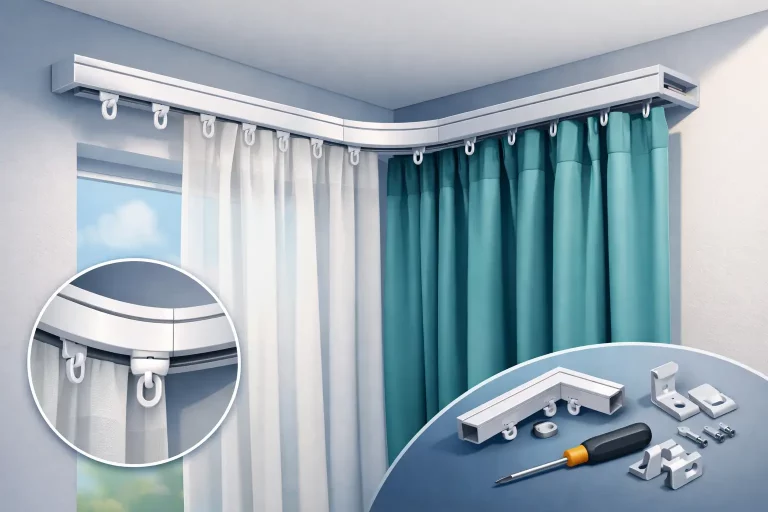
This matters particularly for wide, wall-to-wall runs, bay windows and tracks that turn a corner. The motor position, joins, brackets and curtain stacking space all need consideration. It is not simply a case of selecting a motor and measuring the width of the window.
Share details of the fabric, pole or track position, finished ceiling height and whether the curtains are already made. If the room is being renovated, planning the track and power supply before plastering or fitting a pelmet gives a cleaner result and avoids awkward last-minute compromises.
Plan secure fixing points before installation
A curtain track carries more load than many homeowners expect. The weight is not only the fabric itself. It also includes the repeated force created each time the motor starts, stops and draws the curtains. Fixings must suit the ceiling, wall or recess construction behind the finished surface.
Solid timber, masonry and properly reinforced plasterboard can each provide a suitable mounting point, but they require different fixings and planning. A track should never rely on a weak surface or a decorative pelmet alone. For ceiling installations, it is worth confirming where joists, noggins or other structural support sit before the room is finished.
The same principle applies to recessed tracks. A recess needs enough depth and width for the motor, brackets, curtain heading and fabric stack. If it is too tight, the curtains can rub, snag or place unnecessary pressure on the system. Good fitting drawings make these details clear for your builder, electrician or installer.
Check the curtain weight, not just the width
A narrow pair of interlined curtains can be heavier than a much wider sheer. Thermal linings, blackout fabrics and full headings all add weight. Give the supplier accurate curtain information rather than assuming a standard motor will suit every room.
If you are ordering new curtains alongside automation, ask for the finished weight where possible. This allows the track and motor to be chosen with a sensible margin, rather than operating at the top of their capacity every day.
Treat electrical planning as part of the design
Mains-powered curtain motors should be planned with the same care as lighting or blinds. Decide where power will be available, where the cable will be routed and whether you want a switched spur, wall control or smart home connection. A discreet power position near the motor usually creates the neatest finish.
Any new fixed electrical work should be assessed and completed by a suitably qualified electrician. They can confirm the appropriate circuit, isolation and compliance requirements for your property. This is especially relevant when wiring is being concealed behind a ceiling, within a recess or alongside other home automation equipment.
Avoid trapping cables behind brackets, pulling them tightly around corners or allowing them to hang where they could be caught. The motor cable and any low-voltage control wiring should be protected from accidental damage and kept clear of heat sources, damp areas and moving parts.
If your chosen system uses a plug-in supply, locate the socket so that it remains accessible without creating a visible trailing lead. For battery-operated options, follow the manufacturer guidance on charging, replacement and storage. Batteries and remote-control battery compartments should always be kept secure and out of reach of young children.
Make controls safe and easy for everyone to use
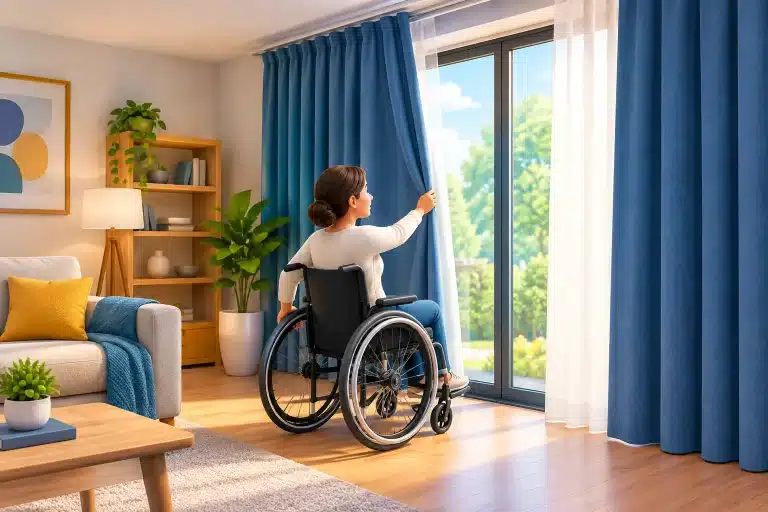
One of the real benefits of automation is accessibility. A wall switch, remote, timer or smartphone control can remove the need to reach behind furniture, lean over a radiator or pull heavy curtains by hand. However, the most convenient control method is not always the best one for every household.
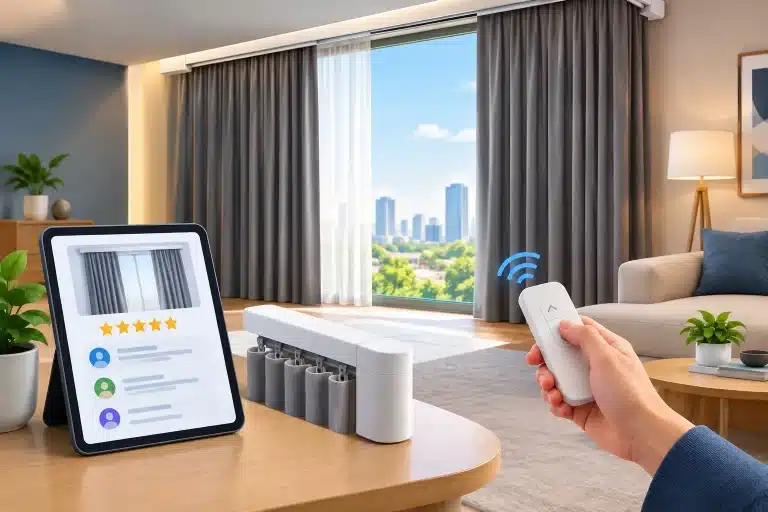
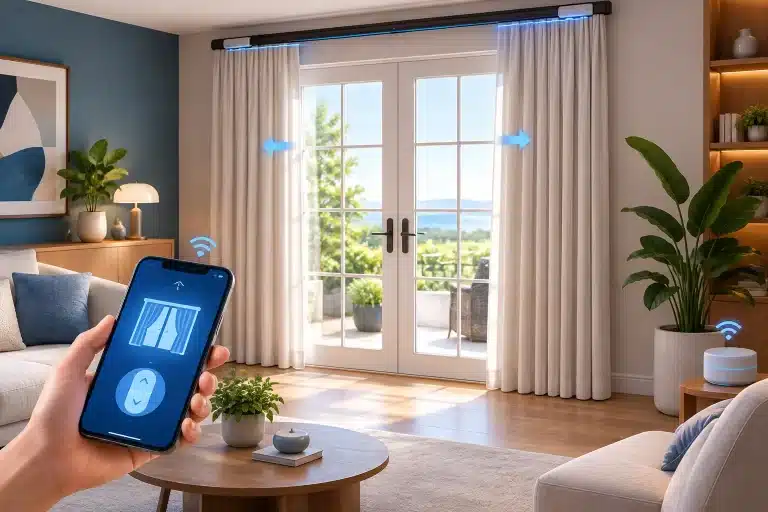
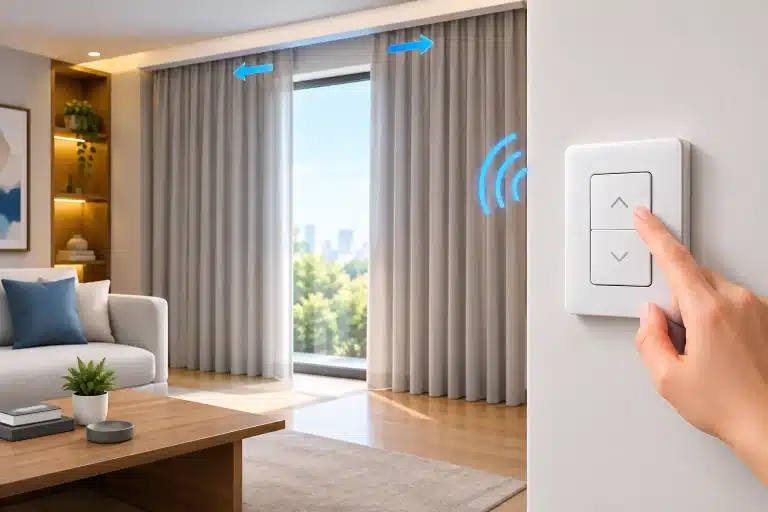
Wall controls work well when they are positioned at a practical height near the room entrance. Remotes should have a consistent home, particularly in households where more than one person uses the system. App control can be useful when you are away, but it should not be the only way you can operate the curtains if your internet connection is unavailable.
Ask how the curtains behave during a power cut. Depending on the system, you may be able to move them manually, use a manual override or need to wait for power to return. Understanding this in advance is particularly worthwhile for bedroom curtains, rooms used by someone with reduced mobility and windows that form part of your usual ventilation routine.
Child and pet considerations
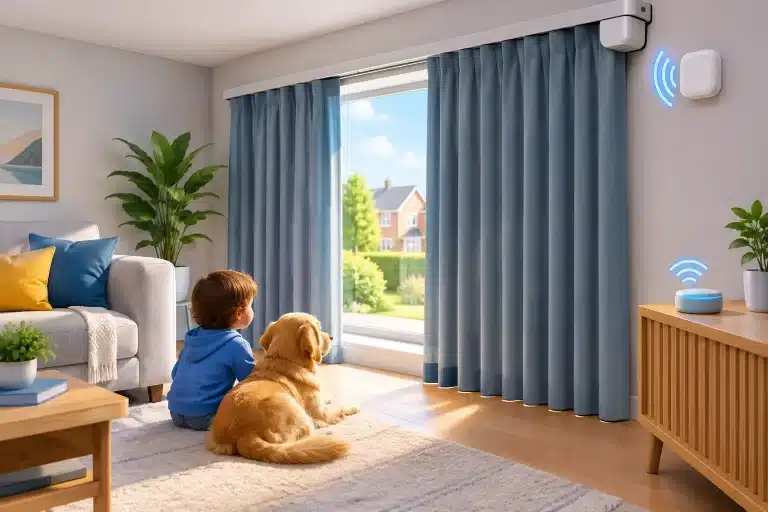
Motorised curtains can reduce the need for looped operating cords, which is a welcome safety advantage. Still, assess the full window area rather than the track alone. Keep curtain tie-backs, loose pull cords from other window coverings and electrical leads out of reach of children and pets.
Do not allow children to play with remotes or repeatedly operate the curtains as a game. Curtain fabric can move with more force than expected, especially on a large track, and small remote batteries can present a serious hazard if swallowed. Choose remotes with secure battery covers and store spare batteries safely.
For households with pets, make sure beds, climbing furniture and feeding stations are not positioned where an animal can become entangled in fabric or obstruct the curtain path. A track performs best when the route is clear from end to end.
Set smart routines with people in mind
Schedules are useful for privacy, comfort and a lived-in appearance when you are away. A simple morning opening and evening closing routine is often enough. The safest automations are predictable, easy to pause and based on how the room is actually used.
Think carefully before setting curtains to close automatically during times when people may be near the window. If you use occupancy sensors, voice assistants or whole-home scenes, make sure everyone in the household knows what will happen. Avoid routines that could close curtains while someone is handling the fabric, cleaning the window or moving furniture nearby.
It is also sensible to retain an easy manual control method. Smart home integration is convenient, but guests, children, carers and tradespeople may not have access to your app or automation platform. A clearly labelled wall switch or remote gives them a straightforward option.
For security when you are on holiday, vary schedules slightly where your system allows it, rather than running the exact same pattern every day. Curtains can support a more occupied appearance, but they should complement sensible home security measures rather than replace them.
Commission the system before relying on it
Once installed, take a few minutes to test the complete arrangement. This is the point to identify a curtain that catches, a bracket that is loose or an automation that does not suit the household routine. A proper handover should leave you confident using the system, not searching for instructions when something changes.
Check the following before treating the installation as complete:
- The curtains travel freely in both directions, without rubbing on a recess, radiator, window handle or pelmet.
- Every bracket is secure, and the track remains straight under the full curtain load.
- Wall switches, remotes and app controls operate as expected, including any stop or pause function.
- Scheduled actions occur at the intended times and can be adjusted or disabled easily.
- Everyone who needs to use the curtains understands the normal operation and what to do during a power interruption.
If the curtains are not moving smoothly, stop using the system until the cause is clear. Forcing a motorised track to overcome a snag can damage the gliders, fabric, motor or fixings. Small adjustments to the heading, track alignment or fabric clearance often solve the problem early.
Keep the track working safely over time
Motorised tracks need relatively little maintenance, but a quick visual check every few months is worthwhile. Look for loose brackets, dust build-up, damaged cables and anything that has entered the curtain path. After redecorating, replacing curtains or moving furniture, repeat a full open-and-close test.
Do not add oil, spray lubricants or household cleaners unless they are specifically recommended for your track. These products can attract dust or affect components that are designed to run dry. If a motor becomes unusually noisy, slows down or stops inconsistently, arrange advice before the issue develops.
A well-planned system makes safety feel almost invisible. With accurate measurements, secure fixings, thoughtful electrical planning and controls that suit the people using the room, automated curtains become a dependable part of a calmer, better-finished home.