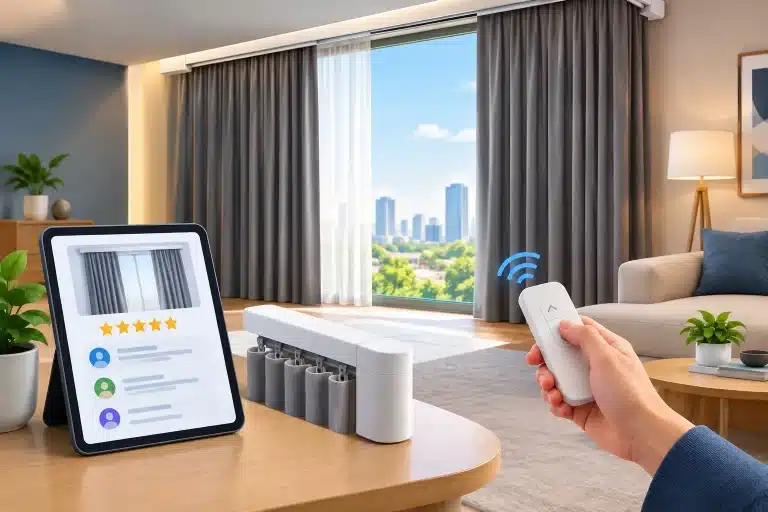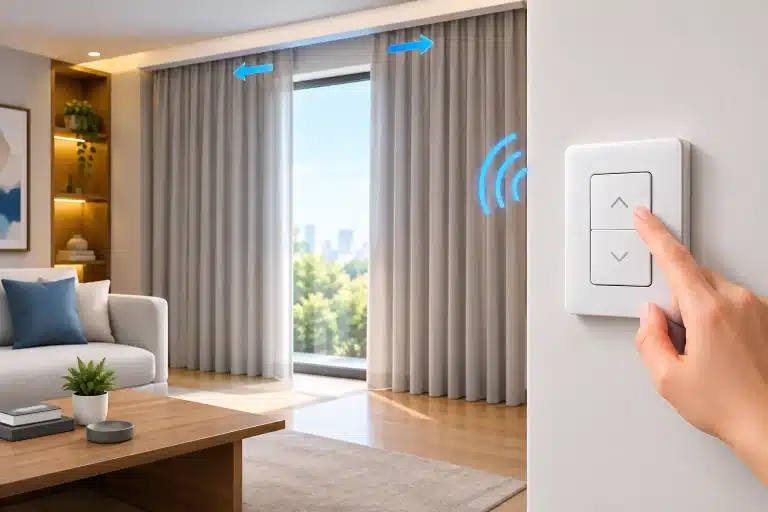
A well-placed wireless wall switch changes the feel of motorised curtains from a clever feature into part of the home. Rather than reaching for a remote or opening an app, you press a familiar control as you enter the room, leave for work or settle down for the evening. For many households, that simple routine is what makes curtain automation genuinely useful.
Thank you for reading this post, don't forget to subscribe!For a made-to-measure motorised curtain system, the switch should be considered early. Its position, style and method of control can affect the electrical plan, the finished wall layout and how naturally the curtains fit into everyday life. The good news is that a wireless option gives far more freedom than a conventional wired switch, particularly during a renovation or when you do not want to disturb finished decoration.
What is a wireless wall switch?
A wireless wall switch is a fixed, wall-mounted control that sends a command to a compatible curtain motor without a control cable running between the switch and the track. Depending on the system, it may use radio frequency, a proprietary wireless protocol or a smart-home platform to communicate with the motor.
It normally provides open, close and stop functions. Some designs also allow a favourite position to be saved, such as partly closed curtains for privacy while still letting in daylight. A switch may be single-channel for one window, or multi-channel for controlling several curtain tracks independently.
The key distinction is worth making: wireless refers to communication, not always to power. Many switches are battery-powered and can be fixed to the wall without wiring. Others are mains-powered but communicate wirelessly with the curtain motor. The right choice depends on the control system, the property and the finish you want to achieve.
Why homeowners choose a wall switch as well as an app
Apps, voice control and timers are all valuable ways to operate automated curtains, but they do not replace the usefulness of a physical switch. Guests can use it without needing access to your smart-home account. Children and older relatives do not need to find the right phone screen. If the internet is temporarily unavailable, local wireless control may still work perfectly, depending on the system specified.
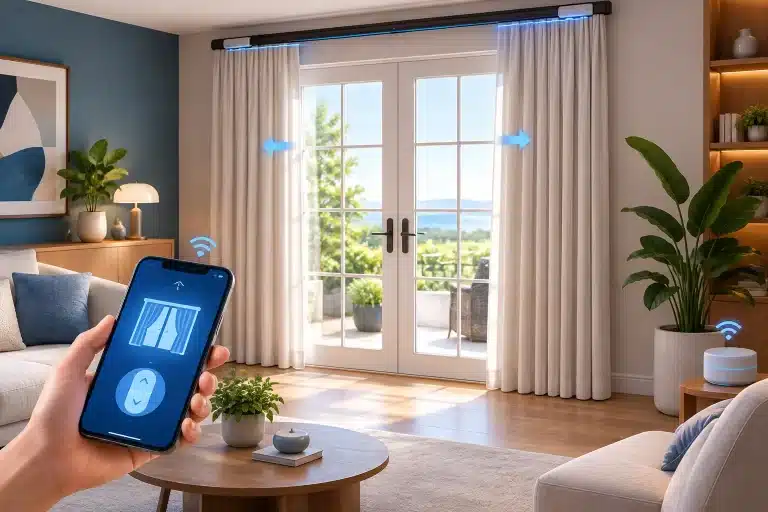
A wall switch also creates consistency. You might use an app to schedule the bedroom curtains to open on weekday mornings, but prefer a button by the sitting-room doorway when you want instant privacy after dark. The strongest installations usually offer more than one convenient way to control the same track.
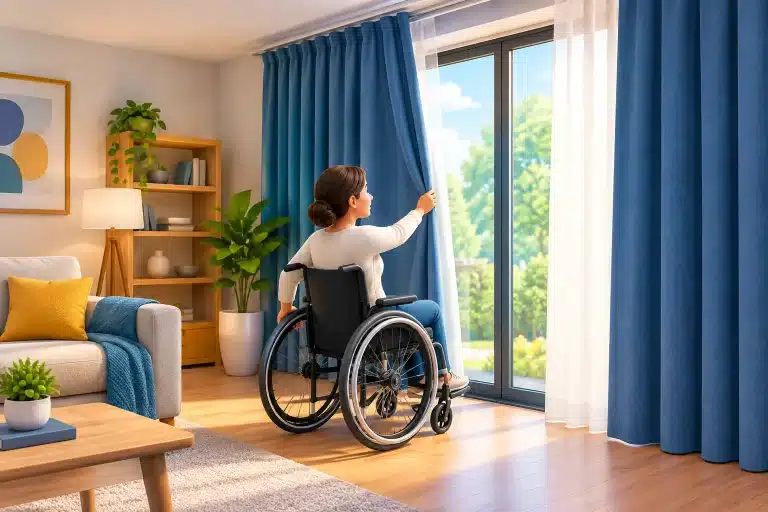
For homeowners with restricted mobility, the benefit can be particularly meaningful. A switch positioned at an accessible height can remove the need to cross the room or handle heavy fabric every morning and evening. It is a small planning decision with a lasting effect on comfort and independence.
Choosing the right wireless wall switch
The best switch is not necessarily the one with the most functions. It is the one that suits your curtain layout and feels intuitive for everyone using the room.
Match the switch to the number of tracks
Start with the window treatment itself. A single pair of curtains across one opening is straightforward: one channel can open, stop and close the track. A wider room may have several windows, perhaps with separate tracks at patio doors, a bay window and a feature window. In that case, you may want individual buttons for each track, a grouped command to move them together, or both.
Consider whether sheers and blackout curtains will share the same window. These are often operated on separate tracks and usually need separate control. It is possible to keep the interface simple, but this needs to be planned rather than added as an afterthought.
Decide how much control you need
Open, stop and close is enough for many homes. A stop button is more useful than it may first appear, allowing you to pause curtains at a preferred point for glare control, privacy or an attractive layered look.
A favourite-position function is worthwhile where curtains are regularly left partially closed. In a ground-floor front room, for example, you may wish to retain daylight while shielding the room from the street. In a bedroom, a favourite setting can soften early sunlight without making the room completely dark.
If you are controlling multiple rooms, scene-based smart-home control can be a better fit than a highly complicated wall switch. One evening scene could close the principal living-area curtains while leaving a kitchen door clear, but the precise possibilities depend on the automation platform and motor selected.
Think about the visual finish
Because the switch will sit at eye level or beside other controls, appearance matters. Choose a style that sits comfortably with your existing sockets, light switches and interior scheme. A discreet white finish may be ideal in a minimal new build, while a more considered plate finish can suit a period renovation or premium interior project.
Placement should also look deliberate. A switch mounted awkwardly around furniture or far from the natural route into the room can make a well-designed installation feel less polished. This is one reason it helps to decide on curtain controls before finalising the electrical layout and decorating.
Where should a wireless wall switch go?
There is no universal position, but there are dependable starting points. Near the main entrance to the room is often the most practical location, ideally alongside the lighting controls. This allows you to close curtains as you leave and create an evening atmosphere without walking across the room.
In bedrooms, a second switch near the bed can be a worthwhile addition. It gives you control at the start and end of the day without relying on a phone, and can be especially useful for wide, heavy curtains. For accessible homes, position and height should be based on the person using the room rather than simply copying a standard light-switch location.
Avoid locating the switch behind a door when open, behind a large piece of furniture or in a place that requires someone to step into the room before they can operate it. Also consider the path of future furniture. The ideal position on an empty floor plan may not remain practical once a wardrobe, sofa or shelving is in place.
A battery-powered wireless wall switch is particularly helpful in finished rooms because it can often be mounted without chasing walls or adding new cables. That said, check how the chosen model is fixed and how easily its battery can be replaced. A clean installation should remain easy to maintain years later.
Plan power separately from control
A wireless switch does not remove the need to power a motorised curtain track. The motor itself will need an appropriate power supply, typically planned close to one end of the track or concealed within the curtain recess. Exact requirements vary by system, so this should be agreed before the track is manufactured and before the electrician completes first fix.
This is especially relevant for bay windows, curved tracks, corners and wall-to-wall installations. The preferred motor end may be influenced by socket locations, access for servicing, the stack-back of the curtains and the shape of the room. It is much easier to resolve these details on a fitting drawing than after plastering and decorating are complete.
For refurbishment projects, the ability to keep the control wireless can simplify the work considerably. You can retain the visual convenience of a wall-mounted switch while reducing disruption to finished surfaces. However, wireless control should not be treated as a substitute for proper planning around motor power and track access.
Wireless wall switches and smart-home integration
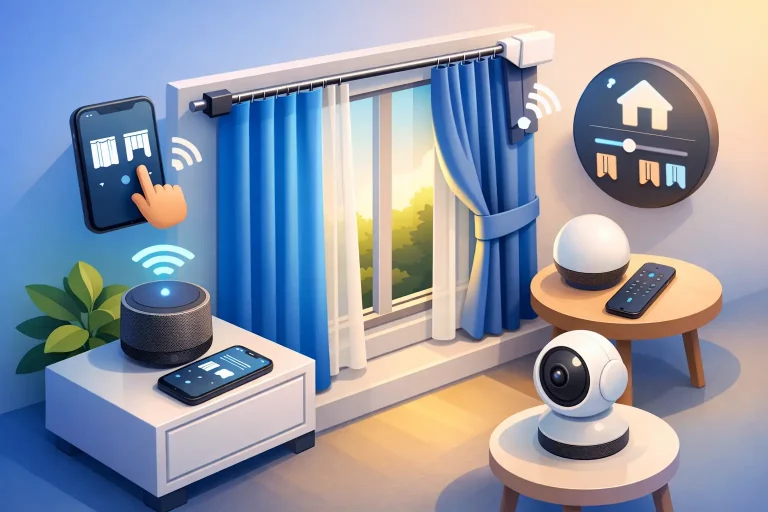
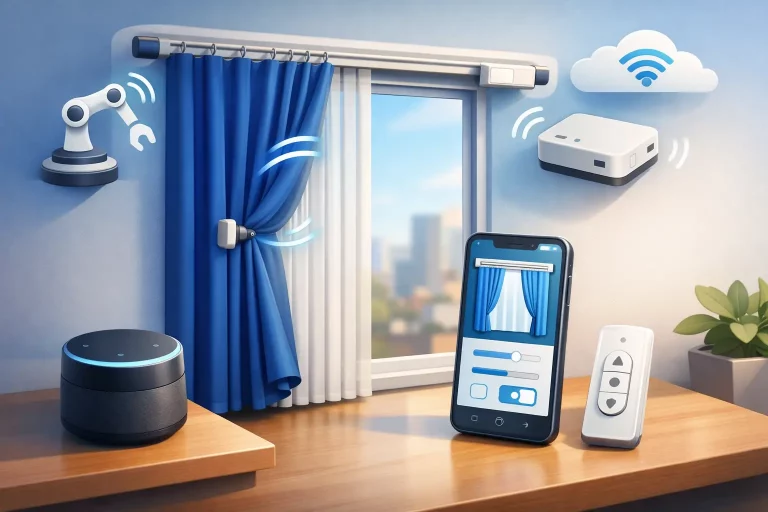
A wall switch does not have to compete with smart-home control. It can sit alongside scheduled operation, remote controls and voice commands, giving you dependable manual control whenever it is wanted.
For example, timed opening can help make weekday mornings easier, while an evening routine can close curtains at a chosen time for privacy. When you are away on holiday, varied schedules can make the house appear occupied. A physical switch remains the immediate option for the moments that do not follow a schedule, such as an unexpectedly sunny afternoon or an early film night.
Compatibility should always be checked before specifying a switch. Not every wireless switch works with every motor, hub or smart-home ecosystem. If you plan to integrate curtains with lighting, heating or security routines, establish the intended platform at the beginning. Retrofitting integration later may be possible, but it can introduce unnecessary limits or additional hardware.
Make the switch part of the wider curtain plan
A wireless wall switch is a relatively small component, yet it has a major effect on how effortless motorised curtains feel. The most successful choice is shaped by the room, the number of tracks, the people using them and the control methods you already prefer.
At Smart Curtains, this is why control choices are considered alongside measurements, recess details, motor position and fitting drawings rather than left until the end. When the track, fabric stack-back, power supply and switch location are coordinated from the outset, the finished room feels considered rather than merely automated.
The best control is the one you will use without thinking: within easy reach, simple to understand and suited to the rhythm of your home.