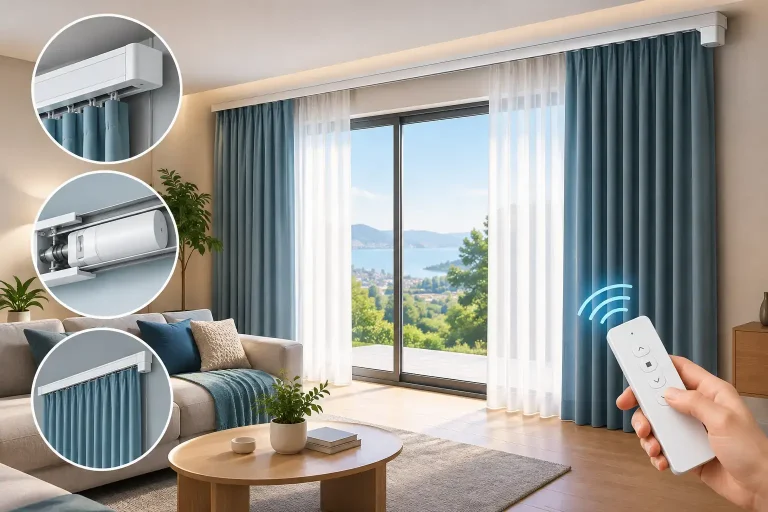
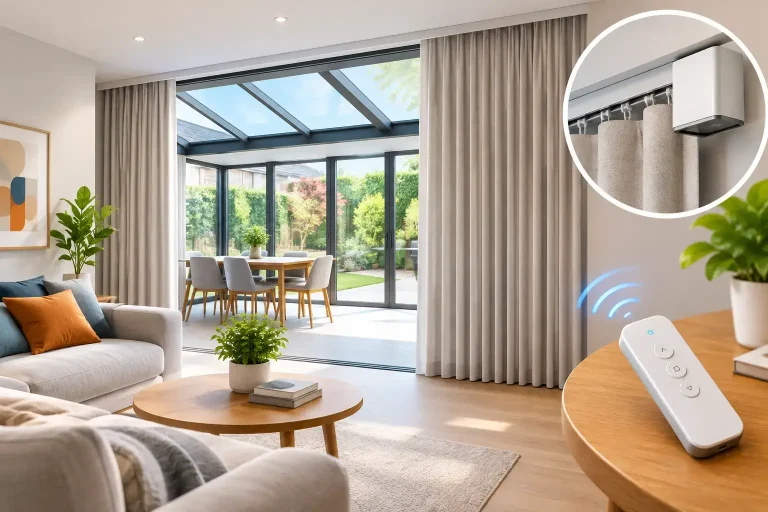
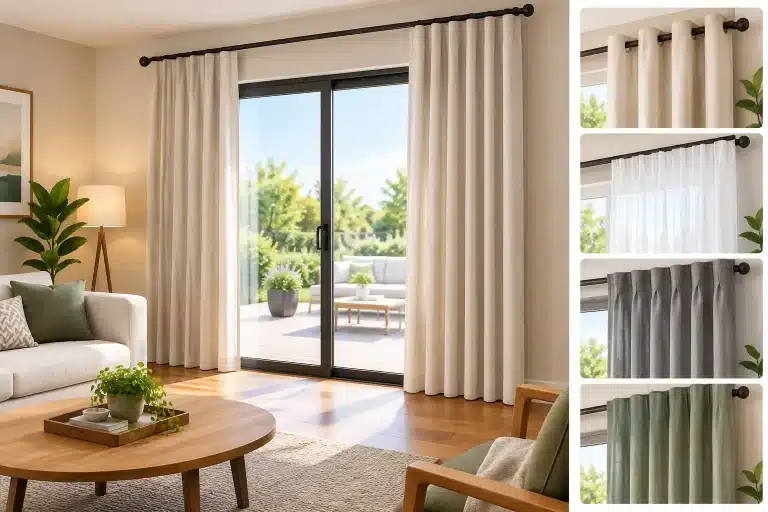
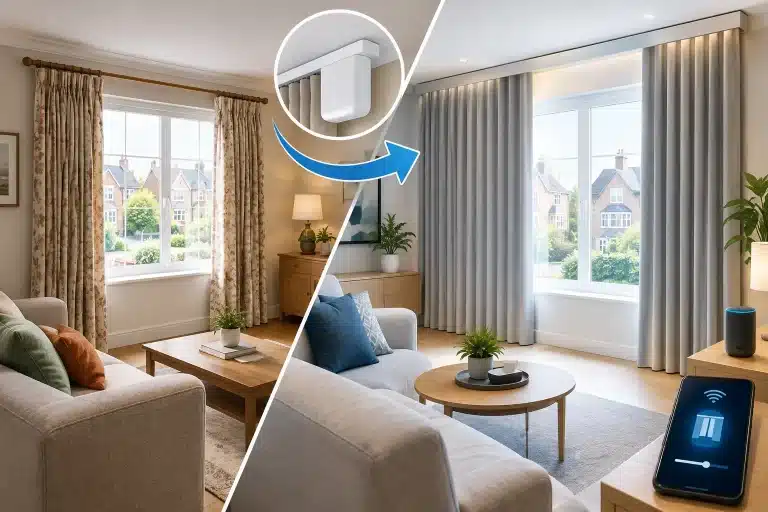
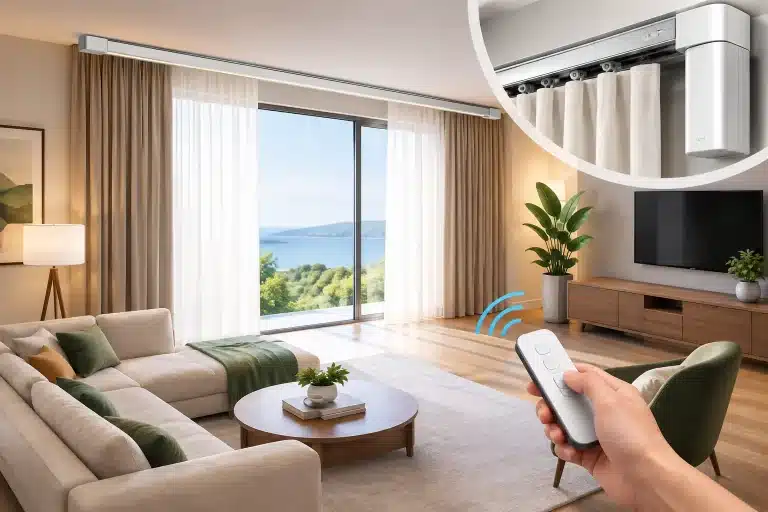
A curtain track can be hidden behind a pelmet, fitted across a wide bifold door or shaped around a bay window, yet still be operated from the comfort of the sofa. So, can electric curtains use remotes? Yes. A remote handset is one of the most straightforward and popular ways to control motorised curtains, giving you instant movement without getting up, pulling fabric or relying on an app.
Thank you for reading this post, don't forget to subscribe!For many homeowners, that simplicity is exactly the point. Remote control brings a polished, practical finish to bedrooms, living rooms and media rooms, while leaving the door open to timers, wall switches and smart home control later if you want them.
Can electric curtains use remotes in every room?
Most electric curtain systems can be specified with remote control, but the best arrangement depends on the track layout, motor and how you want the room to work. A single curtain track may be controlled by one handset, while an open-plan room with several windows can be arranged into zones. That means you might open the main curtains together in the morning, but close only the west-facing window when afternoon sun becomes too strong.
Remote-controlled electric curtains are particularly useful where manual operation is awkward. Think of tall windows, furniture positioned in front of the curtains, wide wall-to-wall tracks, or a bed placed close to the window. They can also make daily routines easier for people with limited mobility, young families and anyone who simply prefers not to handle heavy curtain fabric twice a day.
The key is to decide early whether the remote will be your main control method or one part of a wider system. This affects the motor specification, power planning and the way controls are grouped.
How remote-controlled curtain tracks work
An electric curtain track contains a motor that draws the curtain carriers along the track. When you press a button on the remote, it sends a wireless signal to the motor or its receiver. The curtains can then open, close or stop at a chosen point.
Depending on the system selected, the remote may offer simple open, stop and close buttons, or allow you to control several tracks independently. Some handsets can save channels or scenes. For example, one button could close the curtains in the lounge, while another closes all upstairs bedroom curtains before bed.
The system is usually set up during installation, so it is worth discussing how you use each space before ordering. A beautifully made track should also be intuitive to operate. There is little value in adding automation if every family member needs a lesson before they can close the curtains.
One remote, several curtains
A multi-channel remote is often the neatest answer for homes with more than one motorised track. Each channel can control a separate curtain, a pair of curtains or a room-wide group. It reduces the need for a collection of handsets on the coffee table and makes a larger installation feel considered rather than complicated.
There is a trade-off. More channels provide flexibility, but a very detailed arrangement can be unnecessary in a smaller home. In a bedroom, a single-channel handset is often all that is needed. In a renovation with multiple reception rooms, bedrooms and a cinema room, zoned control is usually worth planning from the outset.
Can you stop curtains part-way?
In most cases, yes. A stop button lets you pause the curtains where you want them, which is useful when you want daylight without fully exposing the room. The exact functionality varies by motor and control system, so it should be confirmed during specification.
If you regularly want a precise partially open position, smart controls or programmed scenes may offer more repeatable results than manually pressing stop at the right moment. A remote remains excellent for everyday control, but it does not have to do every job alone.
Remote, wall switch or app: which is right for you?
Remote control is not an either-or decision. Many made-to-measure electric curtain systems can combine more than one method, allowing different people and situations to be catered for.
A remote is ideal when you want a quick, portable control point. It suits a bedside table, a favourite chair or a room where you do not want to reach a wall switch. It also keeps operation simple for guests and family members who may not use a smart home app.
A wall switch gives a fixed, familiar control point. It can be particularly convenient beside an entrance, next to a bed or where a whole-house automation system is being installed. It needs to be positioned and coordinated with electrical work, so it is best considered before plastering and decorating are complete.
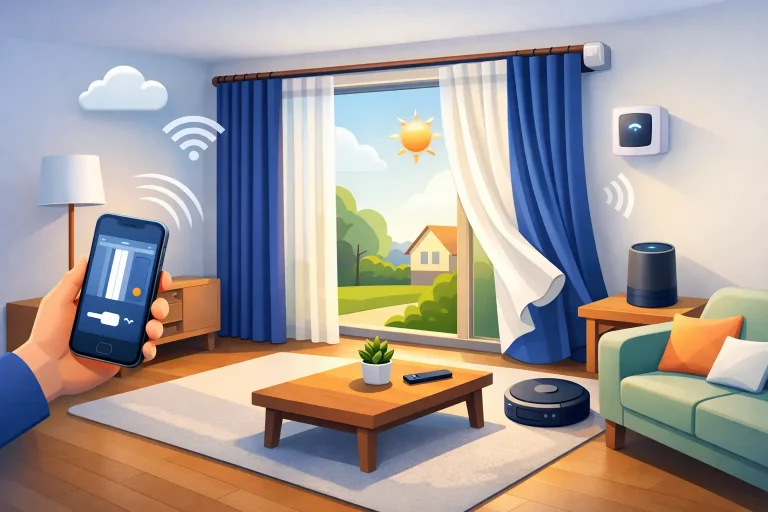
A smartphone app is useful for timers and control when you are away from home. If security is a priority, automated opening and closing can help a property look lived in while you are on holiday. Smart home integration can also link curtains with lighting, heating or voice control. However, an app should be a convenience, not the only way to close the curtains on a quiet evening when your phone is elsewhere.
For many homes, the most comfortable solution is a combination: a handset for immediate control, a timer for routine and a wall switch or app where it adds genuine value.
What to plan before choosing a remote
The remote itself is a small part of the project. The quality of the finished result rests on track design, accurate dimensions and suitable power provision. This is especially true for bays, corners, recesses and wall-to-wall installations, where an off-the-shelf approach can leave awkward gaps or limit the way curtains stack.
Start by considering where the curtains will park when open. Stacked fabric needs room, and the motor also needs a sensible position. On a wide run, you may choose curtains that meet in the middle or draw to one side. Both can work with remote control, but they create different visual results and require different track planning.
Next, think about power. Some systems use mains power and need an appropriate electrical point near the motor location. Others may offer rechargeable battery operation, which can reduce disruption where wiring is difficult. Battery systems are convenient, though they need charging and may not be the preferred choice for very large, heavy curtains or high-use installations. The right answer depends on access, fabric weight and how often the curtains will move.
Finally, decide where the handset will live. A remote only feels convenient when it is easy to find. A wall-mounted holder near the bed or seating area can prevent it disappearing beneath cushions, while a multi-channel handset can keep a whole floor’s controls together.
Choosing a system that feels made for your home
The appeal of electric curtains is not only that they move at the press of a button. It is that a room can feel calmer and more finished when privacy, light and comfort are easy to manage. The best system is rarely the one with the longest feature list. It is the one that suits your windows, curtains and daily habits without asking you to change them.
That is why accurate measuring and installation planning matter. A motorised track must account for the curtain heading, fabric weight, fixing surface, recess depth and any turns in the track. If the project involves a bay, a corner, an offset arrangement or a concealed recess, fitting drawings can remove uncertainty before work begins. Smart Curtains can help homeowners coordinate these details with their builder, electrician or automation installer before the track is made.
A remote is simple, but your choices can grow with you
Choosing a remote does not commit you to a complicated smart home. It gives you reliable, accessible control from day one, with the option to add schedules or broader automation where it genuinely improves life at home. Whether you are closing bedroom curtains without leaving bed, reducing glare in a sunny sitting room or preparing the house before a trip away, the right control should feel effortless.
A made-to-measure conversation is often the best place to start: establish the track shape, fabric arrangement, power position and preferred controls together, then your remote-controlled curtains will feel like part of the home rather than an add-on.