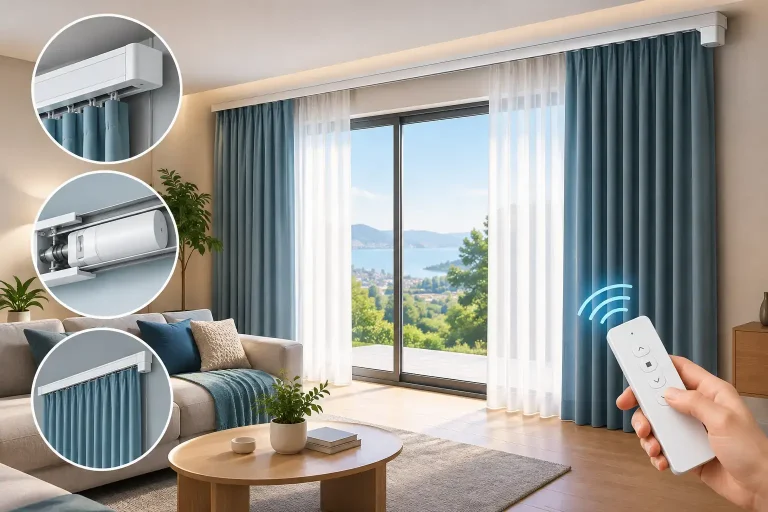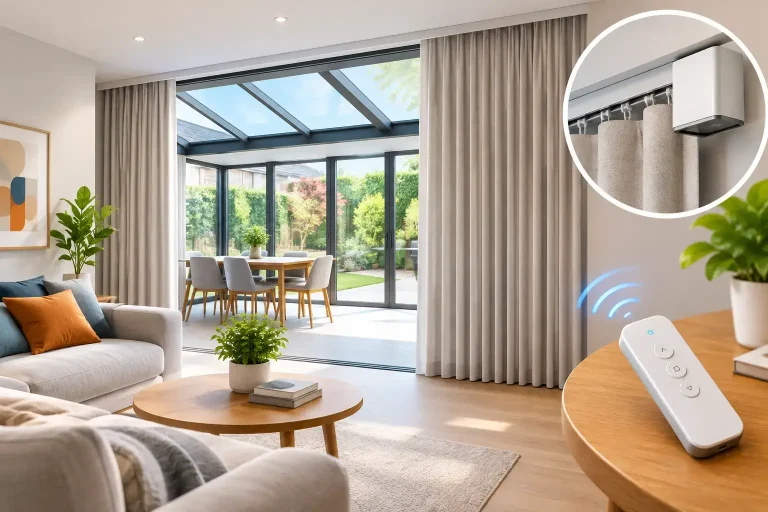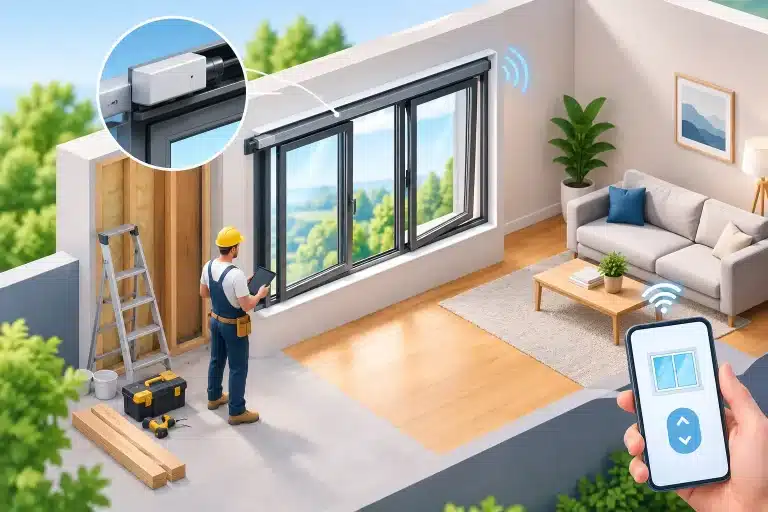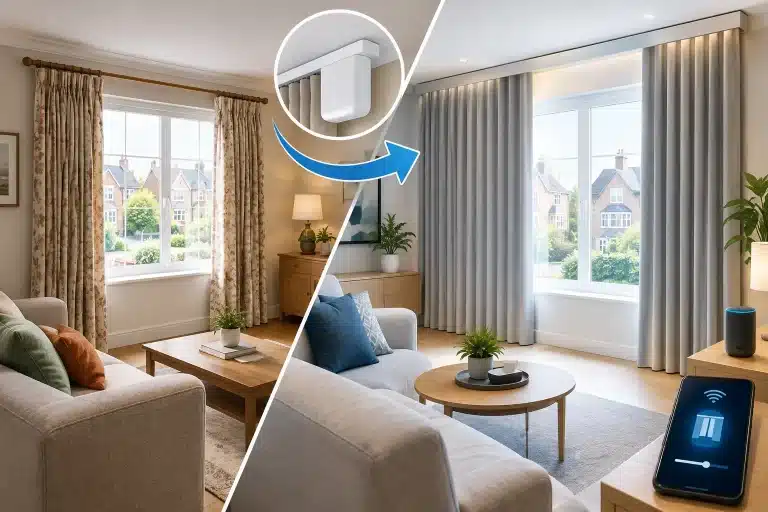
A smart curtains renovation example is often less about adding another gadget and more about getting the small details right before the plasterboard goes up. In a well-planned renovation, motorised curtains disappear into the design while making daily life noticeably easier: open gently in the morning, close for privacy at dusk, and respond without anyone having to cross the room.
Thank you for reading this post, don't forget to subscribe!Consider a typical family renovating a Victorian semi-detached house. They are opening up the rear of the property to create a kitchen-living space, adding large sliding doors to the garden and retaining a bay window at the front. Their brief is simple: soft, full-length curtains that suit the new interior, but without cords, hand-drawn fabric or visible hardware interrupting the finish.
The answer is not simply to buy an electric track. The successful result comes from planning the curtain system alongside the lighting, joinery, ceiling detail and electrical works.
The renovation brief: comfort without visual clutter
At the rear of the house, the new sliding doors are nearly five metres wide. The owners want curtains for warmth, evening privacy and a softer feel than blinds alone can provide. As the room will be used from breakfast through to late evening, they also want the curtains to operate on a schedule and from a wall control near the main entrance.
At the front, the original bay window is being refreshed. This room is used as a snug, where the owners want a more traditional look with lined curtains that can be closed without wrestling with heavy fabric around a curved window.
These are two very different windows, but the priorities are the same: made-to-measure tracks, reliable operation and a finish that looks intentional. A standard off-the-shelf rail would be unlikely to suit either opening, particularly where a bay, a long span or a recessed ceiling detail is involved.
Smart curtains renovation example: planning before first fix
The most valuable point in this project comes before decorating, flooring or curtain fabric selection. Once the layout of the room is agreed, the curtain track position needs to be fixed.
For the rear extension, the owners choose a recessed track, set into a ceiling pocket just in front of the sliding doors. When the curtains are open, the track is largely hidden and the fabric appears to fall directly from the ceiling. This gives the room a more considered, hotel-like finish without making it feel overly technical.
The builder needs clear information early: the overall track length, the recess width and depth, where the motor will sit, and the cable route. A motorised system still needs practical access for fitting and future servicing, so the recess cannot be designed purely for appearance. The curtain heading, fabric fullness and the distance from the glass all affect the space required.
A common mistake is making the recess too narrow. The track may fit, but the curtains can then rub against the ceiling edge or stack untidily when open. Equally, placing the track too close to the doors can cause the fabric to catch on handles. A fitting drawing based on confirmed measurements helps the electrician, builder and curtain maker work to the same plan.
Choosing power at the right stage
Because the extension is being rewired, a mains-powered motor is the sensible option. The electrician provides a switched fused spur in the ceiling void, positioned where it can be accessed but not seen from the room. This avoids regular charging and supports dependable daily use on a wide, heavier curtain run.
Battery-powered systems can be a good solution in finished rooms where running a cable would be disruptive. They are particularly useful for straightforward windows and lighter curtains. During a major renovation, however, hiding a power feed is often the cleaner long-term choice.
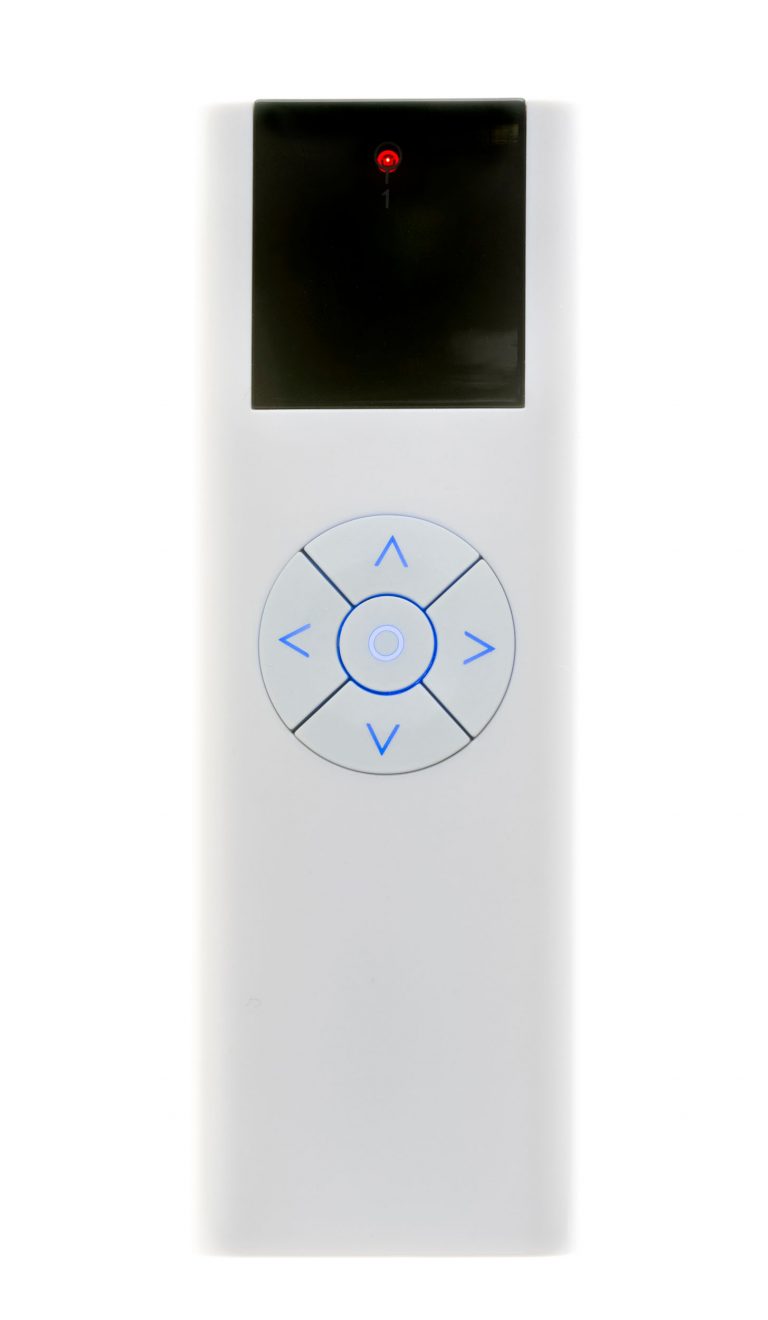
It is worth agreeing the control method before first fix as well. The family want a discreet wall switch, a remote control and app-based timers. Their electrician therefore knows what cabling is required, while their smart home installer can allow for integration at the right point. The aim is not to complicate the project with unnecessary technology. It is to ensure the controls suit how the household actually lives.
Solving the bay window properly
The front bay presents a different challenge. The owners initially assume they need three separate tracks because the window has three faces. In practice, a single bent motorised track can follow the bay angles, allowing one pair of curtains to travel around the shape smoothly.
Accurate measuring matters here. The angles are not always perfectly symmetrical in older homes, and walls can be slightly out of line. Measurements taken from a sketch alone can produce a track that does not sit correctly, especially if there are deep mouldings, radiators or projecting window boards to consider.
The motor position also needs thought. It is usually best placed at one end where it is least noticeable and where the curtain stack will not block a preferred view. If the fabric is particularly heavy or the bay is large, track specification and motor capacity must match the load. A quieter motor is welcome in a snug or bedroom, but smooth movement under the correct weight is equally important.
For this room, the owners choose remote and app control rather than a wall switch. That keeps the original wall finishes clean and gives them an easy way to close the curtains from the sofa. A timed evening close adds privacy without relying on anyone remembering during the rush of family life.
The detail that changes the finished look
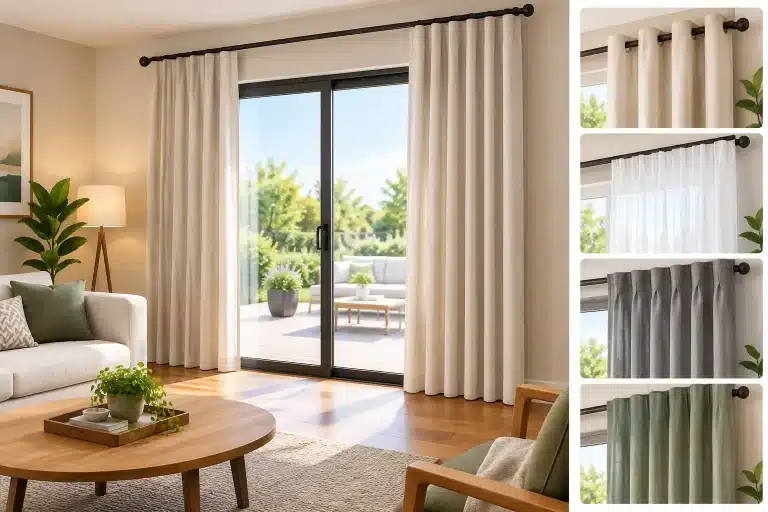
Automation is only one part of the decision. Curtains still need to look right when open and closed. The depth of the stack at either side of the window, the chosen heading and the amount of fabric all affect the final appearance.
At the sliding doors, the owners want the curtains to clear as much glass as possible during the day. The track is therefore extended beyond the door opening, creating room for the fabric to stack to the sides. This is often overlooked when a track is measured only to the width of the glass. A wider track can make a meaningful difference to light levels and the sense of connection to the garden.
At the bay, the stack is kept within the return walls as far as practical, preserving the window shape. The curtain fabric is selected after the track layout is established, not before. That order avoids a lovely but impractical fabric choice dictating an unsuitable heading or creating more weight than expected.
There are compromises in every project. A ceiling recess can look exceptional, but it requires coordination and may not be appropriate where ceiling height is limited. Extending a track beyond a wide door improves the clear opening, but only if there is wall space for the stack. A specialist plan makes these choices visible before they become expensive alterations.
How the finished room works day to day
Once installed, the rear curtains are scheduled to open in the morning and close around sunset during winter. When the family is away, the timetable can vary slightly to make the home appear occupied. The wall switch gives visitors an obvious, simple control, while the app provides flexibility when the owners are upstairs or out of the house.
The front bay curtains close with one command in the evening. This is a modest change, yet it is particularly useful on dark winter nights, for anyone with restricted mobility, or where heavy curtains are awkward to handle. The room feels more private and settled without adding another task to the end of the day.
Smart home integration can add further convenience, such as closing curtains as part of a bedtime routine. But it should be treated as an option rather than a requirement. A well-specified motorised curtain track should remain easy to use even if nobody opens an app or speaks to a voice assistant.
What this example shows homeowners
The best motorised curtain projects are decided early, then made simple in use. Exact measurements, an appropriate power option and clear fitting information are more valuable than choosing controls from a long feature list.
For a renovation involving bays, wide glazing, corners, recesses or wall-to-wall curtains, it pays to seek advice while plans are still flexible. Smart Curtains can help verify dimensions, produce fitting guidance and coordinate the practical questions that arise between homeowners, builders and electricians.
The most satisfying result is often the least noticeable one: curtains that sit beautifully, move quietly and do exactly what you need, precisely when you need them.