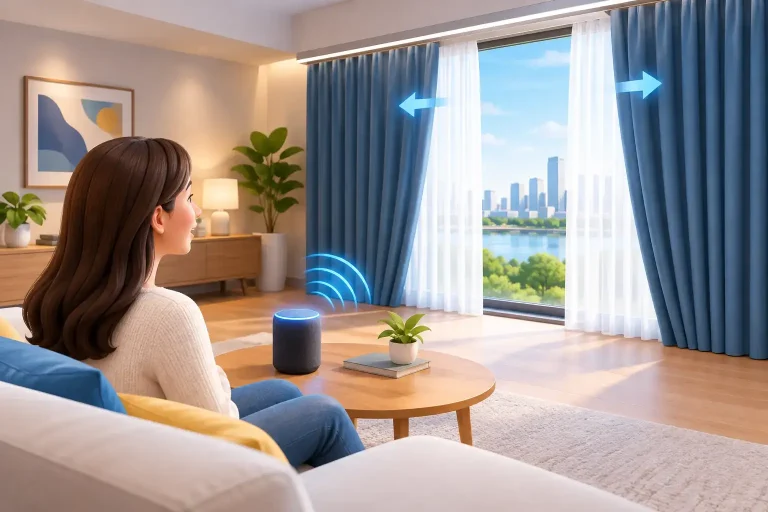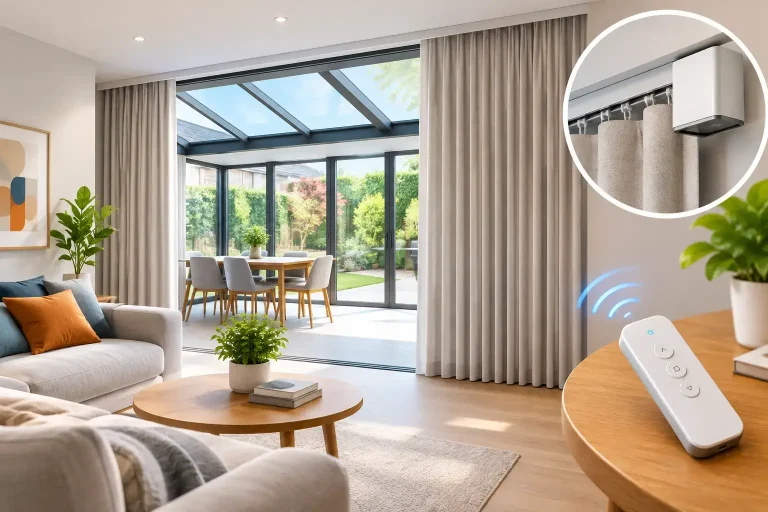
A motorised curtain track can make a bedroom calmer at bedtime, give a tall living-room window a more polished finish, and close the house automatically when you are away. But when comparing battery versus mains curtain motors, the right answer is rarely just about which motor costs less. It comes down to the window, the stage of your project, how often the curtains will move, and the level of control you would like long term.
Thank you for reading this post, don't forget to subscribe!For many homes, both options can provide quiet, reliable opening and closing at the touch of a button, on a schedule, or through compatible smart home controls. The practical difference is how the motor receives power – and that affects installation planning, charging, appearance and future flexibility.
Battery versus mains curtain motors: the key difference
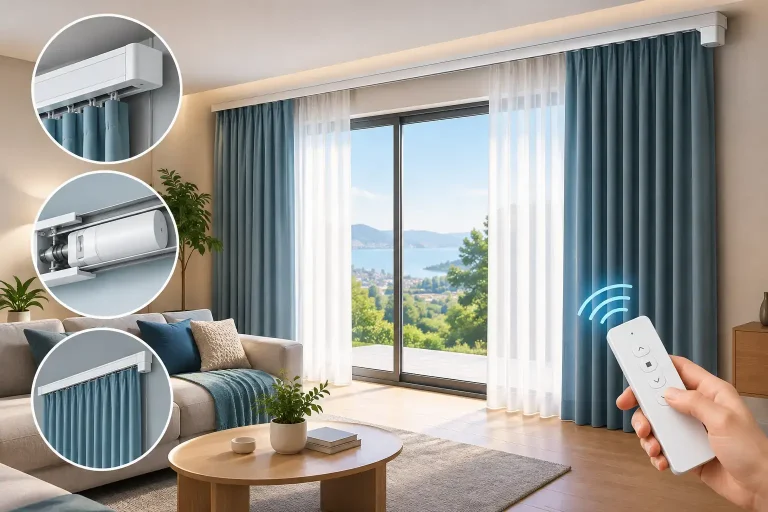
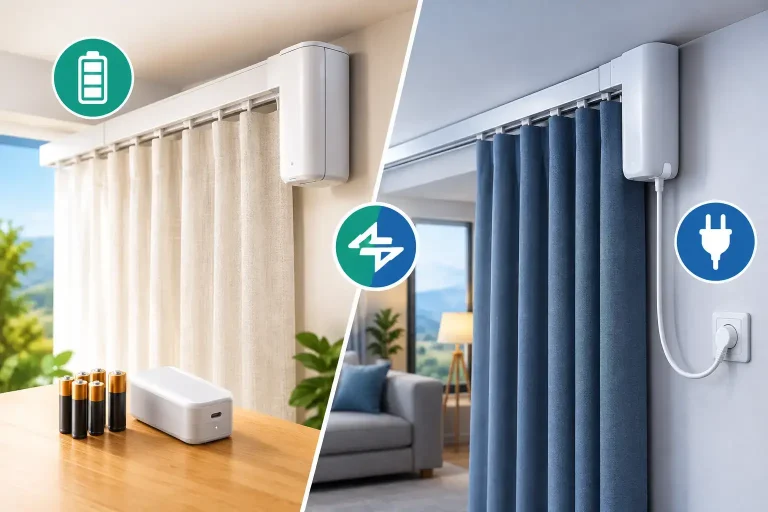
A battery curtain motor uses a rechargeable battery pack, usually mounted within or alongside the curtain track. It avoids the need for a nearby mains supply, making it particularly appealing where decorating is complete or where running a cable would be disruptive.
A mains-powered curtain motor is connected to a permanent electrical supply. Depending on the system and project, this may be planned as a discreet socket near the track or a hard-wired connection installed by a qualified electrician. Once fitted, it has continuous power and does not require routine recharging.
Neither is automatically the better choice. A battery motor can be the sensible solution for a finished room with straightforward windows. Mains power is often the stronger option for a renovation, new build, large or heavy curtains, or a home where automation will be used extensively.
When a battery-powered curtain motor makes sense
Battery power is popular because it keeps installation simple. If you are upgrading a single window in a decorated bedroom, home office or sitting room, a rechargeable motor can avoid lifting flooring, chasing walls or arranging electrical work. That can reduce disruption considerably.
It is also useful where access to power is awkward. Windows set in a bay, in a period property, or on a wall with no suitable socket nearby may suit a battery solution well. With a made-to-measure track, the focus can remain on achieving the correct fit, stacking position and curtain coverage rather than finding a route for cabling.
For many households, charging is not burdensome. Battery life depends on the motor, curtain weight, track length, usage and control method, but a well-specified system should not need attention every week. The best approach is to treat charging as occasional home maintenance, much like changing batteries in a sensor or checking a smoke alarm.
Battery motors can still support convenient controls. Remote operation, wall-mounted wireless switches, timer routines and selected smart home integrations may all be possible, depending on the system chosen. This means you do not have to sacrifice the everyday benefits of automation simply because you do not want new wiring.
The compromises to consider with battery power
The obvious trade-off is that the battery must be recharged. For an easily reached window this is straightforward. For a very high track above a stairwell, behind a large bed, or in a difficult-to-access recess, it may become less convenient.
Battery power may also be less suitable for exceptionally heavy curtains or installations that operate numerous times each day. A motor can be selected to suit the curtain weight, but frequent operation naturally uses more energy. If you expect curtains to run on multiple schedules, respond to smart home scenes and operate daily throughout the year, mains power can offer greater reassurance.
Appearance needs thought too. Battery packs are designed to be discreet, yet their position should be considered alongside the curtain heading, pelmet, recess depth and where the curtains stack when open. Good planning prevents a technically successful installation from looking like an afterthought.
Why mains-powered curtain motors suit planned projects
Mains curtain motors are often chosen during renovations, extensions and new-build projects because electrical provision can be organised before plastering and decorating. Once the cable is in place, the finished room benefits from permanent power without the need to remove or recharge a battery.
This is especially valuable for wide tracks, wall-to-wall curtains, interlined fabrics and rooms with tall or hard-to-reach windows. Larger, heavier curtains need a motor and track arrangement designed around their weight and layout. Permanent power provides confidence that the system is ready whenever it is needed.
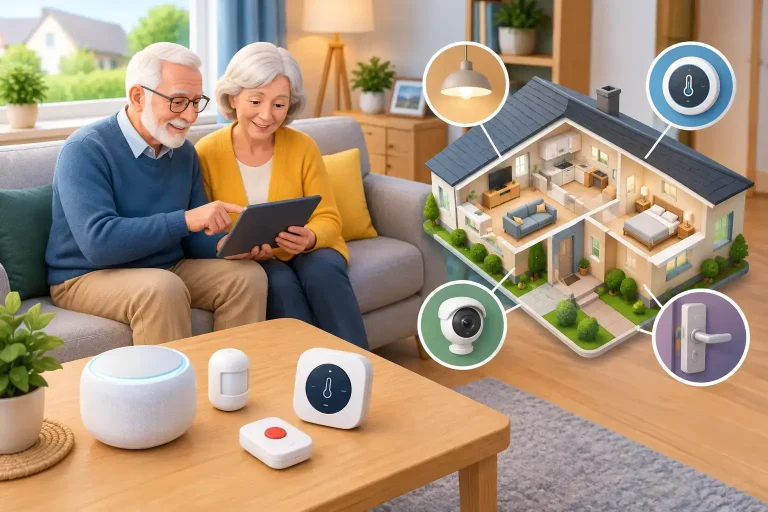
Mains motors are also a natural fit for more involved automation. If curtains are part of a wider smart home plan, perhaps closing at dusk, opening with a morning routine or responding to an away setting, a permanent supply supports regular use without battery management. They are well suited to homeowners who want the curtains to feel like an integrated part of the property rather than a separate gadget.
Plan power before the track is ordered
The main consideration with mains power is timing. It is easier and more cost-effective to arrange the electrical point while building work is underway. Leaving the decision until after a room is complete can still be possible, but cable routes may be more visible or require additional work.
The motor position matters. On a standard straight track, it may sit at one end. On a bay, corner, offset or split-draw arrangement, the preferred location can depend on the track design and how the curtains stack. Power should be planned around the final made-to-measure drawing, not assumed from the window alone.
Your electrician will need clear information about the required supply point and access. This is where fitting drawings and early coordination are useful. It avoids a familiar renovation problem: a beautifully finished ceiling with the electrical point placed just beyond the motor cable or on the wrong side of the curtains.
Control options are not limited by the power choice
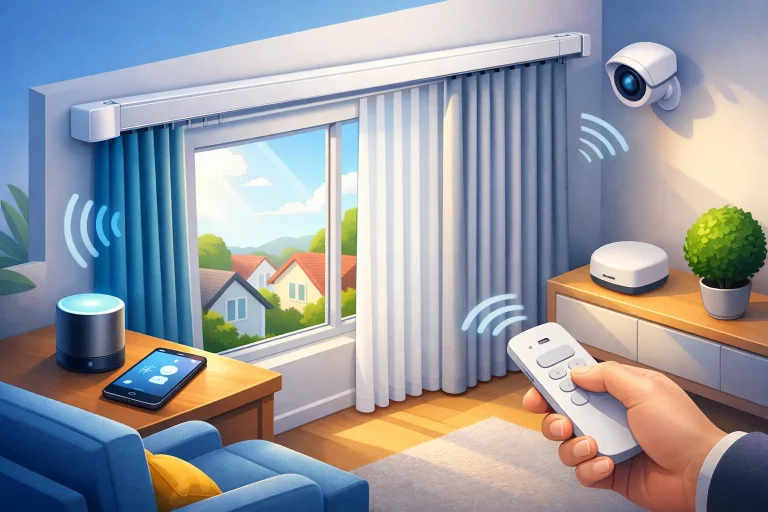
It is easy to assume that mains motors are always smarter than battery motors. In practice, smart functionality depends on the motor system and control equipment, not just whether the motor plugs into the mains.
Both types can offer simple remote control and scheduled opening and closing. These features are useful for privacy in the evening, helping the home look occupied while you are on holiday, and making mornings less rushed. A wireless wall switch can also provide a familiar control point without adding new cables to a finished wall.
For smart home integration, check compatibility at the specification stage. The desired outcome should lead the decision: voice control, app operation, timer routines, integration with lighting, or a simple handheld remote. It is better to choose a motor around how you want to live with the curtains than to add technology that will not be used.
Choose around the room, not just the motor
The motor is only one part of a successful automated curtain installation. Track length, ceiling or wall fixing, recess depth, curtain heading, fabric weight and the open-stack area all influence the final result. A compact battery motor will not solve a track layout that does not allow the curtains to clear the glass, while a powerful mains motor cannot compensate for insufficient fixing support.
For a single, accessible window in a completed room, battery power is often a practical and attractive choice. For a whole-home project, large glazed areas, difficult access or frequent automated operation, mains power is usually worth planning for.
If you are unsure, start with a simple sketch, accurate measurements and photographs of the window area. Smart Curtains can help assess the track layout, motor position and power approach before anything is ordered or wired. The most satisfying result is not the motor with the longest feature list, but a curtain system that fits the room properly and feels effortless every day.