A beautifully fitted motorised curtain track can look effortless, but the power point behind it needs thought long before the curtains are hung. This curtain motor power supply guide explains the practical decisions that help an electric curtain system feel considered rather than added on at the last minute.
Thank you for reading this post, don't forget to subscribe!For most homeowners, the aim is simple: reliable operation, no visible cables, and controls that suit daily life. The right approach depends on your room layout, whether you are renovating or retrofitting, the motor system selected, and how you want to control the curtains.
Start with the motor position, not the socket
The power supply must be planned around the end of the track where the motor will sit. This is not always the side that first seems most convenient. On a straight track, the motor may be positioned at either end depending on the system and the available space. On a bay, corner or offset layout, the best position can be influenced by the shape of the track, curtain stack-back, nearby cabinetry and access for future servicing.
Before an electrician fixes a socket position, establish the final track drawing and confirm the motor end. This is especially valuable with ceiling-mounted tracks, recessed pockets and wall-to-wall curtains, where moving a power point later may mean reopening finished plasterwork or joinery.
Think about where the curtains gather when open, too. A motor tucked behind the stack of fabric can be discreet, but it still needs sufficient clearance. A well-planned installation balances concealment with sensible access.
Curtain motor power supply guide: the main options
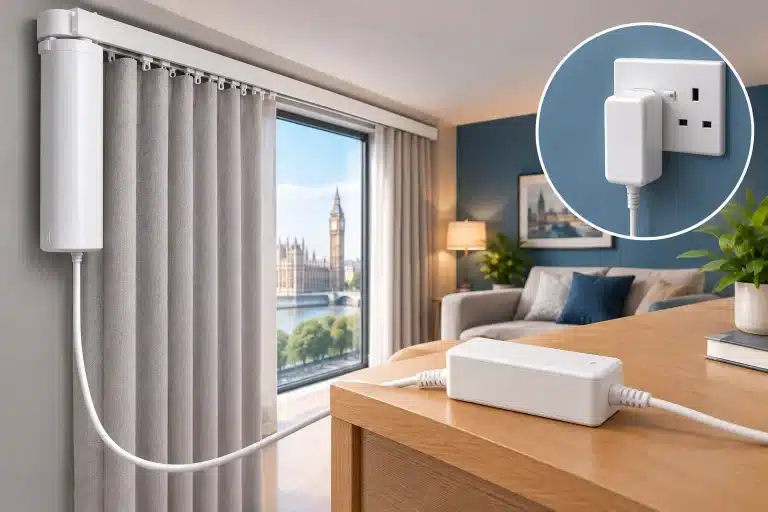
Most mains-powered curtain motors in UK homes are supplied from a standard 230V electrical source. The connection method is generally either a nearby switched socket or a fused connection unit, often called a fused spur. The manufacturer’s requirements should always take priority, as cable types, plug arrangements and connection methods vary between systems.
A switched socket can be a practical choice when it is hidden above a curtain pelmet, in a ceiling recess or inside an adjacent cupboard. It gives straightforward isolation if the motor ever needs to be reset, replaced or serviced. However, the socket and plug need enough room around them, so this option is not ideal in every slim recess.
A fused spur creates a cleaner permanent installation and is frequently chosen for new builds, major refurbishments and high-specification interiors. It can be located in an accessible but unobtrusive position, with the motor cable routed neatly to the track. Your electrician can advise on the correct fused connection and ensure the work meets current wiring requirements.
Some systems use a separate low-voltage power supply or transformer. In that case, the transformer itself needs a planned home. It should not simply be buried where it cannot be accessed, particularly if it may need replacement in years to come. Allow a ventilated, accessible location that does not compromise the finished appearance.
Battery-powered curtain motors are another option where wiring is difficult or disruptive. They can be useful in completed rooms or heritage properties, but they involve recharging or changing batteries and may not offer the same fit-and-forget experience as a wired installation. For heavy curtains, frequently used curtains or hard-to-reach windows, mains power is usually the more convenient long-term choice.
Plan power early in renovations and new builds
If walls or ceilings are open, this is the ideal time to provide power for automated curtains. It costs far less to run a cable during first fix than to alter a decorated room later. Share the curtain track layout with your electrician alongside the lighting plan, rather than treating it as a final furnishing detail.
For a ceiling recess, the supply is often planned above or beside the track, with a cable route that remains hidden once the system is installed. Where curtains are fitted to a wall, the supply may be positioned high at the motor end, behind a pelmet or within a purpose-made return. The exact arrangement depends on the track, the depth of the curtain heading and the available structure.
Do not assume every window needs its own visible wall socket. Several nearby tracks may be planned as part of a wider electrical scheme, but each motor must be supplied in the way its specification permits. An electrician should determine circuit capacity, protective devices and any local isolation requirements.
In bathrooms, kitchens and other locations with particular electrical considerations, early coordination matters even more. The track position may be straightforward, yet the permitted location for electrical accessories may not be. A qualified electrician can ensure the chosen arrangement is appropriate for the room.
Retrofitting power without spoiling the room
A completed room does not rule out motorised curtains. It simply calls for a more selective plan. A discreet socket may already exist behind furniture, in an alcove or within a nearby cabinet. Depending on the motor and track design, a neat cable route can sometimes be concealed by curtain fabric, a pelmet or a surface-mounted trunking solution finished to suit the room.
The key is to avoid treating the cable as an afterthought. A loose lead running down the wall is rarely the finish homeowners want, and it can create a snagging risk around children or pets. It can also make a carefully chosen window treatment look unfinished.
Where concealment is impractical, a battery system may be worth considering. This is one of those decisions where the best answer genuinely depends on the window. A rarely used guest bedroom with difficult access to power may be well suited to rechargeable operation. A large living-room bay used morning and evening is more likely to justify the work involved in a wired supply.
Allow for how you want to control the curtains
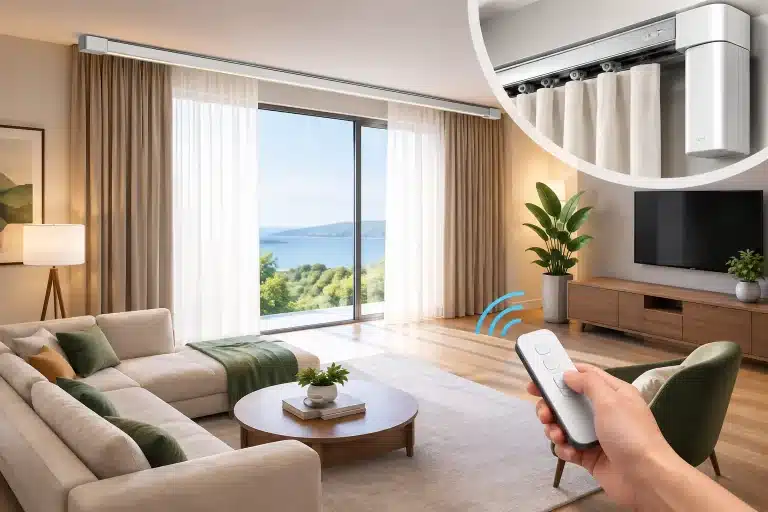
The motor’s power supply and its control method are related, but they are not the same thing. A motor can be powered from a socket or fused spur while being operated by a remote control, wall switch, smartphone app, timer or a broader smart home system.
If you would like a wall switch, decide its position before first fix. It should feel natural to use when entering or leaving the room, without competing with light switches, thermostats or existing control panels. In some homes, a handheld remote or app is enough. In others, especially where accessibility is a priority, a fixed wall control can be more reassuring and easier for every member of the household to use.
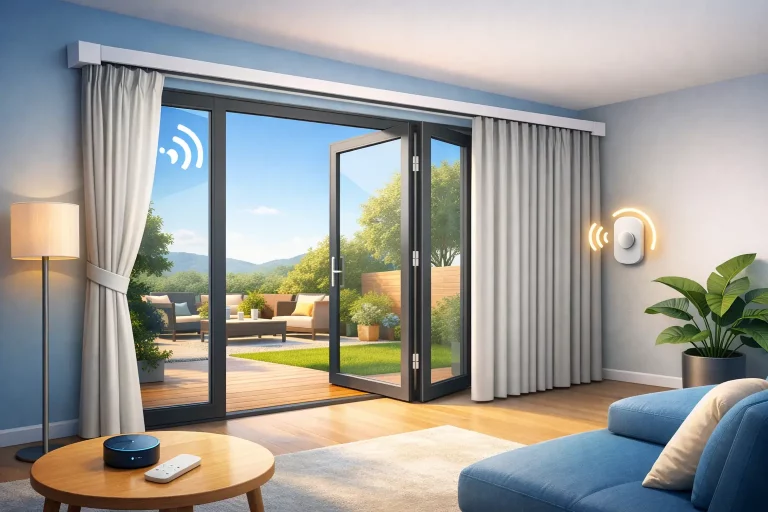
For smart home integration, confirm compatibility before selecting the motor and power arrangement. Some systems communicate wirelessly; others may require a bridge, control module or connection to a home automation platform. Planning these components early avoids discovering that there is nowhere suitable to place them once decorating is complete.
Timers can also make a wired system feel particularly worthwhile. Curtains can open with your morning routine, close at dusk for privacy, or operate while you are away to give the home a lived-in appearance. The benefit is not simply technical convenience. It is a calmer daily rhythm and one less task to remember.
Give the installer the information that prevents mistakes
A successful installation relies on a shared picture of the finished window, not just a measurement from wall to wall. Your curtain supplier, electrician, builder and interior designer may all need to coordinate around the same track layout.
Before work begins, confirm the finished track dimensions, mounting position, motor side, curtain stack-back and proposed power point. Also establish whether there will be a pelmet, ceiling pocket, cornice detail or joinery return. These details affect available space more than many people expect.
It is also wise to consider access after installation. Motors are designed for regular use, but a future reset, inspection or replacement should not require dismantling bespoke joinery or removing an entire ceiling feature. Good planning is partly about hiding the technology and partly about making sure it can still be looked after.
Electrical work should be carried out by an appropriately qualified electrician, who can assess the existing installation and work to the relevant UK requirements. This is not just a safety point. It also gives you confidence that a premium window treatment has a power solution to match.
A small decision with a lasting effect
Power planning may seem like a minor part of choosing motorised curtains, yet it has a lasting impact on the way the room looks and works. At Smart Curtains, fitting drawings and installation planning help turn the details of track position, recess space and motor location into a clear brief for your project team.
Choose the power approach early, confirm it against the final track design, and your curtains can do exactly what they should: respond quietly when needed, disappear into the background when not, and make the room feel better finished every day.