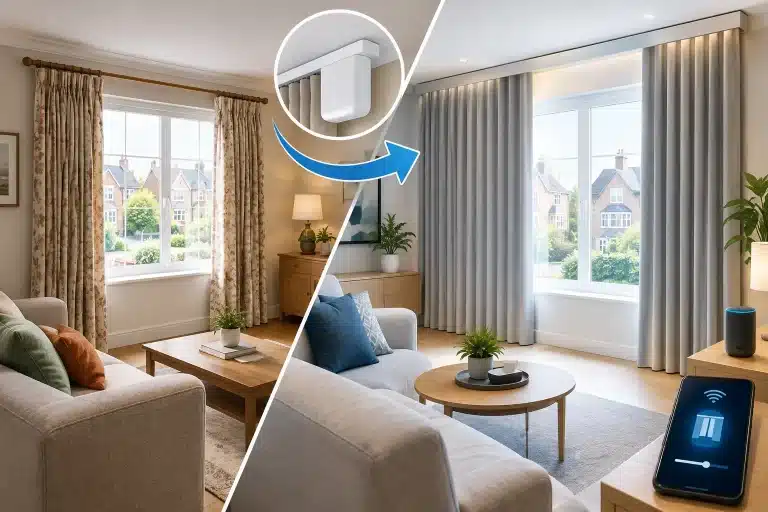
A gentle whirr as curtains open at breakfast or close for the evening is usually part of normal operation. But motorised curtain noise should never feel intrusive, alarming or out of place in a carefully finished home. If the sound is louder than expected, the cause is often not the motor alone. The track layout, curtain weight, fitting surface and installation detail all influence how the system sounds in use.
Thank you for reading this post, don't forget to subscribe!For most homeowners, the aim is not complete silence. A motor has moving parts, and fabric needs to travel along a track. The aim is quiet, consistent movement that becomes an unremarkable part of daily life – whether you are using a wall switch, remote control, timer or wider smart home routine.
What motorised curtain noise is normal?
A well-specified electric curtain system will normally make a low mechanical hum while the motor is moving, followed by a soft sound from the curtain carriers and fabric. You may hear slightly more at the start of travel, particularly with heavier lined curtains, and when the system reaches its final position. In a quiet bedroom at night, any household mechanism can seem more noticeable than it does during the day.
The character of the sound matters more than the fact that there is sound. Smooth and even is reassuring. Sudden knocking, scraping, clicking, squealing or a motor that appears to strain deserves closer attention. These noises can point to friction, an obstruction, excess load or a track that needs adjustment.
Noise also depends on the room. In a busy kitchen or living room, a discreet motor will generally fade into the background. In a main bedroom, nursery, study or cinema room, low-noise operation and considered track positioning become more important. This is worth discussing at the planning stage, rather than treating it as an afterthought once curtains and decoration are complete.
Why one motorised curtain system sounds quieter than another
It is tempting to compare motors by a single noise figure, but real-world performance is more involved. A quiet motor fitted to a poorly planned track can still produce unwanted noise. Equally, a system carrying substantial curtains may sound perfectly appropriate when it has been specified correctly for the load.
Curtain weight and fabric movement
Interlined, blackout and full-height curtains can be substantial, especially across wide openings or wall-to-wall installations. The motor must be matched to the weight it is moving, while the track needs enough support to stay straight and stable. A system working near or beyond its intended capacity may move more slowly, sound laboured or create unnecessary wear over time.
The curtain heading also plays a role. Some styles stack and travel more freely than others. The fabric must be made to suit the track and the available stacking space, so it does not bunch, drag or catch as it draws back.
Track design, bends and joins
Straight tracks are generally the simplest arrangement, but many homes need something more tailored. Bay windows, corners, offset layouts and returns around obstructions all require careful planning. Every bend changes how carriers move, so the radius, transition and positioning must suit both the fabric and the system.
A made-to-measure track should not be treated like a standard rail cut down to size. Accurate dimensions help ensure the route is smooth and the joins are properly aligned. If a carrier catches at a join or tight bend, it can create a repetitive click or jolt that is heard every time the curtains move.
Fixings and the surface behind them
A motorised track transfers movement into the wall, ceiling or pelmet where it is fixed. If the structure is lightweight, uneven or inadequately reinforced, vibration can be amplified. This is particularly relevant with plasterboard ceilings, recessed installations and purpose-built pelmets.
Secure fixings at the right intervals keep the track stable. In renovation projects, it is sensible to establish the fixing surface before the ceiling is closed or joinery is fitted. A small amount of coordination with the builder or electrician can prevent difficult alterations later.
Obstructions and everyday friction
Noise is sometimes caused by something very simple: a curtain brushing a radiator, window handle, blind, decorative pole or nearby furniture. It may only happen at one point in the journey, which makes it easy to identify. Loose hooks, incorrectly spaced gliders and fabric caught behind the stack can have a similar effect.
Before assuming there is a motor fault, watch the curtains operate from end to end. Look for a point where the movement changes or the fabric pulls unnaturally. A clear observation gives an installer or supplier useful information and often speeds up the solution.
When should you investigate the noise?
A new system may sound slightly unfamiliar for the first few uses, but it should settle into smooth, predictable operation. Investigate if the noise has suddenly changed, if movement has become hesitant, or if the curtains stop before reaching their expected position. A smell of overheating, visible track movement or a motor that repeatedly struggles should be dealt with promptly rather than ignored.
Start with the straightforward checks. Make sure nothing is blocking the curtain path and that the fabric is not caught. Check that curtain hooks and carriers are sitting correctly, then listen for whether the sound comes from the motor, a particular section of track or the fabric itself. Do not force the curtains by hand while the motor is running, as this can make diagnosis harder and may affect the system.
If the track is concealed in a recess or pelmet, resist the urge to dismantle components without guidance. Made-to-measure systems vary in their arrangements, and the correct adjustment depends on the motor, track and curtain design. Clear photographs or a short video of the issue can be helpful when seeking support.
Planning for quieter operation before installation
The most effective way to reduce unwanted motorised curtain noise is to plan the entire installation as one system. This begins with accurate width, drop and stack-back measurements, but it also includes curtain specification, track position, power provision and the room’s intended use.
For bedrooms, consider where the motor will sit in relation to the bed. For a cinema room, think about whether the track will be hidden in a ceiling recess and how access will be retained. For large glazed areas, establish the curtain weight early, particularly if you are choosing lined or blackout fabrics. These decisions help determine the appropriate motor and track arrangement.
It is also useful to agree how the curtains will be controlled. A timer that opens curtains gradually at a regular morning time can feel less disruptive than a manual command at an unexpected moment. Smart home integration can coordinate curtains with lighting and occupancy routines, although reliable physical control, such as a wall switch or remote, remains valuable for everyday use.
At Smart Curtains, installation planning is considered alongside the product itself. Checking measurements, producing fitting drawings and discussing recesses, bays or offset layouts helps avoid the compromises that can affect both appearance and operation.
Quiet operation is about more than the motor
The quietest-feeling system is often the one you barely notice. It opens to bring in daylight, closes to create privacy, and supports security routines while you are away. The quality comes from the way each part has been considered together, not simply from choosing a motor described as quiet.
If you are planning automated curtains for a new build, renovation or a single difficult window, raise noise expectations early. Share how the room will be used, what fabric you have in mind and whether the track will be visible or concealed. With the right specification and careful fitting, the sound of your curtains moving can remain exactly what it should be: brief, smooth and easy to live with.