There is a big difference between a room that looks finished and one that still feels like a work in progress. Curtains are often part of that difference, and when they open and close at the touch of a button, the result feels calmer, cleaner and far more considered. Wall switch electric curtains are a popular choice for homeowners who want that polished result without relying on a handset that can be misplaced or an app that not everyone in the house wants to use.
Thank you for reading this post, don't forget to subscribe!For many homes, a wall switch is the most natural way to control motorised curtains. It feels familiar because it works much like lighting control, and it keeps operation simple for everyone – family members, guests, children and anyone who prefers a fixed control point. That simplicity is a major reason people choose it, but it is not the only one.
Why choose wall switch electric curtains?
A wall switch gives electric curtains a permanent, intuitive control method. You do not need to charge anything, pair a device or explain which remote does what. If the curtains are installed in a main bedroom, lounge, dining room or media room, a switch on the wall can feel like the right fit from day one.
This approach also suits clients who want a more discreet smart home. Not every automated feature needs to be run from a phone. In many households, the best technology is the kind that quietly does its job and is easy to use without any learning curve. A well-positioned switch helps deliver exactly that.
There is also a visual advantage. When electric curtains are planned properly, the control method becomes part of the room design rather than an afterthought. A neat wall switch by the door, beside the bed or near an existing lighting plate can make the whole installation feel integrated with the property.
How wall switch electric curtains work
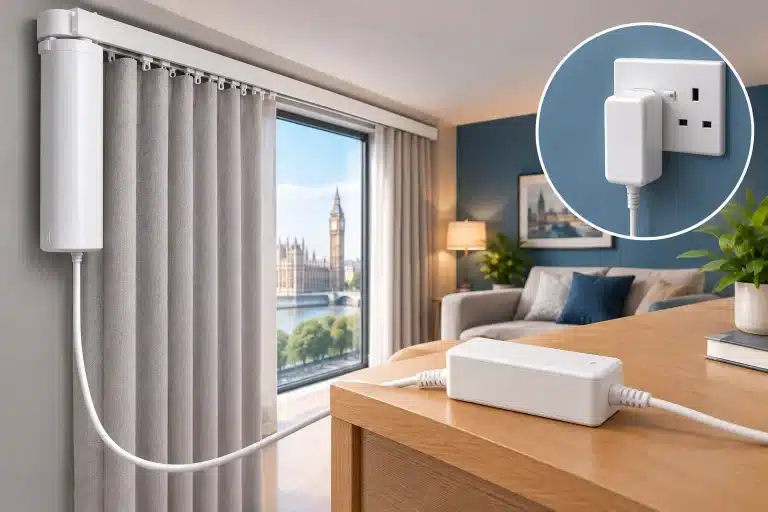
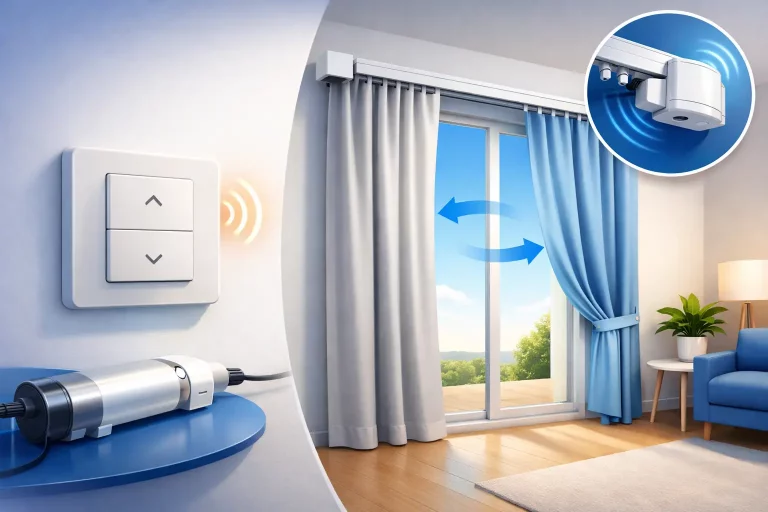
At the simplest level, the curtain track contains a motor that drives the curtains open and closed. The wall switch sends the command to that motor. Depending on the system specified, the switch may be hardwired, low voltage or designed to work alongside other control options such as remote control, timer functions or home automation.
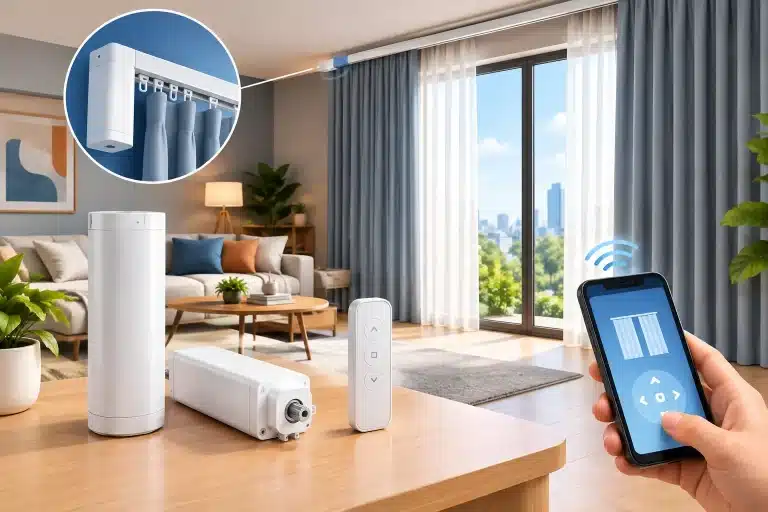
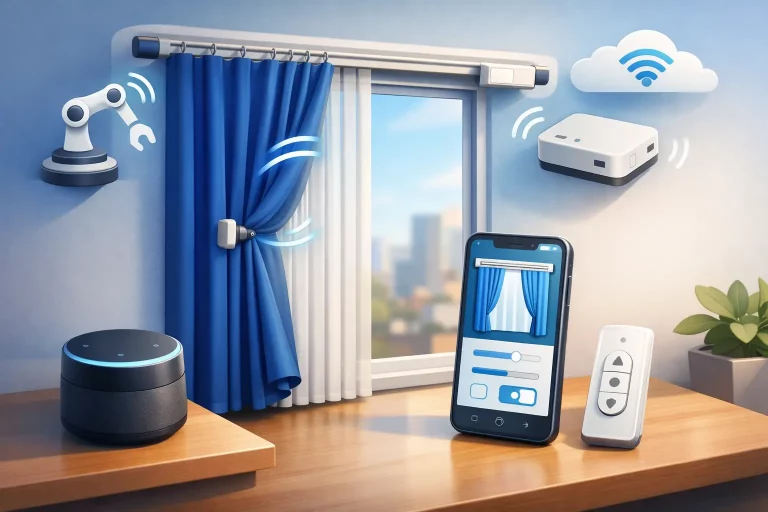
That last point matters because a wall switch does not have to limit the rest of the system. Many homeowners assume they must choose between a switch and smart control, when in practice the best setup often includes both. You might use the wall switch day to day, then schedule opening times through an app or integrate the curtains with your wider smart home setup.
The right control arrangement depends on the room, the build stage and how you actually live in the home. A renovation project offers different possibilities from a finished room where decorating is already complete.
Where a wall switch makes the most sense
Some rooms naturally benefit more from switch control than others. Bedrooms are a strong example, particularly when you want one-touch operation without reaching for a remote. A switch by the bedside or by the bedroom door can make the curtains easy to manage morning and night.
In living spaces, wall switch control works well where the curtains are part of the everyday routine. If you regularly close them in the evening for privacy and warmth, or open them every morning to bring in light, a fixed switch keeps that routine straightforward.
It is also a very practical choice for accessibility. For people with restricted mobility, heavy curtains can be difficult to manage manually. Electric operation removes that effort, and a clearly positioned wall switch can be easier to use than a handset, particularly if it is installed at an appropriate height and in a predictable location.
For larger glazed areas, wall-to-wall curtains and wide bifold or sliding door arrangements, the convenience becomes even more noticeable. The heavier the curtain, the more valuable powered operation tends to be.
Planning the switch position properly
The success of wall switch electric curtains often comes down to planning before installation. The switch position wants careful thought, because what looks obvious on a floor plan does not always work best in the finished room.
You need to consider how you enter the space, where furniture will sit, whether bedside tables or wardrobes may block access, and whether the switch should sit with existing electrical accessories for a cleaner appearance. In some homes, the ideal location is by the main door. In others, especially bedrooms, a second position can make more sense.
Cable routes also matter if the switch is hardwired. This is one reason early coordination with builders and electricians is helpful. If the curtain track, power supply and switch location are all considered together, the result is usually neater and simpler to install.
This is especially important with bespoke tracks, bay windows, recess fixing, corner layouts or offset designs. The curtain itself may be the visible feature, but hidden planning is what makes the system feel effortless once installed.
What to think about before ordering
The most common mistake is treating electric curtains like an off-the-shelf accessory. In reality, they are part of the room finish and should be specified accordingly. The track size, stacking space, bracket positions, curtain weight, power point and control method all affect the final result.
With wall switch electric curtains, one of the first questions is whether you want the switch to be the main control or one of several control methods. If it is the only control, it needs to be positioned with even more care. If it sits alongside a remote or app control, you have more flexibility.
You also need to think about the build stage. In a new build or full renovation, it is usually easier to plan a hardwired switch and concealed power arrangement. In an existing room, there may be reasons to consider alternative control methods or a hybrid setup that avoids unnecessary disruption.
Then there is curtain behaviour itself. Do you want centre opening curtains or one-way draw? Are you covering a straight run, a bay, or a wall-to-wall span? Is there enough room for the curtains to stack back neatly when open? These are not minor details. They affect both appearance and performance.
The trade-offs to be aware of
Wall switch control is convenient, but there are trade-offs. A fixed switch is only useful from that location, so some homeowners still like the flexibility of a remote when seated across the room. Others prefer app control when away from home or when setting routines around sunrise, sunset or occupancy.
There is also the installation question. A hardwired switch may deliver the cleanest result, but it generally needs more pre-planning than a remote-based setup. If walls are already decorated and you want minimal disruption, the best answer may be a system that combines simple local control with less invasive installation.
This is why there is no single best specification for every property. The right answer depends on whether you are renovating, redecorating, furnishing a new extension or upgrading one room at a time.
Why bespoke guidance matters
Made-to-measure electric curtains are one of those products where good advice saves time, avoids rework and improves the finished look. Measurements need to be right, but so does the planning around recesses, returns, overlaps and fixing positions. Add motorisation and wall switch control, and the details become even more important.
That is where specialist support adds real value. Instead of guessing where the power should go or whether the track can work across a bay or corner, you can have the layout checked before anything is manufactured or installed. For homeowners, that means more confidence. For builders and electricians, it means clearer information to work from.
At Smart Curtains, that consultative approach is central to getting the system right. A bespoke track should do more than fit the opening. It should suit the room, the curtains, the control method and the way you want to use the space every day.
Are wall switch electric curtains right for you?
If you want a reliable, easy-to-use and visually tidy way to operate your curtains, the answer is often yes. They are especially well suited to homes where convenience matters, where accessibility is a priority, or where you want automation to feel built in rather than added on later.
They also appeal to homeowners who care about the overall finish. A made-to-measure motorised track with a properly planned wall switch has a different quality from a pieced-together solution. It feels intentional, and that makes a difference every single day.
The key is not simply choosing electric curtains. It is choosing a control setup that suits the room, the property and the people using it. When that part is planned well, the result is not just easier curtain control – it is a home that feels better organised, better finished and more enjoyable to live in.
If you are considering motorised curtains, think about the moments when you will actually use them. The right wall switch in the right place can turn a nice feature into one you would not want to be without.