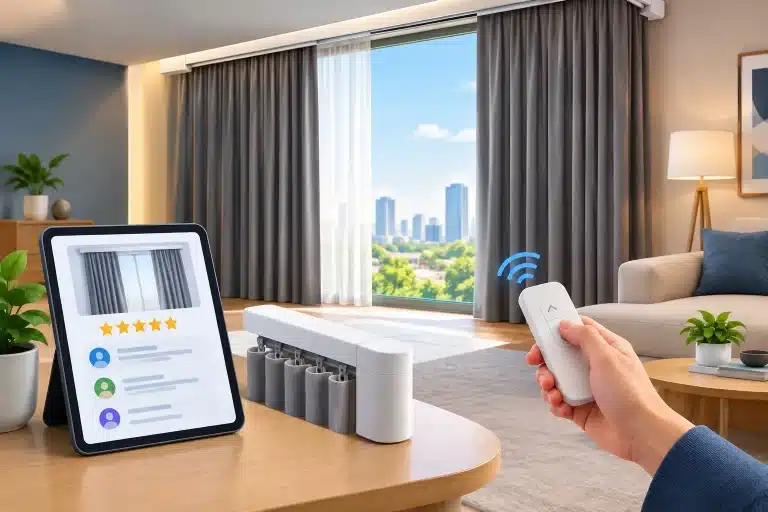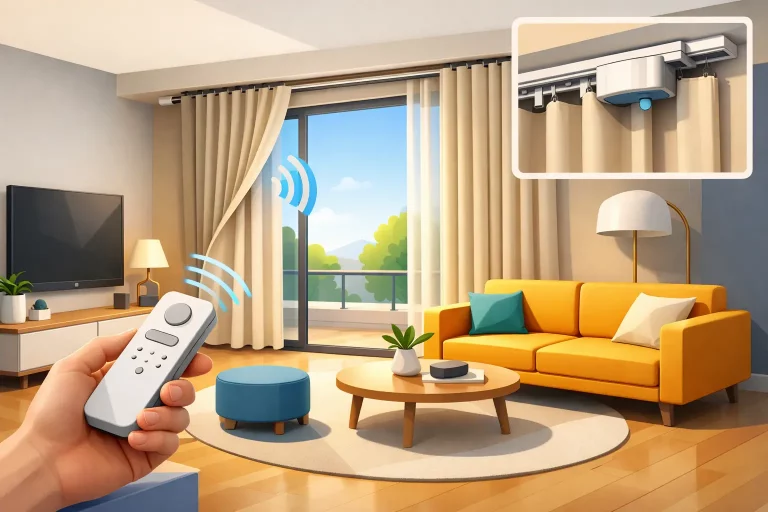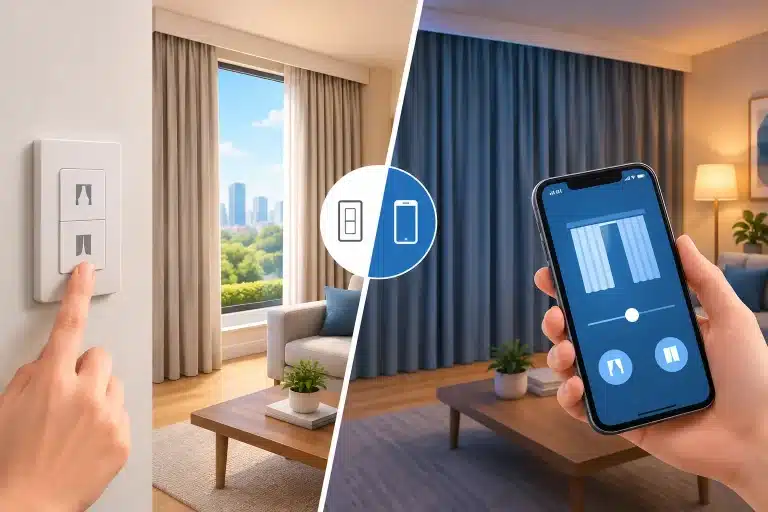
A beautifully made motorised curtain track can be controlled in several ways, but the best choice is rarely about technology for its own sake. The curtain switch versus app control decision comes down to how each room is used, who uses it and how far your renovation has progressed. A wall switch gives immediate, familiar control at the point of use. An app adds timers, remote access and a greater role within a connected home.
Thank you for reading this post, don't forget to subscribe!For many homes, the strongest answer is not one or the other. A well-planned system often combines a simple physical control with app-based automation, so the curtains remain effortless whether you are getting ready for bed, carrying a sleeping child or away for the weekend.
Curtain switch versus app control at a glance
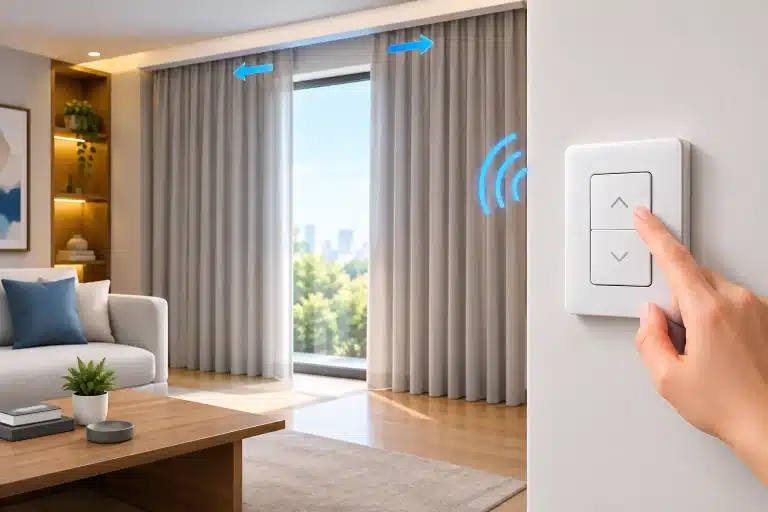
A curtain switch is a dedicated wall-mounted control, normally placed beside the room entrance, near the bed or wherever it will be most convenient. Pressing a button opens, closes or stops the curtains. It is straightforward, visible and useful for everyone in the household, including guests who do not have access to your smart home system.
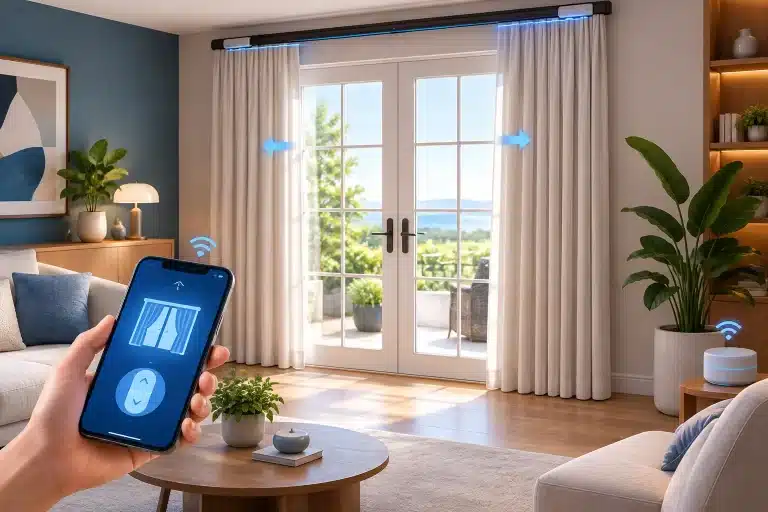
App control allows the same motorised curtains to be operated from a phone or tablet. Depending on the system selected, it can also support schedules, scenes and integration with wider smart home controls. Instead of remembering to close the living room curtains each evening, you can set them to close automatically at a chosen time or as part of a bedtime routine.
The practical difference is simple: a switch is immediate local control, while an app provides flexible control beyond the wall. Neither is automatically better. The right specification depends on the room and the result you want from it.
Why a wall switch still earns its place
A physical switch is often the most natural control for motorised curtains. It does not require a phone to be charged, an app to be opened or a visitor to understand your home automation setup. One press gives a clear result, which is particularly welcome in bedrooms, guest rooms and family spaces.
Everyday control without a device
Think about the moments when curtains are most often adjusted. You may want privacy as you enter the house after dark, shade while watching television, or darkness from bed in the evening. In each case, a wall switch is quick and instinctive. It is also easier to use when your phone is in another room or you would rather not rely on a screen before sleep.
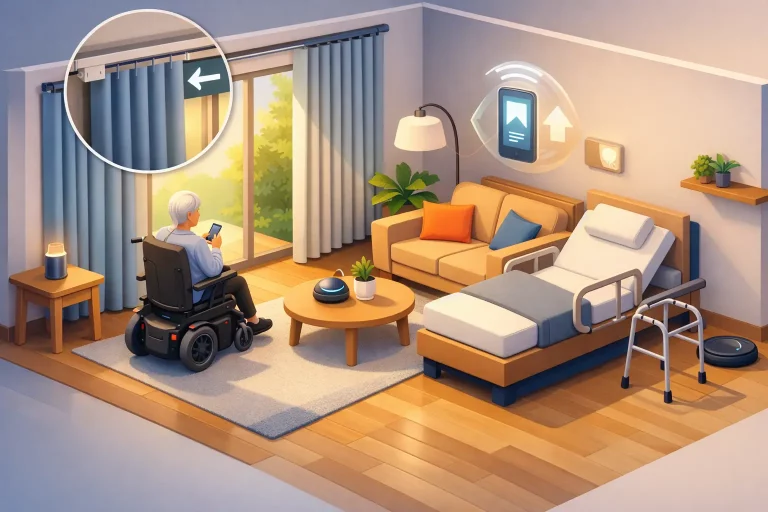
Switches can be especially valuable for people with restricted mobility. Positioning the control at an accessible height and location can remove the repeated effort of reaching curtains or handling cords. In a bedroom, a switch beside the bed may offer more independence than walking to the window or finding a phone.
A considered finish for a renovation
Where electrical work is already planned, a wired switch can give a polished, permanent finish. It can be coordinated with other switch plates and placed exactly where it makes sense for the room layout. This is often easiest during a new build, extension or full refurbishment, before walls are finished and decorating is complete.
That said, a switch needs early consideration. Cable routes, power supplies and the location of the curtain motor all need to work with the window treatment, pelmet or recess. For a bay window, a wall-to-wall track or an offset layout, the control position should be agreed before fitting rather than treated as an afterthought.
Where app control offers more value
App control becomes particularly useful when curtains need to respond to a routine rather than a button press. It gives you the freedom to manage several rooms without walking from one to another, and it keeps control available when you are not at home.
Timers support privacy, comfort and security
A scheduled opening can bring daylight into a bedroom in the morning without manually pulling heavy curtains. An evening closing time can improve privacy before the lights go on. These are small changes, but they make a home feel more considered and can be helpful for busy households where the same tasks are easily forgotten.
When you are on holiday, app control can also support a more lived-in appearance. Opening and closing curtains at sensible times can be part of a broader home security routine. It should not be treated as a replacement for proper security measures, but it is a useful layer of everyday reassurance.
Timers work best when they are realistic. A blanket 7pm closing schedule may suit winter but feel too early in high summer. Some homeowners prefer separate weekday and weekend routines, while others want a simple evening setting they can adjust seasonally. The benefit of app control is that those changes do not require rewiring.
Useful for connected homes, but not compulsory
If you already use smart lighting, heating or voice control, app-operated curtains can join those routines. A single evening scene might lower the lights and close the curtains, while a morning scene opens them gradually. This is convenient, but it is worth choosing integration because it will genuinely be used, not simply because it is available.
Compatibility should be checked at the specification stage. The motor, control bridge or hub, home network and preferred smart home platform may all affect what is possible. A made-to-measure track can be designed around an awkward window, but the control method also needs to be planned as part of the full system.
The trade-offs to consider before choosing
A wall switch depends on access to the room and, for a wired installation, coordination with an electrician. It is wonderfully simple once installed, yet it will not normally give you control when you are away. App control offers that flexibility, but it relies on a compatible system and a reliable home network. It may also take a little initial setup to create the schedules that make it worthwhile.
There is also the question of resilience. If a phone is misplaced, a physical switch remains reassuringly available. If your Wi-Fi is interrupted, the exact behaviour will depend on the system, but local controls such as a switch or remote can provide a useful fallback. This is one reason a combined approach is often the most practical option.
Cost can vary too. A single-room installation with a straightforward daily pattern may not need the additional features of a connected app system. In contrast, app control can represent good value in a larger property, a second home or rooms where timed privacy and remote operation will be used regularly.
The best option room by room
Bedrooms often benefit from both. A bedside switch is convenient at night, while an app timer can open curtains in the morning. For children’s rooms, a parent may value scheduled closing while still wanting a simple wall control as children grow.
Living rooms are a strong candidate for app control when they are part of an evening routine or used at varied times. A switch by the entrance remains useful for immediate privacy, particularly if the room faces a road or neighbouring properties.
In kitchens and home offices, the deciding factor is usually daylight management. If you regularly work at home, a timed routine can help reduce glare at predictable times. If your needs change throughout the day, a switch or remote may be quicker than reaching for your phone.
For less frequently used rooms, such as guest bedrooms, a wall switch may be all that is needed. The goal is not to add technology to every window. It is to make each curtain easier to live with.
Plan the control alongside the track
Control choice should be decided before the track is manufactured, especially with bespoke curtains and non-standard window layouts. The motor position, mains supply, stack-back space, recess depth and access for future use all influence the final result. A beautifully dressed curtain can still be frustrating if the motor ends up difficult to reach or the switch is positioned behind furniture.
At Smart Curtains, planning support considers the track and its operation together. Accurate dimensions, fitting drawings and early coordination with your builder or electrician help avoid late changes that can affect both appearance and usability. This matters even more with bays, corners and wall-to-wall installations, where the best motor and control locations are not always obvious from the front of the window.
The most satisfying curtain control is the one you barely have to think about. Choose a switch where immediate, dependable access matters; choose app control where routines and remote operation will make a genuine difference; and combine them when your home deserves both.