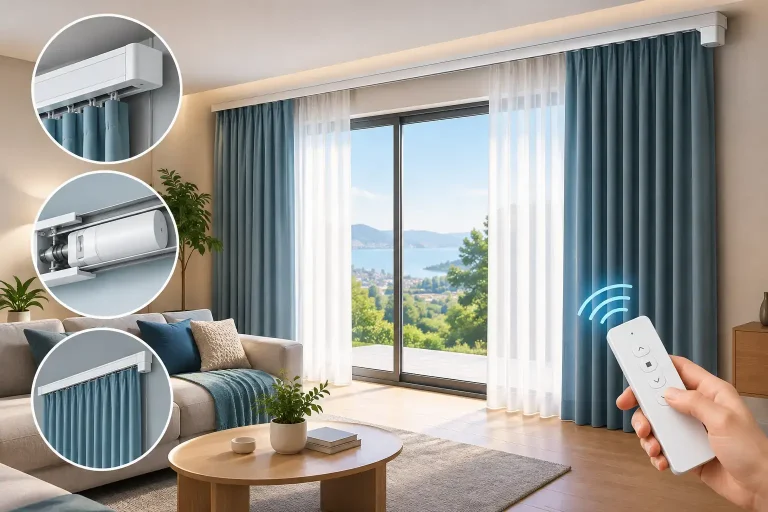
A ceiling-mounted curtain can change the proportions of a room before you have even chosen the fabric. By taking the track up to the ceiling, rather than fixing it above the window, you create a longer, cleaner line and allow curtains to fall with real presence. This guide for ceiling mounted curtains explains what to plan before ordering, from track position and fabric clearance to the practical advantages of motorised control.
Thank you for reading this post, don't forget to subscribe!For many homes, the result is more than decorative. Ceiling fixing can make a compact bedroom feel taller, soften a wide run of glazing, conceal an awkward lintel and give better coverage at the edges of the window. It is also particularly effective when curtains need to work across bi-fold doors, sliding doors or a wall-to-wall opening.
Why choose curtains mounted from the ceiling?
A ceiling-mounted track places the curtain heading at the highest available point. That gives the eye an uninterrupted vertical line from ceiling to floor, which is why it is often specified in contemporary renovations and premium interiors. It can be equally useful in period properties where the existing window position leaves little room for a conventional pole.
The approach is also a practical answer where there is no suitable wall above the window. Deep recesses, bulkheads, full-height glazing and low ceilings can all make wall fixing difficult or visually cluttered. A correctly planned ceiling track keeps the hardware discreet while allowing the curtains to cover the opening properly.
There are trade-offs. Ceiling-mounted curtains need careful positioning so they clear handles, radiators, projecting sills and adjacent blinds. If the ceiling is plasterboard, the track must be fixed into suitable structure or prepared noggins, not simply attached wherever the room layout looks best. Planning those details early prevents a beautiful finished scheme becoming a frustrating fitting problem.
Plan the track position before choosing the curtains
The most important dimension is not just the width of the window. It is the full track length and its exact position in the room. A track might run a little beyond each side of a window so that, when open, the curtains sit off the glass rather than reducing daylight. For a wall-to-wall treatment, it may extend from one side wall to the other, even if the glazing occupies only part of that wall.
Depth matters just as much. Measure from the wall to the front of anything the curtain must pass, such as a sill, radiator, handle or blind. The track needs to sit far enough forward for the fabric to hang freely. A small compromise at this stage can lead to curtains catching every time they are operated.
If you are fitting a blind and curtains together, establish which treatment sits nearest the glass. In many rooms, the blind is fitted within or close to the recess and the curtain track is positioned in front. The required clearance varies with the blind type, the curtain heading and the fabric weight, so it is worth confirming the arrangement rather than relying on a standard measurement.
Allow for stacking space
When curtains are open, they gather into a stack at one or both ends of the track. This stack takes up more room than many homeowners expect, especially with lined, interlined or full fabric curtains. If preserving the view is a priority, plan for the stack to park beyond the window where possible.
A centre-opening arrangement creates a stack at each side. A one-way draw leaves one larger stack on the chosen side, which can suit a door opening or a layout where one side has more wall space. Motorised tracks can be specified for either arrangement, but the preferred opening direction should be decided before the system is made.
Recesses, ceiling pockets and curtain pelmets
A recessed track – often called a ceiling pocket – conceals the track within the ceiling finish. The effect is refined: fabric appears to emerge directly from the ceiling, with no visible rail above it. It is especially popular in new builds, extensions and rooms with a modern, architectural look.
However, a recess must be large enough for both the track and the curtain heading. A narrow slot may look neat on a drawing but can restrict the movement of a fuller fabric or make access difficult later. The depth must also account for any blind behind the curtains and for the line of the fabric as it travels around the end of the track.
A pelmet or fascia is another option where a ceiling recess is not possible. It hides the track and headings while giving the room a softer, more traditional finish. The best choice depends on the ceiling construction, the interior style and whether the project is at first-fix stage or already decorated.
Choosing the right track for the layout
Straight windows are only one part of the picture. Ceiling-mounted tracks can be planned for bays, corners, returns and offset layouts, but these situations require precise drawings and dimensions. In a bay window, the track must follow the shape closely enough to preserve the appearance and coverage of the curtains, while still allowing the carriers to move smoothly around bends.
For wide glazing, consider the weight of the finished curtains. Heavier fabrics, tall drops and thermal linings place greater demands on the track and motor. The system should be sized for the real curtain weight, not simply the width of the window. This is particularly relevant in large living spaces, bedrooms with full-height curtains and properties where insulation and blackout performance matter.
It is also worth considering access. A long curtain track above a staircase, a tall atrium window or furniture that cannot easily be moved is a strong case for motorisation. Daily use becomes simple, and there is no need to reach for cords or pull fabric across a difficult opening.
Why motorised ceiling-mounted curtains work so well
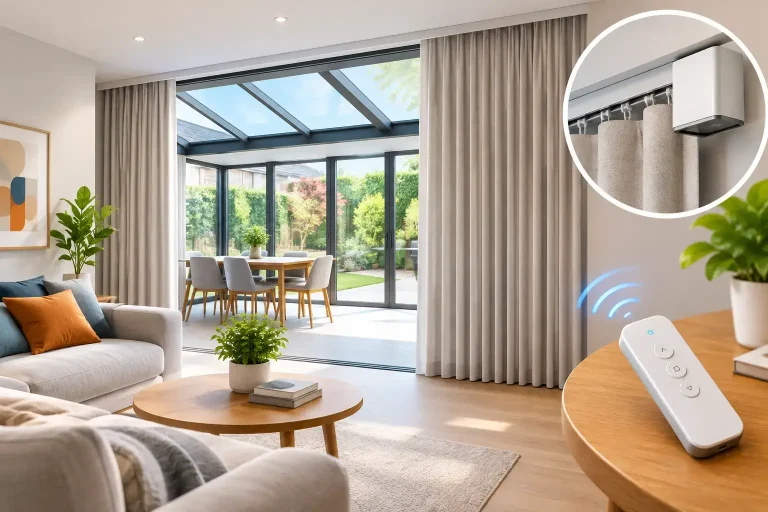
Ceiling mounting and automation are a natural pairing. The visual intention is usually to make the treatment feel calm and unobtrusive, and a motorised track removes the need to handle the fabric or add a visible operating mechanism. At the press of a wall switch or remote, curtains can open in the morning and close in the evening with controlled, even movement.
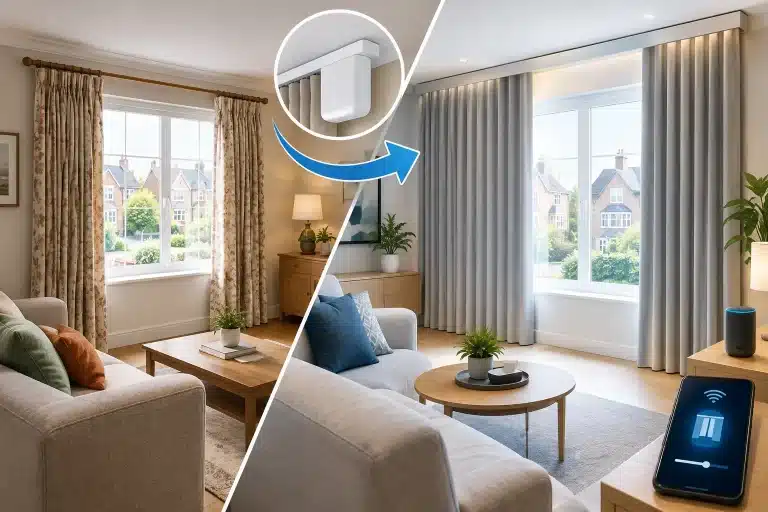
Smart control adds useful flexibility rather than technology for its own sake. Timers can support a more consistent routine, while app control lets you operate curtains from elsewhere in the home or when you are away. Integration with a wider smart home system can coordinate curtains with lighting, heating or scenes for watching television, entertaining or bedtime.
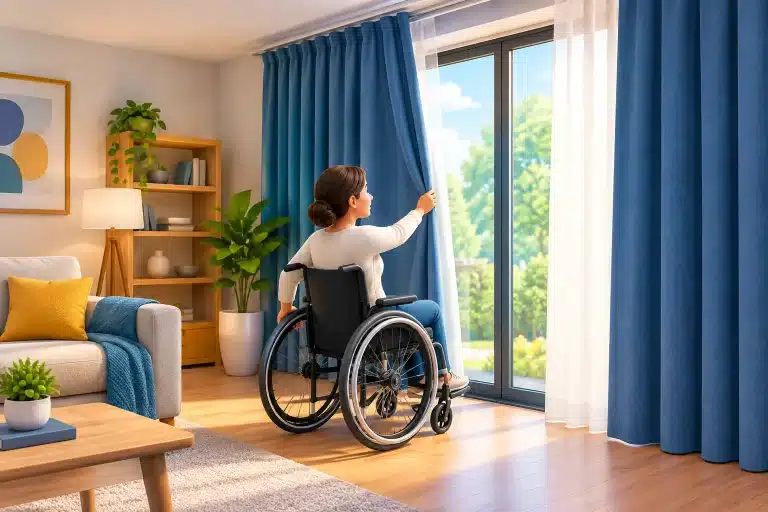
For people with restricted mobility, motorisation can make full-height or heavy curtains far easier to live with. For busy households, it removes one small repeated task from the day. When travelling, scheduled opening and closing can also make the property appear occupied, supporting peace of mind without relying on manual adjustments.
Plan power early
An electric curtain track needs a suitable power supply in the right location. In many projects, the motor sits at one end of the track, often hidden behind the curtain stack or within a recess. The power point and cable route should be agreed before the ceiling is closed or the final decoration begins.
Retrofitting is possible in many homes, but early coordination gives the cleanest result. Your electrician, builder and curtain-track supplier should be working from the same plan, particularly where a recess, bulkhead or bespoke bay arrangement is involved. This is where fitting drawings and a review of the dimensions can save time and unnecessary remedial work.
Fabric and drop: details that affect the finish
The finished drop is measured from the underside of the track or the relevant curtain carrier position to the chosen floor level. In a newly laid floor, allow for the final finish, whether that is carpet, wood or tile. Measuring before flooring is complete without making that allowance is a common source of curtains that sit too high or puddle unexpectedly.
A close finish just above the floor is practical and tidy. A light break can feel softer, while deliberate pooling creates a more decorative look but is less convenient for everyday cleaning and operation. In a family home or a room used frequently, a neater finish is often the sensible choice.
Fabric fullness also affects the appearance of a ceiling-mounted scheme. Generous fullness creates a richer wave and better visual coverage, but it increases stack size and weight. Lighter fabrics may need less visual bulk; blackout or lined curtains may call for a stronger motor and more room within a recess. There is no single right specification – it depends on the room, the fabric and how the curtains will be used.
Get the installation plan checked before ordering
Made-to-measure ceiling-mounted curtains are most successful when the track, fabric and building details are considered as one system. A quotation based on verified dimensions can account for the opening direction, stack-back, ceiling structure, motor location and control preference before anything is manufactured.
At Smart Curtains, this planning support can include fitting drawings and practical advice for builders, electricians and home automation installers. That is particularly valuable for bay windows, recesses, corners and wall-to-wall installations, where a few millimetres in the wrong place can affect the finished result.
A ceiling-mounted curtain should feel effortless once it is installed: a precise line at the ceiling, fabric that moves without catching, and control that suits the rhythm of your home. The best time to create that ease is while the room is still being planned.