A curtain motor is easy to overlook until you picture opening every curtain in the house from bed, setting the living room curtains to close at dusk, or giving a hard-to-reach bay window the attention it deserves. The best curtain motors for homes do more than move fabric: they make privacy, light control and everyday comfort easier to manage.
Thank you for reading this post, don't forget to subscribe!For a polished result, the motor should never be considered in isolation. Its suitability depends on the weight and width of the curtains, the track layout, the available power supply and how you would like to control it. A quiet motor on a well-planned made-to-measure track feels effortless. The wrong specification, even with a good motor, can leave you with slow movement, awkward access or a track that does not suit the room.
What makes a curtain motor right for your home?
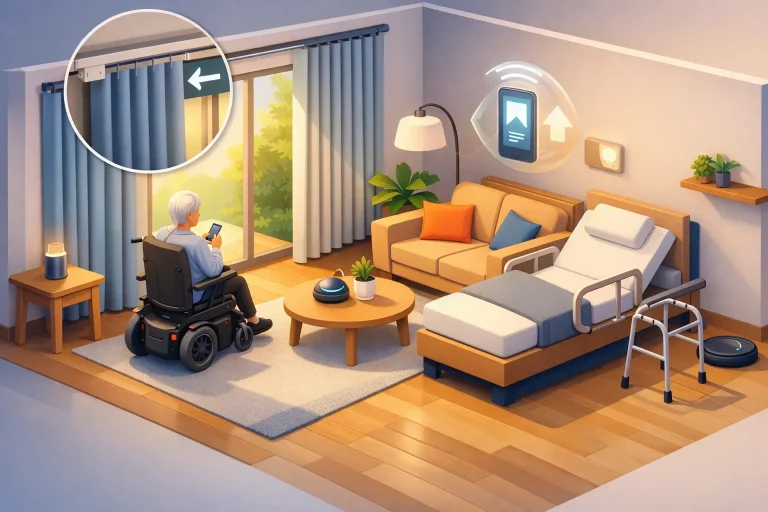
The best choice is rarely the one with the longest feature list. It is the one that suits your windows and your routine. In a bedroom, quiet running and scheduled opening may matter most. In a large entertaining space, you may prioritise a strong motor capable of moving full-height, lined curtains across a wide opening. For someone with restricted mobility, simple wall-switch or remote control can be more valuable than a complex app.
Start with the curtain itself. Heavy interlined curtains, wide wall-to-wall treatments and tall windows all place greater demand on the system than lightweight sheers in a small room. The motor needs enough pulling power to operate the curtains comfortably, without strain or hesitation. This is one reason a bespoke system is preferable to selecting a motor from a shelf and hoping it will suit the finished curtains.
The track layout matters just as much. A straight run is relatively straightforward, while a bay window, corner, recess or offset arrangement requires careful planning. The motor position, stack-back area and route of the track should all be considered before fitting. A drawing based on confirmed measurements can prevent unpleasant surprises when the curtains arrive.
The best curtain motors for homes are quiet and properly sized
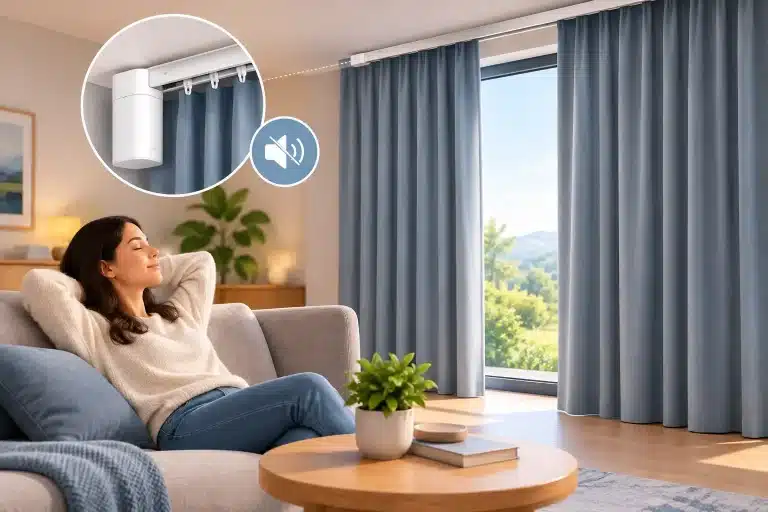
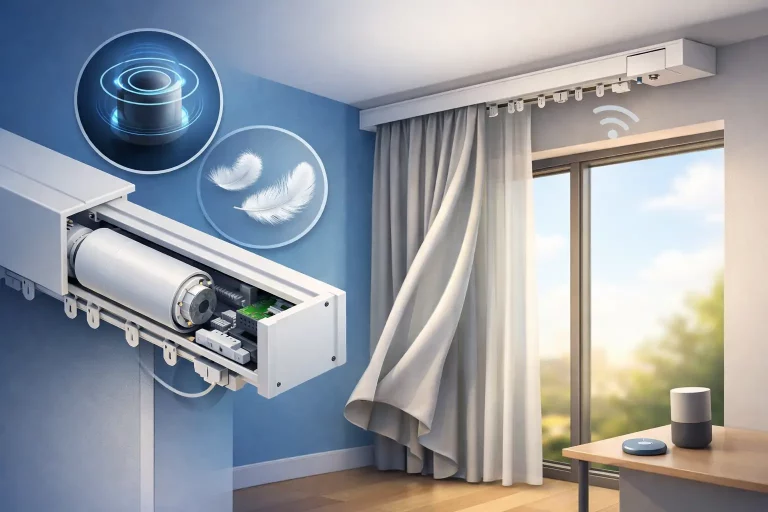
Noise is often the first concern for homeowners, particularly in bedrooms and nurseries. A quality electric curtain system should operate with a discreet, low-level sound rather than an intrusive mechanical whirr. However, quiet operation is not only about the motor. Correctly fitted track components, a suitable curtain heading and a system matched to the curtain weight all play a part.
Motor strength should be specified for the real load, not estimated casually. Curtain weight can increase quickly with blackout lining, thermal lining, interlining and generous fullness. A larger motor may be advisable for long runs or particularly substantial curtains, but overspecifying without considering the overall arrangement is not automatically better. The aim is confident, smooth movement that feels proportionate to the room.
It is also worth considering where the motor will sit. In some schemes it can be tucked neatly behind the curtain stack, while other layouts may call for a different position. A good plan keeps the system discreet without compromising access for future adjustment or servicing.
Battery, mains or low-voltage power?
Power choice affects both the installation process and the finished look. Battery-powered motors can be useful where wiring is impractical, particularly in an existing room where you want to avoid opening walls or redecorating. They can offer a tidy retrofit option, although the battery will need recharging or replacement according to use and curtain weight.
Mains-powered systems are often the preferred route during a renovation, extension or new build. They remove the routine of battery charging and can be especially suitable for regularly used, heavy or large-scale curtains. They do require early coordination with an electrician, ideally before plastering and decorating, so the power point is placed where the track design needs it.
Low-voltage arrangements can also suit certain projects, particularly where centralised control or specialist smart home equipment is being planned. There is no universal winner. The best option depends on the room, the building works involved and the level of automation you want.
Choose controls around your daily routine
A motorised curtain system should make life simpler, not introduce another device to learn. Most homeowners benefit from choosing one primary control method, then adding alternatives where useful.
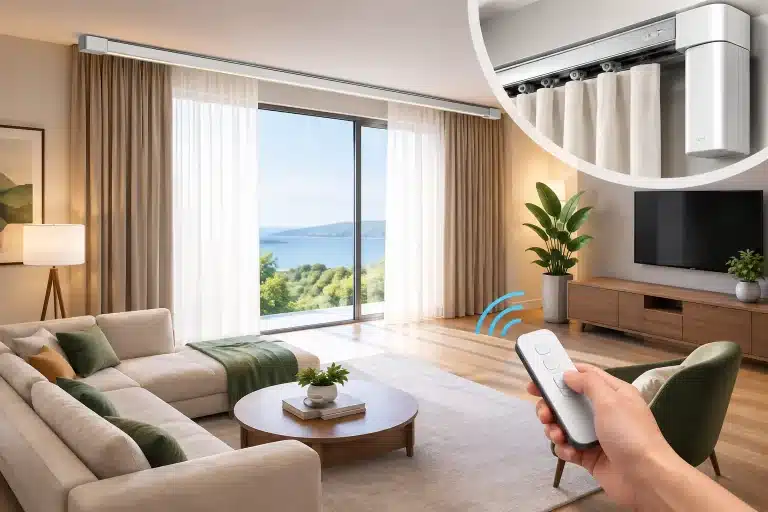
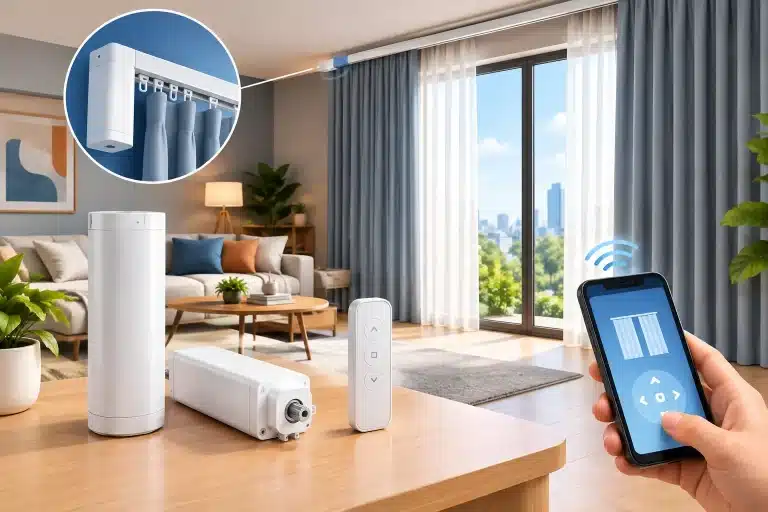
A wall switch provides familiar, immediate control at the door or bedside. A handheld remote is useful for sofas, beds and rooms with several windows. Smartphone control can be appealing if you want to operate curtains while away, check their status or set routines without relying on a fixed remote.
Timers are particularly practical. Opening curtains at a chosen time can help a bedroom feel more natural in the morning, while closing them in the evening brings privacy without needing to remember. When you are away on holiday, scheduled movement can also make a home look occupied. It is a modest feature with a reassuring effect.
For homes with a wider smart home setup, integration can allow curtains to respond to scenes and routines. For example, a “goodnight” command might close curtains, lower lighting and arm other household settings. This works best when the curtain system and automation platform are discussed early, especially if an integrator is involved. Compatibility should be confirmed rather than assumed.
Manual use and safety features still matter
Automation should not remove practical control. Many systems allow the curtains to be moved by hand, depending on the selected configuration, or can be controlled easily during a power or connectivity issue. This is worth discussing if you prefer a familiar manual feel or want flexibility for guests and children.
Safety features such as obstacle detection are also valuable, particularly in family homes. The system should respond appropriately if something interferes with the curtain path. Keeping the track clear and ensuring the curtains are correctly made for the system remain essential for reliable operation.
Plan the track and curtains together
A motor cannot correct a track that has been measured poorly or curtains that have not allowed enough room to stack back. This is where expert planning makes a visible difference.
In a recess, you need to establish whether the curtains should sit within the opening or cover it from outside. For a bay window, the shape, angles and whether the curtains meet or draw to one side all affect the track design. On a wall-to-wall installation, consider where the curtain stack will sit when open, especially if there are radiators, furniture or doors nearby.
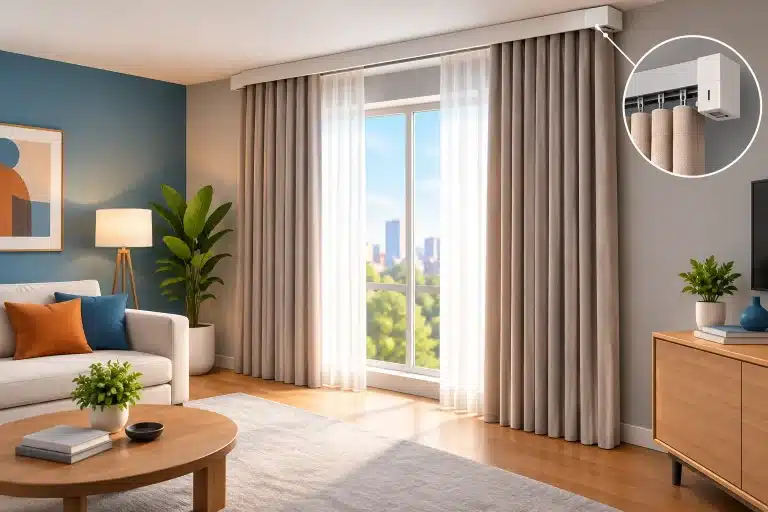
The finished curtain heading also influences the outcome. Wave curtains create a contemporary, even appearance and often pair beautifully with motorised tracks, but they need adequate stack-back space. Pencil pleat, pinch pleat and other styles can also work well when specified correctly. The right choice is as much about the look you want as the clearance and movement required.
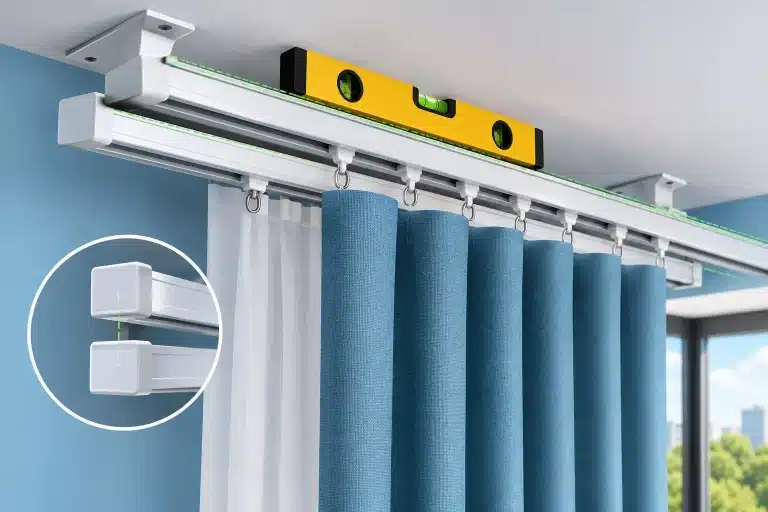
Before ordering, confirm final site measurements rather than relying on architectural plans. Check ceiling details, coving, pelmets, existing blinds and access for fitting. If building work is underway, share track drawings with the builder and electrician early. This allows the recess, ceiling fixing and power provision to be prepared properly, rather than adapted at the last moment.
When made-to-measure support is worth it
Off-the-shelf curtain motors can suit a simple, lightweight window where the dimensions and power arrangement are uncomplicated. Yet many homes have at least one window that is not standard: a wide patio door, a bay, a corner, a tall stairwell or a room where a concealed finish is important.
For these spaces, quote-based made-to-measure planning offers more confidence. At Smart Curtains, this includes checking measurements, considering the intended curtain arrangement and producing fitting guidance for the people completing the work. That support can be particularly useful when several trades are involved or when you want the motor, track and curtains to look as though they were always part of the room.
Do not choose solely on initial price. Consider the cost of making good after incorrect wiring, replacing an unsuitable track or living with curtains that catch, stop short or fail to cover the window properly. A carefully specified system is an investment in how the room works every day.
The right curtain motor should disappear into the background once fitted. Choose one that has the strength for your curtains, the controls that suit your household and a track designed around the exact shape of your windows. Then the first touch of a switch, remote or timer simply becomes part of a better-finished home.