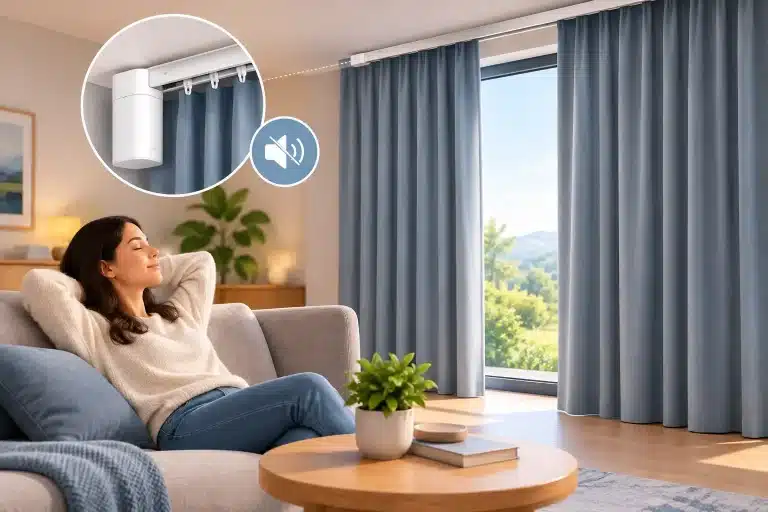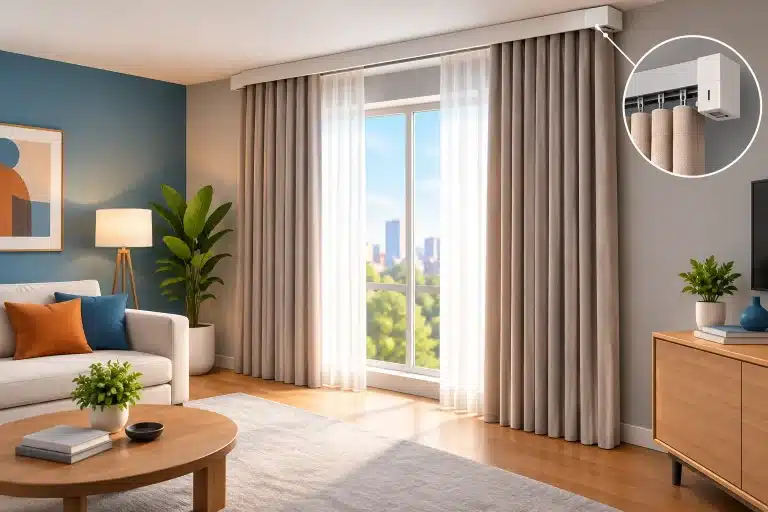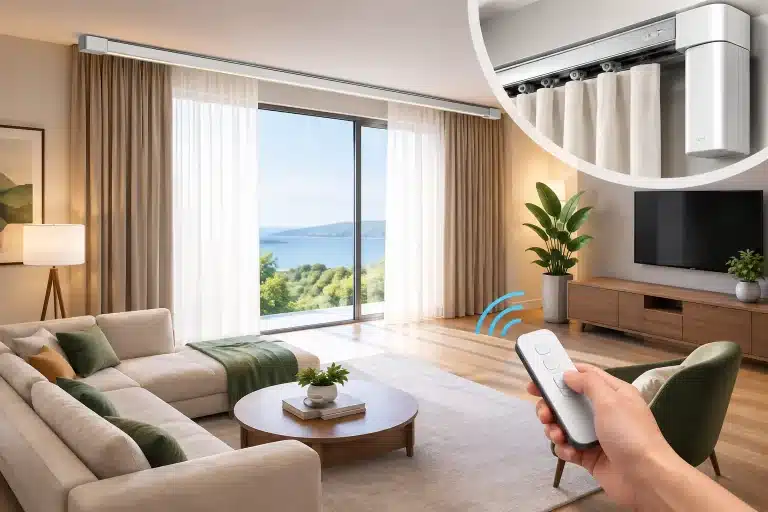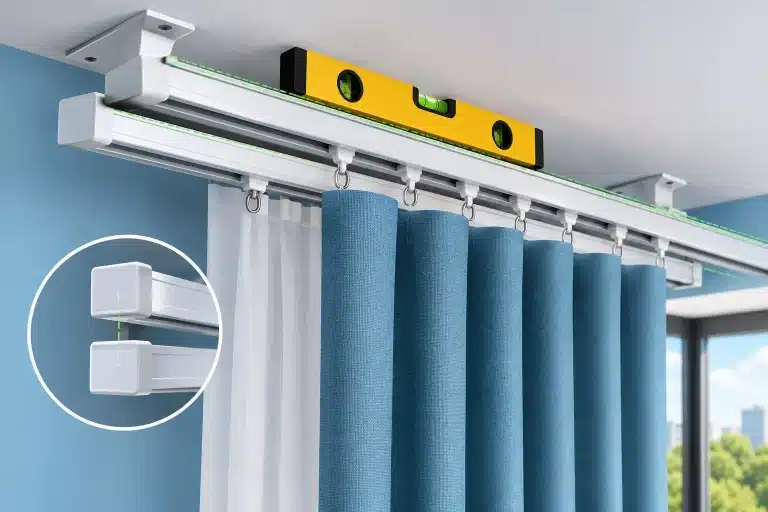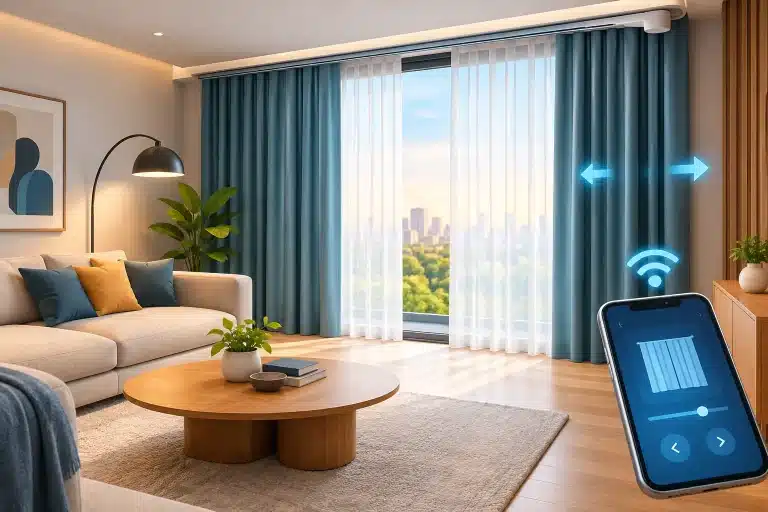
A wide, heavy curtain can look superb when it is open, then become the one thing you avoid dealing with at the end of a long day. Curtain automation changes that small daily friction. With the right motorised track, curtains can open to greet the morning, close for privacy at dusk, or respond to a wall switch, remote control, timer or smart home routine.
Thank you for reading this post, don't forget to subscribe!For many homeowners, the appeal is not simply having a more technical home. It is making a room easier to live in while keeping the finish considered. The best results come from planning the system around the window, the curtain fabric and the way you want the room to work.
What curtain automation can do for your home
Motorised curtains bring a sense of ease to bedrooms, living rooms, media rooms and large glazed spaces. A single command can close curtains across a long run of glass, a bay window or a wall-to-wall track without anyone reaching, pulling or disturbing the hang of the fabric.
Privacy is often the immediate benefit. Rather than remembering to close the curtains once the lights are on, you can set an evening schedule or use a switch by the door. Timed opening and closing can also make a home appear occupied while you are away on holiday, which is a practical addition to wider home security measures.
Accessibility matters just as much. For people with restricted mobility, a bed positioned near a window, or curtains that are simply difficult to reach, powered control removes repeated physical effort. It can also be useful in family homes, where a dependable routine is preferable to cords and manual handling.
There is an aesthetic benefit too. Made-to-measure electric tracks allow the curtain layout to be designed as part of the room, rather than treated as an afterthought. When the track position, stack-back and heading are considered early, curtains can frame the window properly and sit neatly when open.
Curtain automation starts with your routine
Before choosing a motor or control method, consider when and why you use the curtains. A bedroom may need a gentle morning opening schedule and a simple bedside control. A living room may benefit from a wall switch near the entrance, plus timed closing in winter. In a smart home, you may want curtains to work alongside lighting, heating or voice control.
The most suitable control method depends on the room and the household. A remote control is straightforward and familiar. A hard-wired wall switch offers a tidy, permanent solution, particularly during a renovation. Smartphone control gives flexibility when you are out, while automation integration can bring several actions together in one routine.
It is worth avoiding control for its own sake. If a room only needs curtains opened and closed manually from time to time, a remote may be all that is needed. If the window is difficult to access, or the curtains form part of a daily security routine, timers and integrated control become more valuable.
Timers, smart homes and reliable everyday control
A well-planned system should still be easy to use when the internet is down, a guest is staying, or somebody simply wants to close the curtains without finding an app. This is why many homes combine controls: for example, a wall switch for everyday use, a remote for convenience and a smart home connection for schedules.
If you are working with a home automation installer, involve them early. They can confirm how the curtain motors will communicate with the wider system, what cabling or gateways are required, and where controls should sit. Planning this before plastering or decorating is far simpler than trying to add infrastructure later.
The track matters as much as the motor
Curtain automation is only as good as the track layout behind it. A motor cannot compensate for a poorly measured run, insufficient clearance or a curtain heading that catches on nearby fittings. This is particularly relevant with recesses, bays, corners, offset layouts and windows that run close to the ceiling.
For a straight wall-to-wall installation, the key questions are where the track will be fixed, how far it will project from the wall, and where the curtains will stack when open. The stack-back is often overlooked. If you want to preserve as much daylight and glass as possible, there must be enough space at each side for the gathered curtain fabric.
Bay windows need more detailed thought. The track may need to follow the angles of the bay, and the position of each bend affects both the curtain movement and the final look. Corners and returns require the same care. Precise drawings and verified measurements give installers, electricians and curtain makers a clear shared plan.
Allow space for fabric, poles and other window treatments
The curtain fabric and heading influence the specification. Heavier, lined or interlined curtains have different demands from lightweight sheer curtains. If there is also a blind, plantation shutter, radiator cover or projecting window handle, the track needs enough clearance for everything to operate without rubbing.
Double-track arrangements are popular where homeowners want a sheer for daytime privacy and a fuller curtain for darkness and warmth. They can look refined, but they require sufficient depth. A shallow recess may not accommodate two tracks and the curtain fullness comfortably, so an early check prevents compromise later.
Plan power before the room is finished
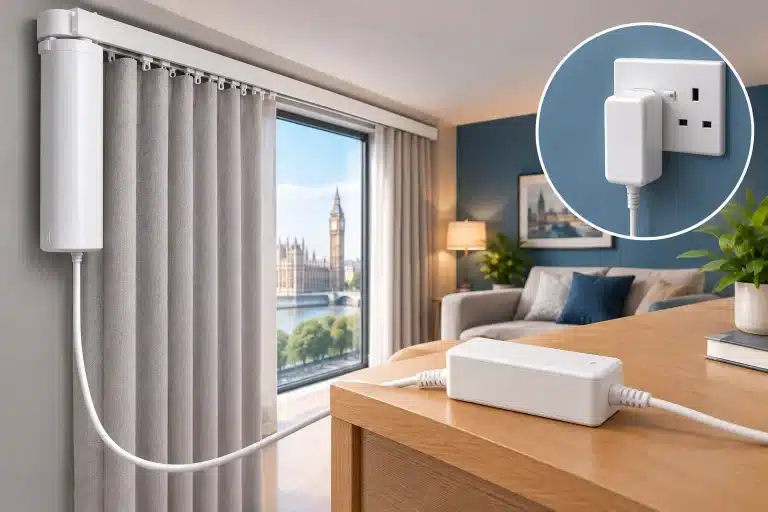
For a hard-wired motorised curtain track, the power point should be located discreetly and accessibly, normally near the motor end of the track. The exact position depends on the layout, so it should be agreed once the track drawing is finalised. Your electrician will need the relevant information before first fix where possible.
This is one reason curtain systems work best when included in a renovation or new-build plan rather than chosen at the very end. That said, existing homes can still be suitable. The answer may be a carefully positioned power supply, surface routing where appropriate, or a control arrangement that fits the constraints of the room. It depends on the finish you expect and how much work you are willing to undertake.
Do not assume the motor must be hidden in the least accessible position. It should be visually discreet, but consideration should also be given to future access for inspection or adjustment. Good planning balances a clean look with sensible practicality.
Getting measurements and fitting details right
Made-to-measure curtain automation is not a product you should specify from a rough width alone. The finished track length, fixing surface, recess dimensions, motor position, curtain split and track shape all affect the order. A few millimetres can matter when a track sits between walls or alongside fitted joinery.
Start by deciding whether the track will be ceiling fixed or face fixed. Ceiling fixing can create a more architectural, full-height effect and is often preferred where curtains are intended to sit close to the ceiling. Face fixing may be the better option when the ceiling is unsuitable or the window geometry calls for it.
Next, establish the final curtain arrangement. Will the curtains meet in the centre, draw to one side, or split around doors? Are they intended to cover the whole wall, or only the glazing? These decisions affect where the motor sits and how the fabric gathers.
At Smart Curtains, installation planning support can help turn these decisions into a workable specification before ordering. That is especially valuable where builders, curtain makers, electricians and smart home professionals are all involved. Everyone benefits from working from the same dimensions and fitting drawing.
Is motorised control worth the investment?
The answer usually comes down to frequency, scale and convenience. Motorised tracks are particularly worthwhile for large, heavy or hard-to-reach curtains, and for rooms where privacy needs to change predictably through the day. They also suit homeowners who value a calm, coordinated finish rather than visible cords or repeated manual adjustment.
There are trade-offs. A bespoke system costs more than a basic manual track and needs earlier decisions about power, control and fitting. Smart home integration adds capability, but may not be necessary for every room. A simple remote-controlled system can still deliver the main benefit: curtains that move easily, reliably and at the touch of a button.
The most satisfying installations are rarely the most complicated. They are the ones that suit the window, respect the fabric and fit naturally into the household routine. If you are planning a refurbishment or choosing curtains for a new room, decide how you want the space to feel at seven in the morning and seven in the evening. That is usually the clearest starting point for a system that will serve you well for years.